



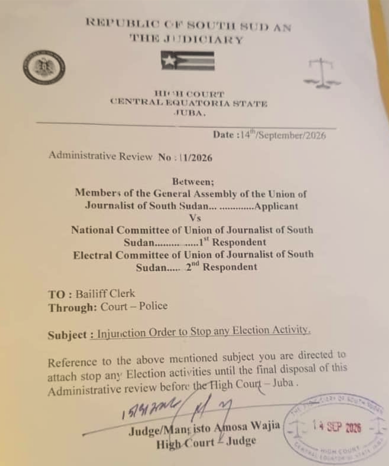
The High Court of Central Equatoria State in Juba issued a judicial decision to halt all activities and arrangements related to the elections of the South Sudan Journalists Union, based on an appeal and administrative review submitted by members of the Union’s General Assembly against both the Union’s National Committee and the Election Committee.
Delegates from across the country arrived in Juba for the General Assembly scheduled to begin on Wednesday and run until Friday, with the election expected to take place at the end of the meeting.
The court order issued under Administrative Review No. (11/2026), signed by Supreme Court Judge Mengistu Amosa Waja on 14 September 2026, contained explicit instructions to stop all electoral operations and activities until a final decision is reached in the Administrative Review case pending before the court.
A statement issued by a cross-section of members of the General Assembly of UJoSS, which this publication saw on Tuesday, welcomed the court’s decision, describing it as an “important and responsible step” to strengthen the rule of law, uphold democratic principles, and protect the unity and independence of the union.
The statement explained that the judicial decision came after repeated demands and appeals to the union’s executive office, headed by President Oyet Patrick and Secretary-General Majak Kwang, to address disputes over the union’s constitution and to comply with the orders of the Registrar of Trade Unions at the Ministry of Justice.
The members affirmed their categorical rejection of attempts to hold elections without submitting and approving the financial and administrative reports to the General Assembly, and without obtaining its approval for the formation of the electoral committee, stressing that the legitimacy of any election does not come from the mere fact of holding it, but from the extent of its commitment to the constitution, the law, and the principles of transparency and integrity.
The General Assembly called on the Union’s leadership and the electoral committee to fully comply with the court’s decision and suspend the electoral procedures until all outstanding legal and regulatory issues are resolved.
On July 15, 2026, the Union held a virtual meeting of the General Assembly of the Union of South Sudanese Journalists, during which a set of resolutions were approved by a voting bloc comprising representatives from eight states and three administrative areas, and with the attendance of more than 70 registered members.
However, the process faced widespread criticism from journalists due to the mechanism used by the Executive Committee to pass the financial report and constitutional amendments with the aim of holding elections, while the Executive Committee attributed this mechanism to a shortage of resources.
The union stated in a statement published on its page that the general assembly had at that time confirmed the quorum for the meeting and unanimously approved the appointment and formation of the electoral committee to manage and organize the union elections in accordance with the union’s 2013 constitution (amended 2024) and the relevant electoral regulations. The General Assembly also set the period from September 16 to 18, 2026, as the date for holding the union’s national elections. These arrangements and decisions have become the subject of legal dispute and a judicial challenge before the High Court by a group of general assembly members.
However, when contacted, UJoSS President Oyet Patrick Charles told this publication on Tuesday that the union was surprised by the injunction, which bars it from conducting electoral activities, but would respect the court’s decision and challenge the case through its lawyers.
He said delegates had already been brought to Juba from South Sudan’s 10 states and three administrative areas to participate in the General Assembly.
“Normally you just have internal ways of resolving problems,” Oyet said, arguing that constitutional, electoral and candidates’ issues should first be addressed by the General Assembly, which he described as the union’s supreme body.
He said the union began preparations for the election earlier this year, initially setting an election period between May 28 and July 28 and appointing an electoral committee.
According to Oyet, concerns about the composition and balance of the electoral committee were subsequently taken to a virtual General Assembly, which endorsed the committee and gave it the mandate to conduct the electoral process.
He said members who were dissatisfied with the process should have raised their concerns through the union’s internal structures before seeking court intervention.
“If we are now unable to resolve the problem with the Media Authority, with authorization from the Media Authority, now where will the Media Authority write a letter and say you complain on A or B?” he asked, adding: “We have tried to resolve this issue and we have failed; now if you want to go to court, you are free to go to court.”
“We respect the decision of the court, even though we disagree with it; we will follow it through,” Oyet added.
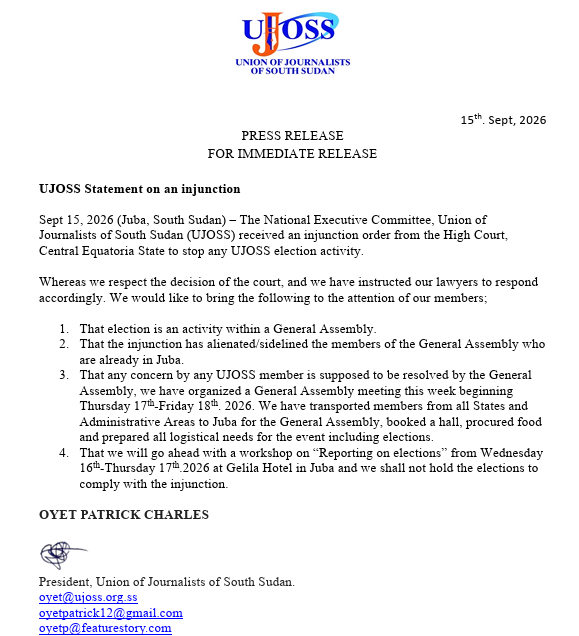
The injunction has also raised financial concerns for the journalists’ union, which says it had already spent money to bring delegates to Juba and to provide accommodations and meals ahead of the General Assembly.
“We have spent a lot of money on putting this together, especially at this time when the economy is very bad,” he said.
Oyet added that if UJoSS succeeds in its court challenge, the union would seek to recover the money it says has been lost because of the halted election.
The dispute comes as UJoSS seeks to hold elections after years of continued leadership under its current executive, whose term has already expired.
Oyet said the union now awaits the court process while its lawyers examine the complaints that led to the injunction.
He maintained that the General Assembly remained the body with the authority to resolve disputes within UJoSS and questioned why the complaints could not have been presented to delegates who had already gathered in Juba.
The UJoSS electoral committee, chaired by Nicola Dominic Mandel and acting Secretary-General Manyang David Mayar, announced on September 11, 2026, the official list of candidates who met the requirements to contest the elections scheduled for Thursday, September 17, 2026, in the capital, Juba. The list included:
Oyet Patrick Charles – candidate for president (he is the current president of the union).
Root George Mott – a candidate for the position of Secretary General, formerly Deputy Secretary General of the Union, whose activities were suspended by the Executive Committee.
Majak Daniel Kwang – Candidate for the post of Secretary-General.
Amir Veronica Mium – Candidate for the position of Treasurer.
The committee had allowed the aforementioned candidates to begin their election campaigns immediately after the list was published and until midnight on Wednesday, September 16, 2026, before the judiciary intervened and issued its order to halt all procedures.
The court’s intervention has left the union’s planned General Assembly and election in uncertainty, with delegates already in the capital and the leadership preparing to challenge the injunction.

 and then