



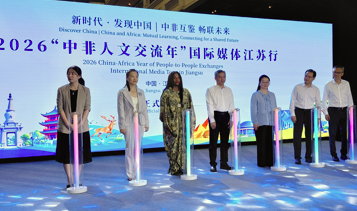
China is seeking to develop economic ties with Africa through trade, technology, manufacturing and skills training, officials said Monday as a foreign media tour of Jiangsu province began in the eastern Chinese city of Wuxi.
Wuxi’s trade with Africa reached 18.6 billion yuan ($2.6 billion) in the first half of 2026, an increase of 40.7 percent from the same period last year, according to city officials.
“Africa has become one of Wuxi’s fastest-growing emerging foreign-trade markets,” said Ma Jian of the Publicity Department of the Communist Party of China’s Wuxi Municipal Committee.
The figures were presented as China marks 70 years of diplomatic relations with African countries and promotes 2026 as the China-Africa Year of Cultural and People-to-People Exchanges.
However, officials used the six-day tour to highlight more than trade.
They pointed to Chinese investment and technical cooperation in African agriculture, manufacturing, ports, health care and fisheries, portraying the relationship as one increasingly focused on production and skills as well as commerce.
Wuxi No. 1 Cotton Textile Factory operates a textile facility in Ethiopia that combines African cotton and labor with Chinese technology and management, said Xu Hua, deputy director of the Jiangsu branch of Xinhua News Agency. The operation has about 300,000 spindles and employs nearly 3,000 people, he said.
In other examples, officials cited a Zhenjiang company operating Marébayah Port in Guinea, agricultural cooperation in Angola and a shipping route connecting Dafeng Port in Jiangsu with Durban, South Africa.
Jiangsu officials also highlighted cooperation in vaccine production. Companies based in Taizhou’s China Medical City are working with partners in Zimbabwe to establish local vaccine production lines, they said.
Fisheries has become another area of technical cooperation.
More than 3,000 fisheries technicians and administrators from more than 50 African countries have received training in Wuxi, Xu said. The city has also worked with African partners on fisheries research and training.
Zhang Xuanya, a journalist with Wuxi Radio and Television Station, presented a documentary about one such relationship. The Fish Coming Home follows a Tanzanian fisheries official who studied fisheries technology in Wuxi before returning to Tanzania.
The documentary was filmed during a 12-day trip to Tanzania and produced with English and Swahili subtitles. It has been broadcast in Tanzania, Zambia, Uganda and Nigeria, Zhang said.
For African journalists taking part in the tour, the challenge is to look beyond official figures and project announcements.
“We must go beyond prepared statements and statistics, meet the people behind the policies, ask thoughtful questions, and report with accuracy and context,” said Rousa Shikoha, a Namibian journalist speaking on behalf of the participating journalists.
“Journalists connect policy with the public,” she said.
The comments highlight a central question for African countries seeking Chinese investment: whether expanding trade and investment will translate into more jobs, technology transfer, skills and local production.
African governments have increasingly sought investment that can help them move beyond exporting raw materials and expand manufacturing and value-added production.
For China, Jiangsu offers a showcase of its economic links with Africa. For African countries, the projects provide potential opportunities but also raise questions about how much production, technology and value remain locally.
The media tour will take journalists to Wuxi, Zhenjiang, Taizhou and Yancheng to examine China-Africa cooperation in trade, manufacturing, agriculture, technology and other sectors.

 and then