



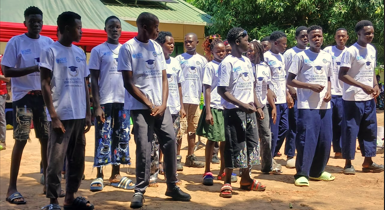
A four-member delegation from the Child Protection National Technical Committee has arrived in Western Equatoria State to assess police training centers, identify underage recruits, and facilitate the release of children found enlisted in violation of child protection policies.
The delegation is led by Mr. Oluku Andrew, National Coordinator for the Release of Children and Acting Director General for Programmes at the Disarmament, Demobilisation and Reintegration (DDR) Commission.
Other members include Major General William Deng Pok, SSPDF Director for Child Protection; Major General James Dak Karlo, Police Director for the Special Protection Unit; and Lilian Raphael Moga.
Speaking during a meeting with state authorities in Yambio, Oluku said the delegation comprised representatives from government institutions mandated to implement the Government Action Plan on Children Associated with Armed Conflict.
“Our mission is supported by UNICEF and the UN Country Task Force and is part of nationwide efforts to prevent the recruitment and use of children by armed forces and security institutions,” he said. “The purpose of our visit is to assess the police training centers, establish the actual situation, and verify the ages of those undergoing training. We have received reports that more than 50 children have been identified in police training centers across the country, and some have reportedly spent three to four months in training.”
“Any child found to be underage must be identified and released in accordance with child protection policies,” Oluku added.
He said the delegation had already conducted assessments in Western Bahr el Ghazal, Northern Bahr el Ghazal and Warrap states, with Lakes State also scheduled for assessment.
He added that the delegation would meet state security authorities, the state police commissioner, instructors and trainees before compiling a comprehensive report for submission to the Inspector General of Police (IGP) for further action.
Brial James Dak, an official working with the Child Protection National Technical Committee, said the committee was working with the police, the Ministry of Gender and the DDR Commission to identify and remove children from the army and police while preventing further recruitment.
“We are working together with the police, the Ministry of Gender and the DDR Commission to ensure that children are identified and removed from security institutions,” he said. “During our mission to Bor, children serving in the police were identified and their release facilitated. We intend to extend these efforts across all states and the three administrative areas to prevent further recruitment and protect children.”
He stressed that individuals responsible for recruiting children, whether within or outside security institutions, must be held accountable.
Meanwhile, Major General William Deng Pok of the SSPDF Child Protection Unit said his department was working with relevant institutions to address child recruitment, child trafficking, sexual and gender-based violence and other violations affecting vulnerable groups.
Rita Bampoo, Child Protection Officer with the United Nations Mission in South Sudan (UNMISS) in Western Equatoria, commended the state government for its continued support of child protection activities.
“The committee has developed a State Action Plan based on the national action plan, which was presented to the governor and subsequently endorsed,” she said. “However, limited financial resources have been a major challenge affecting the implementation of planned activities.”
For his part, Western Equatoria State Caretaker Governor Badagbu Daniel Rimbasa reaffirmed his administration’s commitment to preventing child recruitment and supporting the release, protection and reintegration of children formerly associated with armed groups.
He said the state government supported efforts to end child recruitment since 2018, when more than 1,040 children were released from armed groups in an event witnessed by the then Vice-President Taban Deng Gai.
“We have absolute political will in Western Equatoria to make sure that we implement the government policy that no child should be associated with armed groups,” Rimbasa said.
He said his administration continued to engage armed groups, including the SPLM-IO, to facilitate the release and reintegration of children.
Highlighting reintegration efforts, Governor Badagbu revealed that 71 released children had graduated after completing vocational skills training last week. He revealed that he awarded university scholarships to four of the graduates, two girls and two boys, to support their pursuit of higher education.
The governor also announced plans to establish two child protection centres in Yambio and Maridi to improve access to services across the state’s ten counties.

 and then