



African fabrics made by a Chinese textile company are reaching South Sudan through traders in neighbouring countries.
The company’s owner says difficulties with payments have stopped it from selling directly to the market.
Duan Shitong, owner of Chinese textile company Orientar, says their fabrics are sold in several African countries, including Tanzania, Malawi, Kenya, Uganda, Mali, Zimbabwe, Namibia, the Democratic Republic of Congo and the Republic of Congo.
The products also reach South Sudan, but through traders in Kenya and Uganda rather than direct exports from the company.
Duan says the company has been unable to establish direct trade with South Sudan because of problems receiving payments from the country.
“We export per container,” she said, explaining that Orientar mainly sells its products in large quantities.
Her account points to one of the challenges businesses face when trading with South Sudan: difficulties making international bank transfers.
The Bertelsmann Stiftung’s BTI 2026 Country Report – South Sudan says international transfers to and from South Sudanese banks remain complicated. It also notes that many foreign companies and international organisations use banks in neighbouring countries.
The report gives a picture of the wider banking challenges in South Sudan. It does not, however, examine Orientar’s transactions or confirm the specific problems faced by the company.
From diplomacy to textiles
Duan’s business journey began when she was posted to Zambia in 1992 as a commercial diplomat at the Chinese embassy.
Her time in Africa introduced her to the region’s markets and the demand for traditional fabrics. She later left government service and started her own textile business, initially focusing on East Africa.
Orientar now sells its fabrics in several African countries. The company celebrated its 30th anniversary in July 2026.
Its designs draw on African patterns and styles, while also incorporating modern designs.
For Duan, the fabrics carry a meaning beyond fashion.
“African textile means a kind of spirit,” she said.
The company has also supported African cultural activities in Beijing for more than 20 years. But the GAAS Bazaar, held on 18 October, was the first time it had a dedicated exhibition booth at the event.
Visitors had the chance to see and buy the fabrics. A six-yard piece sold for 100 yuan.
The bazaar brought together African exhibitors, performers and visitors in Beijing, giving businesses a chance to introduce their products to new customers.
Culture creates business opportunities
Some exhibitors say the event was more about displaying their country’s culture.
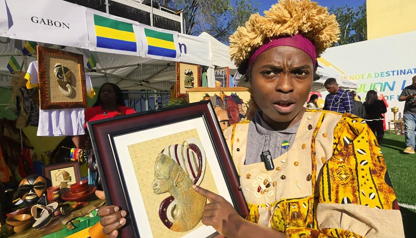
Muyegue Sandra, from Gabon, brought traditional artwork and other items to introduce her country’s heritage to visitors in China.
Among the exhibits were wooden masks representing Gabon’s nine provinces. Each mask carries a particular meaning. She also displayed products made from raffia, a material used in traditional Gabonese culture, including at weddings.
“For me, personally, it is an opportunity to represent my country, to represent its culture, to make its culture known to the world,” she said.
Sandra said some visitors were interested in buying the products and took her contact details because they wanted to make further purchases. Others asked about possible partnerships and invited the exhibitors to take part in other exhibitions.
She hopes the contacts could lead to future business, including a shop or an online store. For now, those plans are still at an early stage.
“There are people who don’t necessarily know that Gabon exists,” she said.
She believes events like the bazaar can help introduce Gabon and its culture to people who may know little about the country.
The challenge of reaching the market
China and South Sudan have an established trading relationship, but doing business between the two countries is not always straightforward.
According to China’s General Administration of Customs, trade between the two countries reached $419 million in 2025, down 10.1% from the previous year.
Chinese exports to South Sudan were worth $113 million, a fall of 31.7%, while imports from South Sudan stood at $306 million.
The figures cover trade in all goods, not textiles alone.
Orientar, South Sudan remains a market its products reach through regional traders. Duan’s account suggests that direct sales could become easier if the company can find a reliable way to receive payments from South Sudanese buyers.
The GAAS Bazaar offered another example of how contact between African businesses and Chinese consumers can develop. Exhibitors introduced their products, met potential customers, and exchanged contacts that could lead to future opportunities.
But turning that interest into regular trade takes more than an exhibition. It also requires reliable ways to make payments and move goods across borders.
For companies looking to reach South Sudan, those practical challenges remain part of doing business.

 and then