



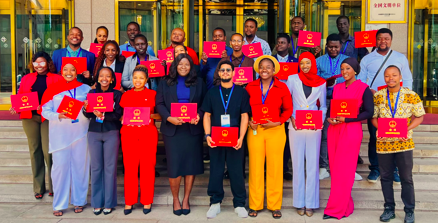
South Sudanese journalists who recently travelled to China for professional training say the experience exposed them to new approaches to journalism, digital technology, research, fact-checking, teamwork and international media cooperation.
The journalists participated in a Young African Media Professionals Training and Exchange Programme organized through the China International Communications Group (CICG) from 21 May to 9 June 2026 in Beijing and Shenzhen. The programme brought together journalists and media professionals from South Sudan and other African countries, including Tanzania, Rwanda, Zambia, The Gambia and South Africa.
The training covered areas including modern journalism practices, investigative reporting, mobile journalism, digital media, multimedia storytelling, fact-checking, artificial intelligence and the use of digital applications for content production.
For the South Sudanese participants, the programme was more than an opportunity to travel abroad. They say it provided practical lessons they hope to apply to journalism and media development back home.
South Sudanese journalist Chukude Emmanuel Mandela, who works with City Review in South Sudan, says one of his main lessons was understanding the role of journalism in national development. He says his experience in China showed him how media can communicate development opportunities, inform the public and contribute to a country’s image.
Mandela says this is particularly important for South Sudan, where years of conflict have affected development and the country’s international image.
He was also impressed by the use of modern technology in journalism, particularly artificial intelligence and other digital tools.
Mandela believes South Sudanese journalists should learn how to use emerging technologies responsibly rather than simply viewing them as a threat.
“We are in the new era of technology,” he said.
He says artificial intelligence and other digital tools can help journalists work more efficiently, access information and reach wider audiences, while journalists must still maintain professional standards and editorial responsibility.
Mandela says another important lesson was the need for stronger investigative journalism in South Sudan.
He says journalists should do more to examine government activities, development projects and issues affecting the public.
He also believes greater cooperation among journalists could improve reporting and contribute to peacebuilding and national unity.
Mandela says journalists should share skills, ideas and professional experiences instead of working in isolation.
He hopes continued cooperation between South Sudan and China will provide more opportunities for journalists to receive training in technology, journalism and professional development.
He also calls for more support for professional media institutions and journalism capacity-building in South Sudan.
Jennifer James, a journalist with The Dawn Newspaper, says the programme strengthened her skills in research, digital journalism, multimedia storytelling and professional reporting.
For James, one of the most important lessons was the importance of research and verification before producing a story.
“Research is very important before you carry out your activities,” she said.
She says journalists need to verify information, identify reliable sources and understand their subjects before publishing or broadcasting stories.
James says she also observed significant differences between the Chinese and South Sudanese media environments, particularly in access to technology, infrastructure and equipment.
However, she says the experience showed that South Sudanese journalists can adapt useful techniques to their own working environment.
She plans to share the knowledge with other journalists, particularly young reporters who may not have opportunities to participate in international training.
James says the exchange also influenced how she views development reporting.
She says journalists should continue reporting challenges facing South Sudan, but should also tell accurate stories about the country’s culture, tourism, opportunities and positive developments.
“It is our role to focus on the positive side of South Sudan to attract people like investors and tourists,” she stated.
James says balanced reporting can give international audiences a broader understanding of South Sudan rather than presenting the country only through conflict and other challenges.
She says South Sudanese journalists, content creators and other media professionals can contribute to telling the country’s own story to international audiences.
The programme also allowed James to interact with journalists from other African countries and build professional contacts that could support future cross-border reporting.
According to James, such networks can be useful when journalists need to work with reporters in other countries on stories that cross national borders.
James is calling for future international media training opportunities to reach journalists working in South Sudan’s states.
She says many professional opportunities are concentrated in Juba, leaving state-based journalists with fewer chances to participate.
“Such training should not just end within Juba.” She says extending such programmes to the states would allow more journalists to gain new skills and share them with colleagues in their local media communities.
Another participant, Dieu Garang, a journalist with Hot in Juba Media, says the training strengthened his skills in fact-checking, storytelling, editing, research and modern media technology.
Garang says he observed that Chinese media organisations often operate with modern technology, specialised teams and structured planning systems.
He says South Sudanese journalists frequently work with fewer resources, but the experience gave him practical ideas that can be adapted to the country’s media environment.
Garang says the training also strengthened his understanding of accurate reporting, story gathering, editing and international reporting.
He intends to share the knowledge he gained with other journalists, particularly young media professionals.
He says international exchanges can strengthen professional networks and cooperation between South Sudanese, African and Chinese journalists.
The President of the Union of Journalists of South Sudan (UJOSS), Oyet Patrick Charles, says he is aware of South Sudanese journalists who travelled to China earlier in 2026 for training and other media programmes.
Oyet says he communicated with some of the journalists while they were in China and followed their experiences.
He says South Sudanese journalists have accessed different China-related training and exchange opportunities over the years.
Oyet also recalls travelling to China in 2012, when he was working with South Sudan Television, now known as SSBC.
He says that programme brought together journalists from 22 developing countries, with two participants representing South Sudan.
Oyet says such professional exchanges can expose journalists to new technologies, reporting practices and international networks.
He encourages South Sudanese journalists to take advantage of available training opportunities and continue developing their professional skills.
The journalists say the real value of the China programme will depend on how the knowledge gained is used after returning home.
Mandela says the opportunity should not benefit only the journalists who travelled.
“Let this knowledge and this opportunity not end with us. Let them extend to other colleagues so that they can also go and learn.”
The participants hope future programmes will give more South Sudanese journalists, particularly those working outside Juba, opportunities to gain international experience.
They also want stronger cooperation between South Sudanese media institutions, international journalism organisations and foreign media professionals.
The journalists say the exchange demonstrated that professional development does not end when a training programme is completed. The knowledge gained must be shared, adapted and applied in the local media environment.
For the South Sudanese journalists who participated, the China exchange provided lessons in technology, research, fact-checking, storytelling, professional cooperation and international networking.
Now, they say, the challenge is to bring those lessons home — and use them to strengthen journalism, improve reporting and tell South Sudan’s story to audiences both inside and outside the country.

 and then