



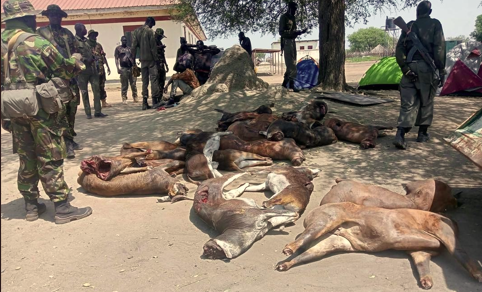
Wildlife authorities in South Sudan have arrested several suspects and impounded a government vehicle transporting over 700 kilograms of bushmeat, in a case officials say reflects tougher enforcement under the country’s newly signed Wildlife Conservation Act.
Khamis Adieng, Director General of Wildlife Conservation and Tourism, said the seizure involved “700 something kilograms, almost one ton of bushmeat” transported in a government vehicle. Authorities declined to name the institution linked to the vehicle.
“We do not want to disclose the owners of this vehicle for security purposes,” he said. “We are now at a juncture where all of us should come together so we can overcome the difficulties the country is facing.”
Preliminary identification suggests the meat likely included Tiang and White-eared kob, species common in the Boma–Badingilo ecosystem.
Asked about the suspects, Khamis confirmed arrests had been made.
“The traders were ladies; these are unfortunate ladies,” he stated. |I do not know if they are being used or if they are the real traders, but anyhow, they were involved in these things.”
New law replaces 2003 framework
The enforcement action comes days after President Salva Kiir signed the Wildlife Conservation Act into law on February 18, ending a legislative process that began in 2015.
“It is a day that we will never forget,” Adieng said. “This law had been awaiting being signed into an Act since 2015. Thank God everything is now finalized and signed.”
The new law repeals the 2003 wildlife legislation enacted during the liberation period.
“It is going to repeal the old one, which we refer to as 2003. It was done during the liberation. It is not full in terms of the areas to be covered. But now this one has closed all the gaps,” the officer said. “We believe community is not the stakeholders, but communities are the owners of the resources, so they should benefit from this. The community will be benefiting directly and will actually manage the resources by themselves.”
Under the new Act, wildlife crimes carry significantly heavier penalties, including prison sentences of up to 10 years and substantial fines.
“This one has got some deterring sentence in it; you may go to prison for 10 years or pay a lot of money,” he explained. He contrasted the penalties with the old law. “The old one was talking about if you kill an animal, you pay 100 pounds. By then, it was money, but this one now, the rates have been reconsidered.”
Still, he acknowledged that enforcement challenges go beyond legislation.
“It is not a matter of new law or old law; the problem we are facing in South Sudan is that we don’t respect laws. We fear laws, but we don’t respect them,” Adieng said. “We are linked 100 percent with the judiciary. We have a legal advisor in the ministry representing the Ministry of Justice.”
“Some years back, I had like 40 cases and none of them had been looked into in court, but now there is a change, and they are paying attention to our issues,” he added.
The legal reform and recent enforcement efforts come as South Sudan pushes for emergency inscription of the Boma–Badingilo Migratory Landscape with the UNESCO World Heritage Centre.
Meanwhile, Becu Thomas, National Professional Officer for Culture at UNESCO, said the nomination aims to accelerate protection of the site.
“It is an emergency, so it is a quick way of protecting, a quick way of safeguarding, of rescuing the site which is in danger,” he said.
The landscape hosts what officials describe as the largest mammalian migration on the planet.
“If the migration is being destroyed, then it means that this site will not have any outstanding universal value,” Becu said. “Once the outstanding universal value is not there, then the site is removed from the World Heritage List.”
The signed nomination dossier is expected to be submitted to the World Heritage Centre ahead of the next World Heritage Committee meeting in July.
According to Adieng, the recent seizure is being presented as an early test of the new Act’s enforcement power.
“At least for now, it will help a lot,” he said of the new law.

 and then