



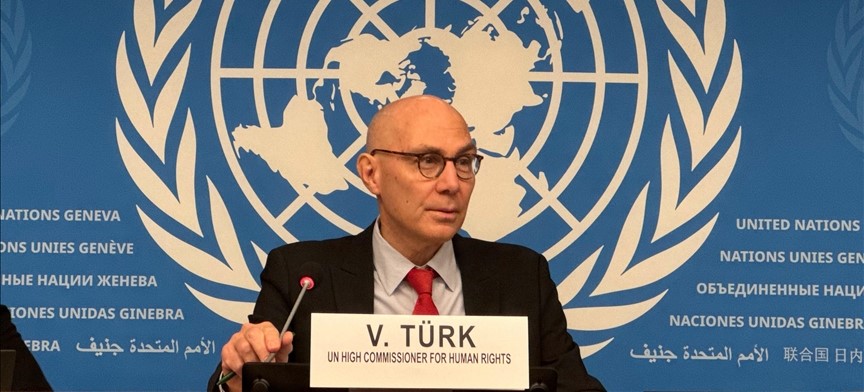
U.N. High Commissioner for Human Rights Volker Türk said on Thursday he was appalled by the growing toll on civilians from drone attacks in Sudan, amid reports that more than 200 people have been killed since March 4 in the Kordofan region and White Nile state.
“It is deeply troubling that despite multiple reminders, warnings and appeals, parties to the conflict in Sudan continue to use increasingly powerful drones to deploy explosive weapons with wide-area impacts in populated areas,” Türk said in a statement.
“I renew my call on them to abide fully by international humanitarian law in their use of these weapons, particularly the clear prohibition on directing attacks against civilians and civilian objects and infrastructure, and against any form of indiscriminate attacks.”
In West Kordofan, at least 152 civilians were reportedly killed in drone strikes by the Sudanese Armed Forces (SAF), including at least 50 when a market and a hospital were hit on March 4 in Al-Muglad.
Attacks on two separate markets in Abu Zabad and Wad Banda on March 7 left at least 40 civilians dead. A lorry carrying civilians was allegedly struck by an SAF drone in Al-Sunut on March 10, reportedly killing at least 50 people, including women and children.
In South Kordofan, at least 39 civilians were reportedly killed in heavy artillery shelling by the Rapid Support Forces (RSF) and allied SPLM-North fighters between March 4 and 5, including 14 in the state capital, Dilling.
Many homes, schools, markets and health facilities were damaged or destroyed in the attacks, compounding the suffering of civilians and local communities.
Türk also expressed alarm at the recent expansion of the conflict to White Nile state, which has come under heavy attack from RSF drones since March 4.
A secondary school and a health clinic in Shukeiri village were hit on March 11, reportedly killing at least 17 civilians, including a health worker. Several other drones have struck the state capital Kosti since March 4, including one that hit a university dormitory on March 9, reportedly injuring seven students, some critically.
Another drone struck an electrical transformer at the Um Dabakir station on March 10, causing widespread power outages.
“It will soon be three full years since the senseless conflict in Sudan began, devastating millions of lives and livelihoods,” Türk said.
“Yet the violence, fueled by these new technologies of war, simply keeps spreading. It is high time it came to an end. The Sudanese people have already suffered far too much.”

 and then