



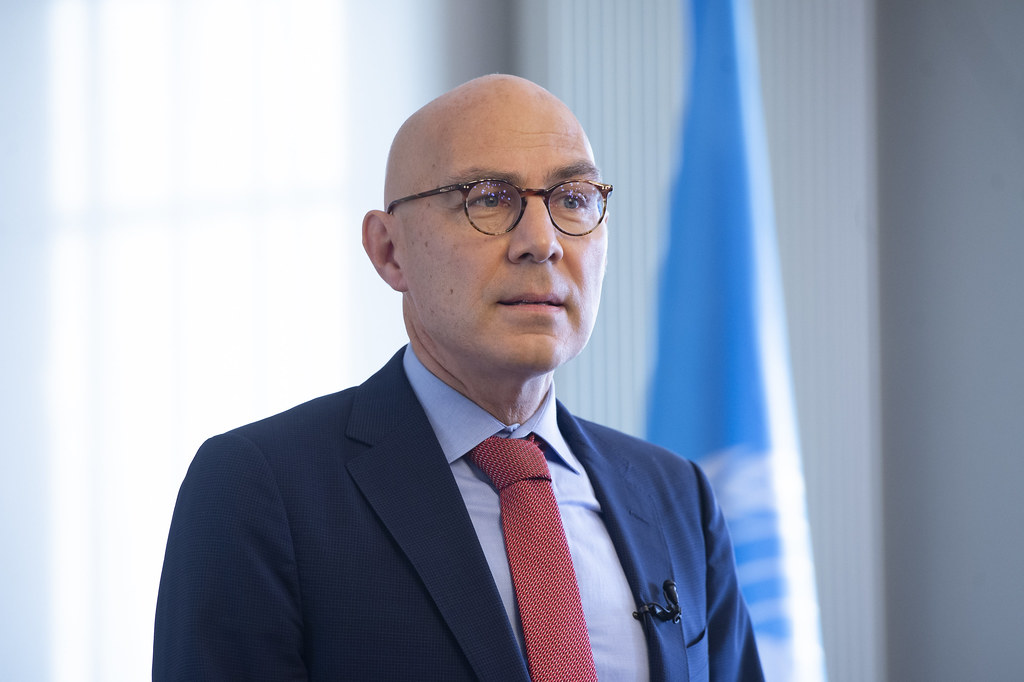
The UN High Commissioner for Human Rights, Volker Türk, on Thursday lamented the impact of increased use of advanced long-range drones in the Sudan conflict, saying the increased use of advanced long-range drones has expanded harm to civilians in areas far from the front lines that were previously peaceful.
He made the remarks in Geneva during the Interactive Dialogue on the human rights situation in the Sudan, 61st session of the Human Rights Council.
“The parties – predominantly the RSF – repeatedly used drones to strike critical infrastructure, including power stations, dams, and fuel storage tanks, with enormous impacts on civilians,” he said. “An attack by the RSF on electrical infrastructure in Kosti, White Nile, early last year crippled water treatment systems, allowing cholera to spread like wildfire.”
“Both the Rapid Support Forces and the Sudanese Armed Forces have continued to use explosive weapons in densely populated areas, often without warning, showing utter disregard for human life. The parties attacked schools, hospitals, markets, and religious sites, in flagrant violation of international humanitarian law,” he added.
On the use of sexual violence as a weapon of war, Türk said the bodies of Sudanese women and girls have been weaponized to terrorize communities.
“In 2025, we identified over 500 victims of sexual violence, including rape, gang rape, sexual torture, and slavery – in some cases resulting in death,” he stated.
Türk also reiterated his concern about the heinous violations committed in El Fasher recurring in the Kordofan region.
“I warned about the risks facing El Fasher many times, but the massacre was not prevented. As the epicentre of the war shifts to the Kordofan region, I am extremely worried these crimes may be repeated. Because these are patterns of heinous, ruthless brutality,” he said. “We are already seeing a worrying escalation in drone strikes and blockades by both the RSF and the SAF in Kordofan and beyond, including on humanitarian aid convoys. Since 1 January, these attacks have killed or injured nearly 600 civilians.”
“This war is ugly. It’s bloody. It’s senseless. I cannot help but wonder how those driving or benefiting from this madness – both inside and outside the country – can sleep at night,” he added.
Türk castigated that if much of the international community continues to act as a passive bystander, “then something is fundamentally wrong with our collective moral compass.”
Recalling the devastation he saw during his recent visit to Sudan, the High Commissioner called on the international community to address the flow of sophisticated weapons into the country.
“During my visit in January, I personally witnessed the devastation caused by modern, sophisticated weaponry that continues to flow into the country. We must reverse this flow: let aid in, and keep weapons out,” he said.
He also hailed the Sudanese people for their strength and spirit amid the continued conflict.
“I said earlier that this conflict has almost turned Sudan into a land of despair, but I need to correct myself,” said Türk. “What holds that despair back is the strength and spirit of the Sudanese people, particularly women and youth. During my visit, I saw that this spirit remains undimmed. They will prevail. That is inevitable.”

 and then