



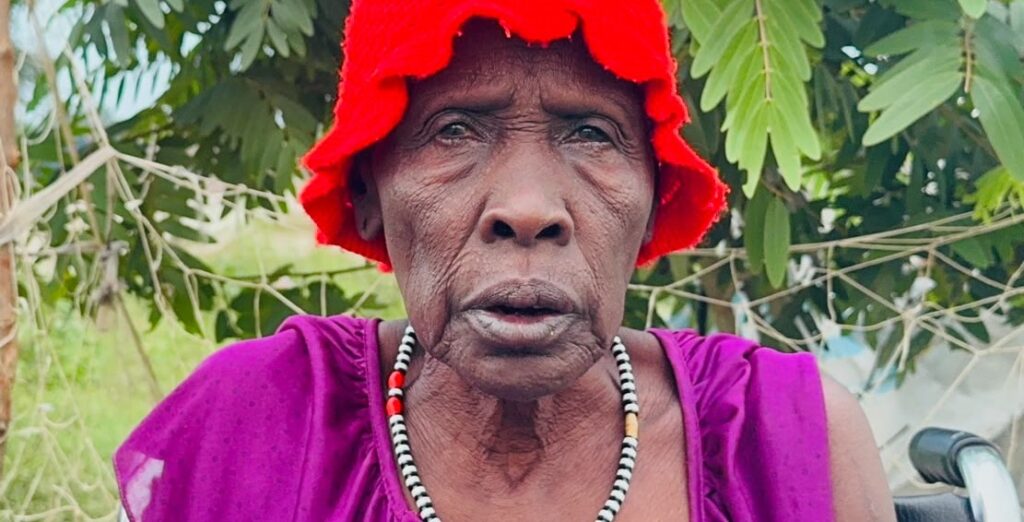
When fighting reached Walgak in Jonglei’s Greater Akobo area in February 2026, 75-year-old Nyanit Jany stayed behind to care for several young children whose mothers had gone fishing.
She wanted to flee with the children but could not carry them because of her age. She decided to wait for their mothers to return.
They never did.
A female neighbour eventually offered to take the children to safety. Shortly after they left, Nyanit said, soldiers arrived at her home in a pickup truck.
She ran inside the house.
“The soldiers immediately started shooting at me,” Nyanit recalled. “They missed me with the first shot, but the second shot hit my left leg. I was then shot again in my right leg. I lost consciousness.”
When she regained consciousness, Nyanit said, she found that her house was on fire.
Despite her injuries, she crawled out of the burning house to escape the flames. She said the soldiers were still outside.
“One soldier told the others to finish me off,” she said. “I begged them not to kill me and asked them to allow my children to come and find me, and perhaps bury me if I later died from my wounds.”
The soldiers eventually left, she said, leaving her bleeding outside.
That night, her children returned and took her to Wec Jal, where hundreds of civilians had sought safety. Her nephew later found a vehicle to take her to Akobo for treatment.
At Akobo Teaching Hospital, doctors treated her severe gunshot wounds but told her that her left leg could not be saved and would have to be amputated.
The operation was carried out, but Nyanit’s ordeal was not over.
On March 8, 2026, civilians were again ordered to leave Akobo following an evacuation order announced by the South Sudan People’s Defence Forces military spokesperson two days earlier. Nyanit, along with other patients from the hospital, was evacuated to Tiergol, a town near the South Sudan-Ethiopia border.
The International Committee of the Red Cross later arranged her evacuation to Juba on March 9 for further medical treatment.
Doctors in Juba told her that the earlier amputation had developed complications and needed to be redone. Her other leg was eventually amputated as well.
Nyanit said the injuries and amputations have left her in constant pain and struggling to meet basic needs.
“My life has become a living hell,” she said. “I am in constant pain throughout my body.”
She said a lack of adequate food has also slowed her recovery.
“I now lack many basic necessities, including food,” she said. “My entire body aches, from my shoulders to the lower parts of my body. I have not fully recovered.”
Nyanit is now appealing for assistance from humanitarian organisations, well-wishers and other supporters.
“I appeal to well-wishers and humanitarian supporters to assist me with food and other basic needs so that I may recover and live with dignity,” she said.
Her story reflects the lasting toll of fighting on civilians caught in conflict, many of whom are forced to flee their homes while injured or undergoing medical treatment.
Nyanit is living with permanent disabilities after suffering gunshot wounds and undergoing multiple amputations. She needs food, medical care and other essential assistance.

 and then