



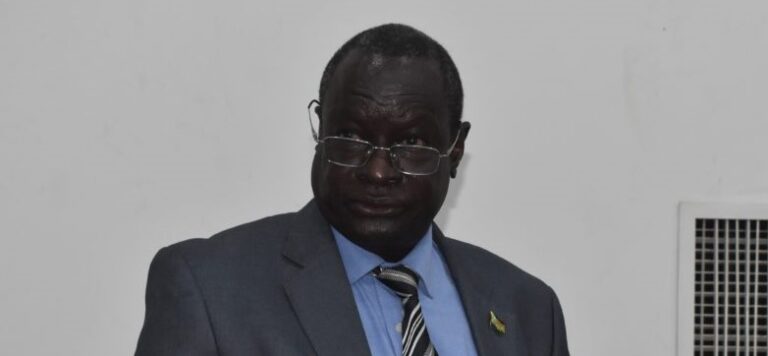
South Sudan’s finance minister warned on Wednesday that “strong individuals” are capturing large portions of the national budget, leaving key state institutions underfunded.
Salvatore Garang Mabiordit, minister of finance and planning, made the remarks while presenting the 2025/26 fiscal year financial bill during its second reading in the Transitional National Legislative Assembly.
“To be frank, we are the richest in the East African Community, but because of the way we manage our financial affairs, we don’t stick to financial regulations that provide transparency and accountability,” Garang told lawmakers.
Oil dependency
The minister’s remarks followed a report by the parliamentary Committee on Finance and Planning indicating that the 2025/26 budget had effectively been exhausted.
Garang said the national budget relies heavily on oil revenues, which account for about 90% of government income.
“When we talk about the budget, it is an assumption that the oil will flow until the end of the fiscal year,” he said. “If it is delayed, then the revenue drops.”
He warned that instability in the Middle East could disrupt oil production or export timelines, further straining government finances.
‘Survival of the fittest’
Garang described a system in which political influence can determine access to public funds, with some institutions overspending while others receive little or nothing.
“The problem is the budget is put in a basket and some strong people get the whole budget,” he said. “We have to abide by the law of nature: the stronger survives. Therefore, you should be very serious.”
He said the situation had left the civil service — which he described as the backbone of the country — in crisis, with some government employees going unpaid for up to a year and relying on relatives for basic needs.
The minister did not name the individuals he said were capturing large portions of the budget.
Call for reform
Garang urged stricter adherence to financial regulations and said funds should only be disbursed according to approved budget allocations.
“If you pay outside of the budget, you are breaking the rules,” he told lawmakers, calling for greater accountability in public spending.
“We are accountable to the public because we are seen with food every day in our houses,” he said.
Garang was reappointed finance minister las month, marking his third time in the role. His first tenure ran from 2018 until September 2020, when he was dismissed by President Salva Kiir in a presidential decree. He returned for a brief second term from March to August 2023.
During his first tenure, reports alleged that he authorised the use of about $100,000 in public funds to cover expenses related to his son’s funeral. The allegation circulated in the media, but he did not publicly comment on it.
His latest appointment followed the dismissal of his predecessor, Bak Barnaba Chol, who had served as finance minister for about three months.
Garang previously served as first undersecretary at the finance ministry from 2008 to 2017 before being transferred to the South Sudan Ministry of Trade and Industry as a technical adviser. He was later appointed finance minister in 2018.

 and then