



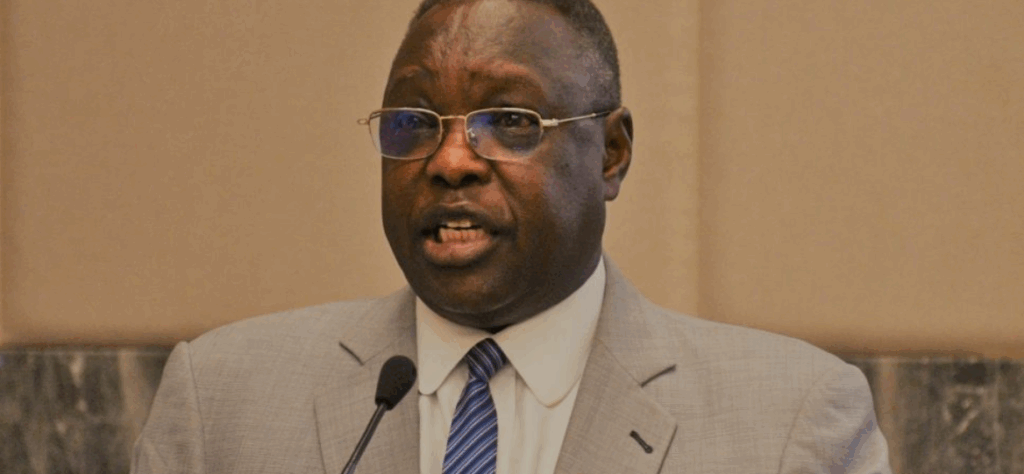
The Government of South Sudan has ruled out any extension of the transitional period beyond December 2026, despite an ongoing Inter-Party Dialogue whose completion date has not yet been set.
Cabinet Affairs Minister Dr. Martin Elia Lomuro on Thursday told journalists that the Presidency had decided to end the transitional period and proceed with elections in December 2026, while the dialogue continues to address political, constitutional, electoral and security concerns.
“There will be no extension, and we should go for elections in December 2026,” he stated.
Dr. Lomuro said the Inter-Party Dialogue was established by President Salva Kiir in response to recommendations from an assessment of the implementation of the 2018 peace agreement.
The dialogue brings together about 73 representatives from parties that signed the 2018 revitalized peace agreement and is supported by an administrative body.
He said five technical working groups have been established to examine legal and constitutional issues, political and governance matters, electoral and institutional preparedness, security and civic space, as well as stakeholders and civil society.
“The Inter-Party Dialogue process is in progress, and I cannot give you a date,” he said. “Inter-Party Dialogue is a big process.”
Lomuro added that consultations were also being extended to non-signatories of the peace agreement and holdout groups, meaning the process could continue as the country approaches the planned elections.
“If there are concerns about civic or political space, this will be discussed, and a mechanism will be developed to address that,” he said.
Lomuro, who is also a party leader, said he was ready for the elections and described himself as “very much prepared”.
Asked whether the remaining timeframe was sufficient, given that voter registration had not started and the National Elections Commission (NEC) had raised concerns about funding and procurement, he said the assessment should come from the electoral body.
“It is up to the NEC to tell us; that is not for me, it is for the NEC,” he stated curtly. “There is a general economic hardship, but the government is working to avail funds. It is taking time, but it will happen.”
Government plans 27,000 grassroots police officers
The minister also disclosed plans by the Ministry of Interior to train up to 27,000 police personnel as part of an administrative police service intended to strengthen security at grassroots level.
He said the ministry was reorganizing the police and other security-related institutions, including the prison service and fire brigade, while developing an administrative police service to provide security across different levels of government. The security personnel are expected to be deployed across 540 stations to strengthen grassroots security.
“Right now as I speak, there is no police service anywhere at the grassroots level,” Lomuro said.
He said the initiative would be important ahead of elections because political actors need assurances that they can campaign and travel safely.
“If I were going to go for an election, I would not be sure that I am going to a place where there is security,” he said.
Government defends transitional justice progress
Dr. Lomuro also rejected criticism that South Sudan’s transitional justice mechanisms remain inactive, saying preparations for the establishment of key institutions are underway.
He said the law establishing the Commission for Truth, Reconciliation and Healing had been promulgated and that interviews for commissioners had been conducted, with the government awaiting the foreign component of the commissioners.
He said legislation establishing the Compensation and Reparations Authority had also been signed and that the process of establishing the institution was ongoing.
On the Hybrid Court for South Sudan, Lomuro said its establishment was a joint responsibility of South Sudan and the African Union, but that the government was waiting for the AU to provide guidelines and engage with Juba.
“No one is running away from these transitional institutions because we know they are important,” he said.
According to the minister, the mechanisms will help establish what victims of the conflict experienced and provide information that could guide efforts to address past abuses.
The minister’s remarks come as South Sudan faces growing questions over whether electoral, political and security preparations can be completed before the December 2026 deadline, while the Inter-Party Dialogue continues without a publicly announced completion date.

 and then