



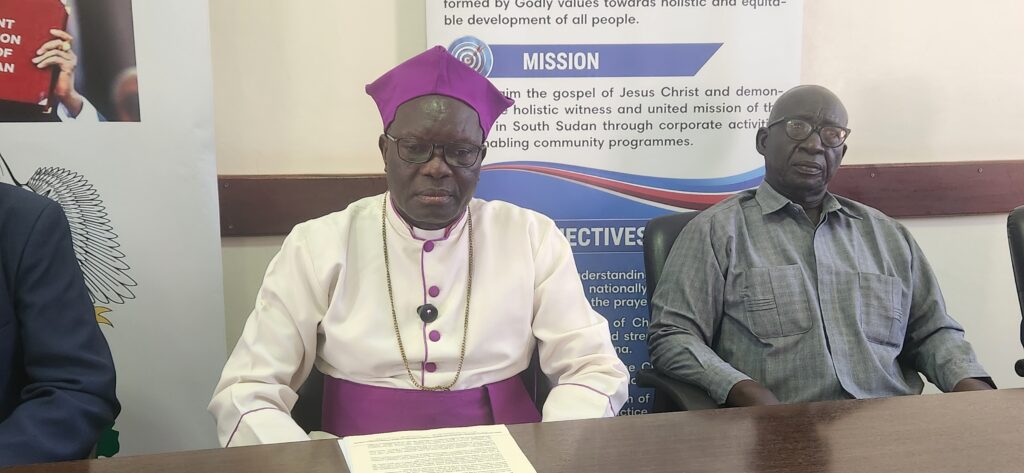
South Sudan’s church leaders have called for an immediate cessation of hostilities across the country, warning that rising armed violence, youth mobilisation and inter-communal fighting are killing and displacing civilians and disrupting humanitarian operations.
The South Sudan Council of Churches made the appeal a press conference in Juba on Tuesday, saying the security and humanitarian situation had continued to deteriorate in several parts of the country.
Justin Badi Arama, Primate of the Episcopal Church of South Sudan, said communities are being displaced, while civilians are being killed and abducted and roads are becoming increasingly dangerous.
“The suffering of our people has reached a point where silence is no longer an option,” the church leaders said.
The council cited renewed fighting and mobilisation of armed youth in Nasir and Ulang counties in Upper Nile State, saying the violence had caused deaths, displacement and restrictions on humanitarian access.
In Jonglei State, it said inter-communal violence and armed youth mobilisation are affecting communities in Nyirol, Uror, Ayod and Akobo counties, as well as parts of the Greater Pibor Administrative Area.
The churches also raised concerns about insecurity around Bentiu and in Ruweng Administrative Area in Unity State, where they said vulnerable and displaced communities remained at risk.
In Warrap State, they identified Tonj North and Gogrial East, as well as the Abyei Administrative Area, as areas where inter-communal and revenge-related violence remained a serious concern.
The council also cited insecurity in the Equatoria region, including attacks along roads linking Juba with Mundri, Torit and Yei, saying the violence was threatening civilians and humanitarian operations.
The churches urged the government, armed groups, traditional authorities and communities to protect civilians, end revenge attacks, ensure humanitarian access and commit to dialogue.
They also called for an end to the mobilisation and arming of young people for violence and urged authorities to secure major roads and river transport routes used by civilians and aid agencies.
“We therefore call upon all conflicting parties and communities to choose restraint over retaliation, dialogue over confrontation, and reconciliation over revenge,” the statement said.
The council urged communities to reject hatred and retaliation and strengthen local peace and reconciliation mechanisms.
South Sudan has endured years of conflict since gaining independence in 2011, including a civil war that erupted in 2013 and killed hundreds of thousands of people. A 2018 peace agreement between President Salva Kiir and his rival, Riek Machar, ended much of the large-scale fighting but implementation has been repeatedly delayed and violence has persisted in parts of the country.
The church leaders said the protection of civilians and restoration of humanitarian access should remain a priority, calling on political leaders and communities to work towards lasting peace and reconciliation.

 and then