



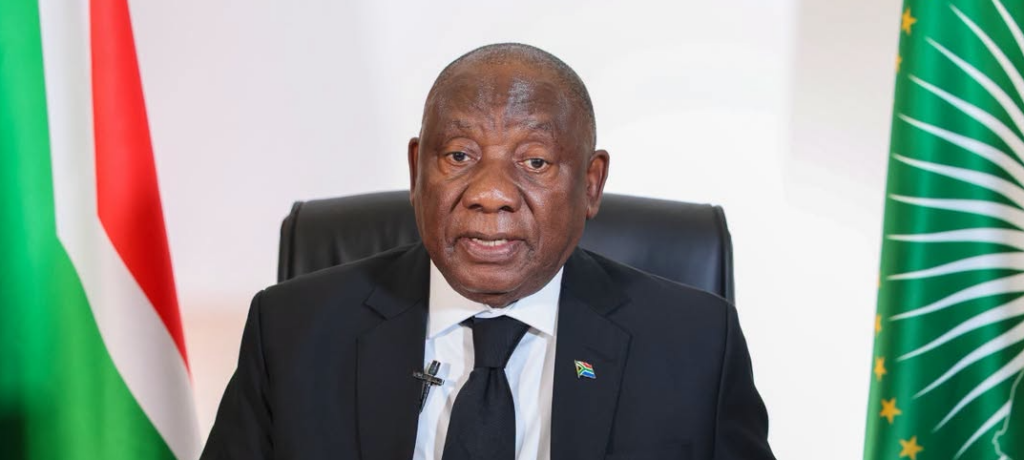
South Africa’s President Cyril Ramaphosa has said South Sudan’s 2018 peace agreement remains the country’s “paramount legal instrument”, as regional leaders urged all parties to comply with the deal ahead of elections due in December.
Ramaphosa made the remarks on Tuesday while closing a virtual summit of the African Union’s High-Level Ad Hoc Committee on South Sudan, known as the C5, which also involved members of the Intergovernmental Authority on Development (IGAD) and the African Union (AU).
South Africa chairs the C5, which comprises South Africa, Algeria, Chad, Nigeria and Rwanda. The committee supports efforts to advance peace and the implementation of South Sudan’s Revitalised Agreement on the Resolution of the Conflict in South Sudan (R-ARCSS), signed in 2018.
“We have agreed that the Revitalised Peace Agreement remains the paramount legal instrument with which all parties must comply and by which progress in South Sudan will be measured,” Ramaphosa said.
His comments come as South Sudan prepares to hold general elections on 22 December, its first national vote since independence in 2011.
Legal framework
Ramaphosa said all parties should fully comply with the provisions of the 2018 peace agreement and avoid unilateral measures that could undermine it.
The summit also called for an immediate end to hostilities and respect for the permanent ceasefire provided for under the agreement.
The regional leaders urged the South Sudanese government to release people arbitrarily detained on political grounds, while respecting the country’s sovereignty and judicial processes, and to guarantee the rights, humane treatment and due process of people facing judicial proceedings.
They also called on the government to adopt a “feasible, consensual and time-bound” electoral roadmap setting out the legal basis, scope and sequencing of the elections.
The summit further urged the government to provide adequate and timely funding to electoral and transitional institutions and to address the political, legal, technical, operational, financial and security requirements needed for a peaceful and credible election.
Ramaphosa said the government had made progress towards the elections but that “many challenges and tremendous work” remained.
“In the interests of national elections that are free, fair and credible, we urge the Government of South Sudan to work with speed to resolve the challenges that remain,” he said.
Election and peace
South Sudan’s peace agreement was intended to end years of conflict and provide a framework for a transitional government leading to elections.
The agreement has been repeatedly extended and amended as the parties struggled to implement key provisions, including security arrangements, constitutional reforms and preparations for elections.
Ramaphosa said the primary responsibility for implementing the agreed measures rests with the South Sudanese government and the parties to the 2018 peace agreement.
He said support from the African Union, the C5 and international partners should reinforce South Sudanese ownership and respond to clearly identified priorities.
The summit also called on all parties to protect civilians, humanitarian and medical workers, and UN peacekeepers, and to ensure safe and unhindered humanitarian access.
It urged accountability for attacks against peacekeepers and humanitarian personnel.
Ramaphosa said the African Union, C5 and IGAD should coordinate technical assistance for the electoral process and implementation of the peace agreement.
“For democracy to take hold in South Sudan, its leaders must demonstrate genuine commitment to inclusivity, peace and national reconciliation,” he said.
“Only then can South Sudan begin in earnest to build its institutions, strengthen democratic practice and build a unified nation.”

 and then