



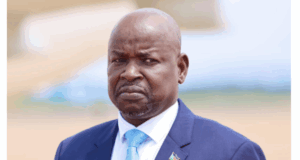
This report is published by Radio Tamazuj as part of an investigative series profiling former Vice-President Dr. Benjamin Bol. It examines his political career, influence, and role in South Sudan’s recent history.
Initially presenting as a businessman, Benjamin Bol Mel quietly and steadily rose under President Salva Kiir Mayardit, with the latter fanning winds under his wings to rise and become almost unassailable in South Sudan.
He was appointed Senior Presidential Envoy for Special Programs a couple of years ago and was soon speedily propelled to First Deputy Secretary General of the SPLM Party. Before that, Bol was propelled by Kiir to serve on the SPLM Party Political Bureau, the party’s top organ, and on the National Liberation Council (NLC) without formally serving in and or rising through the outfit’s structures, to the chagrin of historical members who still consider him an upstart and Kiir apparatchik. On 10 February, Kiir appointed Bol Vice President, replacing long-serving Vice President Dr James Wani Igga.
No one was surprised as Bol’s star had been rising in Kiir’s court, and rumours had been making rounds for the last couple of years that the president was positioning Bol to replace him. There are seldom rumours in South Sudan that do not come true because people often speak the truth freely, even when whispering.
It is of paramount importance from the outset to qualify that Bol is a principal business partner of Kiir and his family and runs lucrative illicit deals that thrive on pilfering and diverting public funds for their mutual benefit.
Early Life
Benjamin Bol Mel was born in late 1978 in Makuac Athian village in the current Aweil East County in South Sudan’s Northern Bahr el Ghazal State. As a very young lad, like thousands of others, he trekked to Dimma in Ethiopia shortly after the commencement of the SPLM/SPLA guerrilla war in early 1983.
Dr John Garang, the leader of the SPLM/SPLA, christened these children who were too young to fight the “Red Army.” They were put in makeshift camps where they were given rudimentary and basic education with the promise that they were the future of the revolution and upcoming leaders.
However, things were not going very well for the Ethiopian regime led by Mengistu Haile Mariam, which was bankrolling and arming the SPLM/SPLA, and by 1990, the Soviet Union had withdrawn support. The withdrawal of Soviet support further weakened Mengistu’s power, and in May 1991, the Ethiopian People’s Revolutionary Democratic Front (EPRDF) forces advanced on Addis Ababa from all sides, forcing Mengistu to flee to Zimbabwe. The war in Ethiopia spelt doom for the SPLM/SPLA, which relocated its offices to the Kenyan capital, Nairobi. Sudanese refugees in camps and SPLM/SPLA elements in western Ethiopia, where they had bases, had to hastily up and leave in a disorganised manner for liberated areas in Sudan, and members of the Red Army trekked hard to Kakuma Refugee Camp and Eastern Equatoria in Sudan. Many died along the way.
Move to Uganda
Being a member of the Red Army, it is interesting how Bol found his way to Uganda despite being a minor. With luck on his side, he was taken in by Lanyero Christine Awany, a Ugandan businesswoman from the Acholi tribe of Gulu in Northern Uganda who is the sister of General Otema Awany, the current Uganda People’s Defence Force’s (UPDF) Reserve Force Commander.
Lanyero had business dealings and other liaisons with Bol’s uncle, Garang Deng Aguer, an industrious businessman since before the war broke out in Sudan in 1983, who had dealings in SPLA liberated areas in the then Sudan and was also living in Uganda and fleeted between Kampala, Gulu and Arua in the West Nile region, where he ran a hotel. Many say this is why the Awany family took Bol in.
A fairly green and traumatised Bol joined Murchison Falls Primary School before going to Gulu Public Primary School, where he sat the Uganda Primary Leaving Certificate in 1994. The Awany family then facilitated his enrollment into the Apostles of Jesus Minor Seminary in Moroto, in Uganda’s North East Karamoja region, for the Uganda Certificate of Education, which he completed in 1998. After a long vacation, Bol went to St. Paul’s College in Mbale, a town in eastern Uganda on the slopes of Mount Elgon. Here, he completed his Uganda Advanced Certificate of Education (UACE) in 2000.
By this time, Bol had reestablished contacts with his uncle. The duo would, later in Juba after the signing of the Comprehensive Peace Agreement (CPA) in 2005, team up to run a string of businesses together.
Entering Nairobi
Bol then moved to the United States International University-Africa (USIU) in Nairobi, Kenya, for his undergraduate studies in International Business Administration, which he completed in 2005 after navigating several hurdles.
USIU is where Bol cut his teeth and where his story makes astounding twists and turns. He joined the university on a scholarship from a Baptist Church benefactor but soon ran afoul of his sponsors, and his bursary was terminated because “he abandoned his gentle Christian ways after being taken up by the freedoms and debauchery that come with campus life.”
In late 2001 and early 2002, Bol enrolled in USIU’s Work Study Program, which is designed for needy students to continue with their education while working on campus. This, however, meant that he could only take a few courses and classes at a time, meaning that he would take longer time to complete his studies.
He opted to work at the USIU Multimedia Centre and later the Computer Laboratory, where he acquired computer and Information Technology (IT) skills that would become invaluable in his nefarious scheme to obtain money using wire fraud. At this point and for background, it is imperative to point out that students who were sponsored by institutions and or benefactors had to have accounts with the university. However, students could not access the funds in these accounts without express permission from their sponsors and without the latter authorising the university.
Bol, now IT savvy, saw a gap, cooked up a serious plan, and linked up with fraudulent people in the USIU Accounts Department and started hacking and removing money from students’ accounts for a cut. After students discovered that they could draw money from their accounts without the permission of their sponsors, Bol instantly became famous and cashed in big too.
He started living luxuriously like a king and treating his friends to food and beverages at the university canteen, which was too expensive for most penurious students.
Luck was still smiling on Bol, and with the help of South Sudanese students who were on church scholarships, he was introduced to an official at the New Sudan Council of Churches (NSCC) who recommended him to the Association of Member Episcopal Conferences in Eastern Africa (AMECEA) and then finally to Bishop Caesar Mazzolari, the then prelate of the Catholic Diocese of Rumbek.
The bishop managed to arrange for Bol a very hefty scholarship, which allowed him to live lavishly. He rented a three-bedroomed house in the Roysambu suburb of Nairobi’s upscale Kasarani area. He then set about fast-tracking his studies.
While at USIU, Bol, shrewd always, would link up with friends and colleagues who were relations of, or had camaraderie with, the leaders of the SPLM/SPLA and cajole them to take him to their homes in Nairobi. He often visited the homes of the likes of the late Dr John Garang, Commander Salva Kiir, Mario Mour Mour, Aurthur Akuein, and Mori Didimo, among many prominent leaders. These contacts were to prove invaluable in the future after the Comprehensive Peace Agreement (CPA) was signed in 2005 and after Independence in July 2011.
While pursuing his business interests in South Sudan, Bol continued pursuing further education at his alma mater (USIU) and enrolled for a Global Executive Master’s in Business Administration, which he completed in 2011. He went back for a Doctorate in Business Administration, which he accomplished in 2016. However, students at the university and others in the know vow that Bol was never in class for his later advanced degrees and that his coursework was done by hired academic hands and his PhD thesis was written for him by a Kenyan Jaluo friend who also studied at USIU-Africa called Owuor Emmanuel Okode. When contacted for this investigation, Okode denied doing Bol’s academic work. Among other errands, Okode ran for Bol was exchanging substantial amounts of hard currency, mostly U.S. dollars, from forex bureaus around Nairobi. Bol also bankrolled Okode’s university education and provided him with a good stipend.
Move to South Sudan
Circa late 2005, after completing his bachelor’s degree, Bol mended fences with his Baptist Church benefactors who had abandoned him, and he would later claim that they gave him two trucks as a startup. He would often narrate to all and sundry who listened that he took the lorries and leased them to the SPLM/SPLA in Rumbek, Southern Sudan, for a year and that he was owed US$135,000 in dues. Rumbek was at the time the de facto headquarters of the SPLM/SPLA.
He soon landed a job with UNDP and moved to Rumbek. From early 2007, Bol would travel to Juba at every opportunity to try and claim the money he was owed by the SPLM/SPLA. By this time, the government of the semiautonomous Southern Sudan was taking shape. Now disillusioned, Bol repeatedly asked to be transferred to Juba but was repeatedly turned down and decided to quit his UNDP job and move to Juba.
He reconnected with Arthur Akuein, who was now the Minister of Finance in the Government of Southern Sudan. The minister’s office was fully staffed, but he managed to appoint Bol as his “Special Private Secretary for Special Duties.” Bol had now arrived at the then-gushing financial pipeline of Southern Sudan and also put his bucket to collect. He put in his claim for the rent and use of his two trucks by the establishment and was expeditiously and handsomely paid off.

 and then