



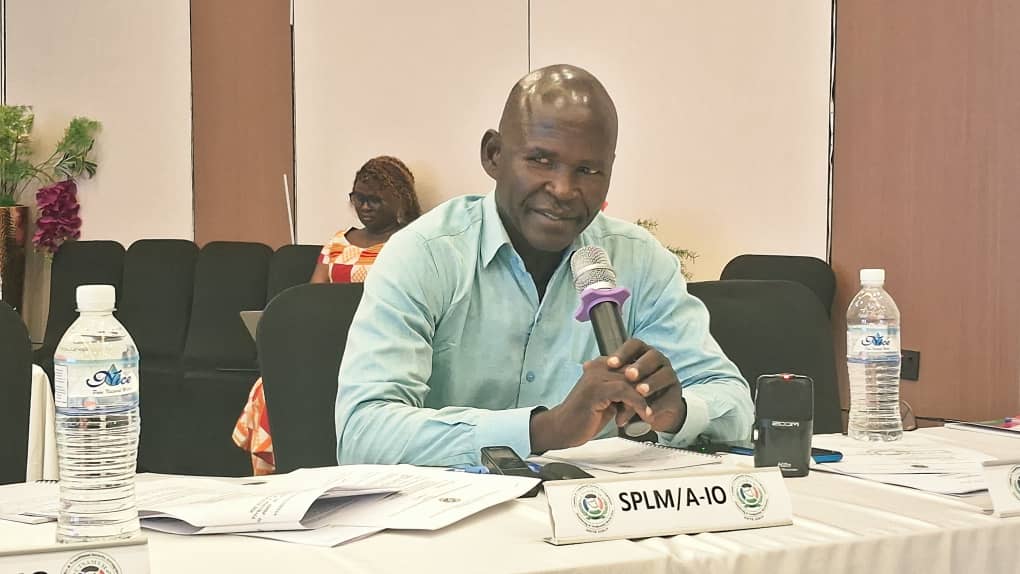
Senior representatives of South Sudan’s political parties have urged the government to accelerate the deployment of unified forces, warning that delays could undermine security and preparations for elections scheduled for December.
The call was made on Tuesday during a meeting of the Technical Committee of the Ceasefire and Transitional Security Arrangements Monitoring and Verification Mechanism (CTSAMVM) in Juba.
Representatives raised concerns about continuing insecurity, attacks on civilians and humanitarian workers, road ambushes and the slow implementation of Chapter Two of the 2018 peace agreement, which covers transitional security arrangements.
Gen. Andrea Mangu, a senior representative of the opposition Sudan People’s Liberation Movement in Opposition (SPLM-IO), said the deployment of unified forces was critical to restoring security across the country.
He said forces that had already graduated but had not been deployed should remain in their designated locations while mechanisms needed to complete the security arrangements are reactivated.
“Our unified forces who have already graduated and are not yet deployed should keep in their places … and wait for the right time to come,” Mangu said.
He said the National Transitional Council should help reactivate the Joint Defence Board so that the remaining security mechanisms could resume work.
Gen. Ywodo John, representing the South Sudan Opposition Alliance (SSOA), linked delays in integrating the forces to concerns over security for the forthcoming elections.
“Unified forces are not yet integrated,” Ywodo said. “Will protection of voters and ballots rely on the responsibility of the one-side forces?”
He said the country was now counting down to the elections, with only about three months remaining, and questioned whether there was enough time to complete the integration process.
Ywodo urged CTSAMVM to work more closely with the government and provide regular updates on security developments.
He also linked insecurity along major roads to the incomplete integration of forces, saying increased deployment could improve road safety.
“I think the looting and robbery along the roads is related to the integration of forces. Once we have more forces, we are more secure and our roads are safe,” he said.
Gen. Wuoi Mayom Deng, senior representative of the Revitalized Transitional Government of National Unity, called on the committee to use its monthly meetings to strengthen cooperation and support implementation of the peace agreement as elections approach.
“As we gather for this monthly meeting, we should remain focused on our shared responsibility to objectively assess progress, strengthen cooperation, identify challenges and support the implementation of the revitalized peace agreement, especially as we are in the last quarter to elections,” Deng said.
He said the effectiveness of the monitoring mechanism depends not only on its reports but also on cooperation, impartiality, professionalism and mutual respect among stakeholders.
Maj. Gen. Bior Leek Kuareng, representing the Former Detainees, also called for full implementation of the security arrangements, saying continued violence and the failure to establish unified security institutions were undermining public confidence in the peace process.
“The permanent ceasefire must mean a permanent ceasefire because there are so many violations within the ceasefire,” Kuareng said.
He cited armed confrontations, attacks on civilians, illegal checkpoints, displacement, abductions and looting as continuing threats to implementation of the peace agreement.
Kuareng called for completion of the unification process, the establishment of a unified command structure, transparent deployment of forces and further training to create a professional and accountable security sector.
“We therefore call for completion of unification of forces, establishment of unified command structure, transparent deployment of unified forces, completion of necessary training for professionalization, disarmament, demobilization and reintegration where applicable,” he said.
He warned against using security institutions for political competition and called for national security forces that serve the country rather than individual political interests.
“The security sector must ultimately become national, professional, non-partisan and constitutionally accountable,” he said.
Kuareng said peace requires more than an end to armed conflict, stressing the importance of political inclusion, freedom of political participation, dialogue and public confidence.
“Peace is not simply the absence of shooting,” he said. “Peace also requires political inclusion, freedom of political participation, dialogue and confidence among the parties and citizens.”
The unification of the country’s various armed groups into a single national army is a cornerstone of the 2018 peace agreement. However, the process has stalled amid disputes among the parties and renewed fighting.

 and then