



South Sudan is a sovereign nation founded on the sacrifices of its people after decades of struggle. Since independence in 2011, however, the country has endured prolonged civil conflict, political instability, and institutional breakdown.
The suffering of the citizens—rooted in colonial legacies and compounded after independence—demands a bold constitutional solution that can restore unity, peace, and the rule of law.
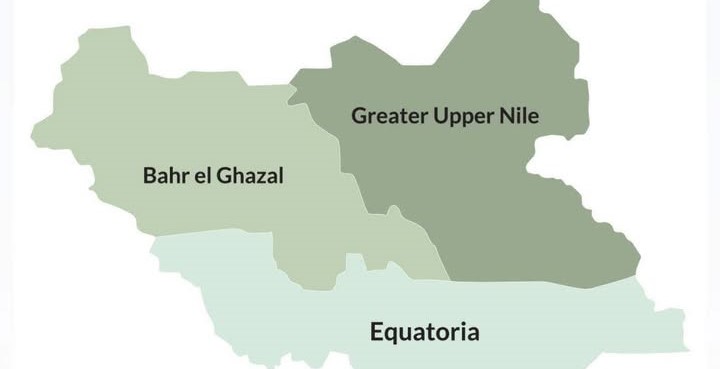
I propose three federal states—based on the historic regions of Greater Upper Nile, Equatoria, and Bahr el-Ghazal. This offers the most practical and constitutional pathway to end division, prevent further conflict, and build a durable democratic future.
Since independence, South Sudan has faced prolonged civil war, deep ethnic and political divisions, weak constitutional enforcement, abuse of executive power, mismanagement of national resources and widespread corruption at national and local levels.
Although the Transitional Constitution originally provided for decentralized governance through 10 states, this framework was undermined by excessive centralization of power under President Salva Kiir. The shift to 32 states further fragmented national unity along ethnic lines, intensifying local competition and mistrust.
A centralized system, in a deeply diverse society, has proven unstable. The concentration of power in one executive authority weakens institutions and fuels grievances.
Therefore, restructuring is necessary, and the proposed three federal states correspond to the former British-administered regions of Greater Upper Nile, Equatoria and Bahr el-Ghazal
These regions previously functioned as coherent administrative units and remain socially recognizable geographic identities. During the liberation struggle under John Garang, regional governance structures in SPLM/A-controlled areas promoted relative administrative order and unity. This historical foundation provides legitimacy and continuity.
Three federal states would reduce ethnic fragmentation caused by excessive state proliferation, encourage broader regional identity, distribute political authority more equitably, reduce competition for control of the presidency and promote shared national ownership of government.
When power is shared among strong federal regions, political competition becomes less violent and more institutional. Under the proposed structure, the three regions become federal states, current counties are upgraded to provinces and payams and bumas receive stronger administrative authority.
This layered governance ensures that local communities manage their affairs, public services are delivered closer to citizens, accountability improves and development planning reflects local needs.
Effective federalism strengthens unity by empowering local governance without breaking national sovereignty. To reinforce unity and prevent over-centralization, the three arms of government would be distributed geographically. Parliament would be located in Equatoria (Juba remains the parliamentary seat). The Judiciary would be headquartered in Bahr el-Ghazal, with Wau as the judicial capital, and the Executive would be based in Pigi in Greater Upper Nile, establishing a new federal capital between the White Nile and Sobat River.
This arrangement would prevent domination by one region, symbolize national balance, encourage shared responsibility and resolve land and political tensions concentrated in Juba.
By physically separating the arms of government, institutional independence is strengthened.
The Addis Ababa Agreement demonstrated that regional autonomy can reduce conflict and foster coexistence. In Equatoria particularly, regional identity often outweighed tribal divisions during that period.
Three federal states can revive that spirit of regional solidarity, while maintaining national unity.
Some argue that federalism increases division. However, division already exists under extreme centralization, the multiplication of small states has intensified tribal politics, yet true federalism unites diversity within a constitutional framework.
Those opposing three federal states often benefit from the centralized patronage systems. But sustainable peace requires institutional reform, not preservation of political monopolies.
The three federal states model does not divide South Sudan. Instead, it preserves territorial integrity, establishes constitutional balance, ensures equitable resource distribution, strengthens rule of law and promotes durable peace.
Unity is strongest when it is voluntary, fair, and constitutionally protected.
The future of South Sudan depends on structural reform. The current centralized governance model has contributed to civil war, corruption, and institutional collapse. A return to three historically grounded federal states offers a constitutional solution rooted in history, legitimacy, and balance.
Federalism is not fragmentation—it is structured unity.
If South Sudan is to achieve lasting peace, justice, and prosperity, the establishment of three federal states is not merely an option; it is a necessary constitutional reform.
The writer, Bol Gatkouth Kol, is a political analyst and former Member of National Assembly. He can be reached via email: bolgatkouth2@gmail.com
The views expressed in ‘opinion’ articles published by Radio Tamazuj are solely those of the writer. The veracity of any claims made is the responsibility of the author, not Radio Tamazuj.

 and then