



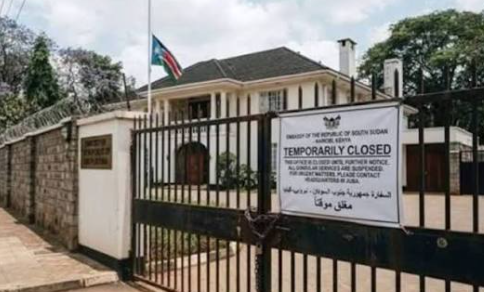
In the quiet corridors of Juba’s diplomatic landscape, a haunting reality has recently come to light: the lights are flickering in foreign capitals. Reports surfacing this week regarding the disruption of services at South Sudan’s embassy in Nairobi have peeled back the veil on a deepening fiscal crisis. While the government officially maintains that its missions remain operational, the narrative on the ground, underscored by persistent reports of unpaid rent and abandoned staff, tells a story of a nation struggling to afford its own shadow on the world stage. This is not a logistical hiccup; it is a signal that the status quo of South Sudan’s foreign representation is no longer sustainable.
Embassies are the eyes, ears, and voice of a sovereign state. They serve as the critical conduit for bilateral trade, the protection of citizens abroad, and the projection of national interests in a competitive geopolitical arena. For South Sudan, these missions should be lifelines, facilitating foreign investment and navigating regional peace processes. Instead, when they become symbols of insolvency, characterized by shuttered doors and arrears, they cease to be assets. They become liabilities that erode the very national dignity they were designed to uphold.
The current crisis is a direct reflection of South Sudan’s broader economic malaise. With an economy tethered precariously to volatile oil revenues and hampered by systemic fiscal mismanagement, the state finds itself in a cash-flow trap. The inability to pay rent for missions in regional hubs like Nairobi is not just an administrative failure; it is a symptom of a political culture that has struggled to align its diplomatic ambitions with its economic reality. When the cost of maintaining a global footprint outweighs the tangible benefits, the government must confront the uncomfortable truth: you cannot project power you cannot pay for.
Historically, post-conflict and newly independent states have often faced this diplomatic overreach dilemma. After the initial euphoria of statehood, the sobering reality of institutional maintenance sets in. Nations such as Ethiopia and Rwanda, at various junctures, have undergone rigorous right-sizing of their diplomatic corps. The lesson is clear: effectiveness is not a function of the number of flagpoles, but the clarity of the mission. A smaller, well-funded, and strategically placed diplomatic network is invariably more effective than an expansive, hollowed-out one that constantly begs for credit to cover basic overheads.
To navigate this, South Sudan must embrace a policy of radical rationalization. The current model, which stretches thin resources across a wide, unsustainable geography, needs a drastic pivot. Consolidating its presence into a lean, strategic network, the country can ensure that its representatives are not merely present, but productive. Focusing on fifteen core embassies, strategically situated to protect citizens, foster economic growth, and maintain regional stability, would allow for the professionalization of staff and the consistent fulfilment of fiscal obligations.
This proposed architecture prioritizes depth over breadth. Maintaining two missions in the Americas, one in the Asian powerhouse of China, two in European centres of influence, and key nodes in the Middle East and Africa, including South Sudan, can cover the essential bases of its national interest. The concentration of resources in these fifteen locations would transform these missions from rent-burdened outposts into high-impact hubs. The remaining international engagement can be managed through non-resident missions, digital diplomacy, and robust regional coordination, reducing the drain on the national treasury.
This shift will not be easy. It requires the political courage to close offices and repatriate staff, a move that will undoubtedly meet resistance from those who benefit from the current, bloated system. However, the alternative, a slow and embarrassing decay of diplomatic credibility, is far worse. The government must view this not as a retreat, but as a tactical repositioning. A nation that cannot keep its lights on in Nairobi or Kampala today will surely struggle to maintain influence in London or Washington tomorrow.
Furthermore, this rationalization creates an opportunity to reform the recruitment and management of diplomatic personnel. By reducing the quantity, the state can raise the quality of its representatives. Future diplomats should be selected based on merit and expertise in trade, law, and conflict resolution, rather than political patronage. A smaller, elite corps can better embody the professional standards that President Salva Kiir has rightfully called for, turning the current crisis into an institutional catalyst for renewal.
The goal is to create a foreign service that serves the South Sudanese people, not just the state’s vanity. If the goal is economic recovery and regional stability, then the diplomatic missions must be the tip of that spear: sharp, focused, and sustainable. The current fiscal constraints provide the perfect justification for this long-overdue housecleaning.
Let the era of the oversized, under-funded mission end. In its place, let there be a compact, professional, and powerful diplomatic network. Choosing to occupy fifteen vital spaces properly rather than fifty spaces poorly, South Sudan can reclaim its narrative and secure its place in the global order. It is time for the government to move beyond the technical excuses and embrace a strategy of survival and strength, proving that even a struggling nation can be a mature, responsible actor on the international stage.
Bec George Anyak is a PhD student at the University of Nairobi, Kenya, and an associate researcher at The Sudd Institute, South Sudan.
The views expressed in ‘opinion’ articles published by Radio Tamazuj are solely those of the writer. The veracity of any claims made is the responsibility of the author, not Radio Tamazuj.

 and then