



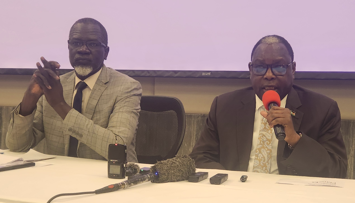
South Sudan’s permanent constitution-making process is more than 70 percent complete, the National Constitutional Review Commission (NCRC) said on Thursday, as it prepares to move from nationwide consultations to drafting the country’s first permanent constitution.
Oyet Patrick Charles, Chairperson of the NCRC Civic Education and Public Consultation Committee, said the commission had completed consultations across all 10 states and three administrative areas, as well as with key national institutions.
“We have covered more than 70 percent of what we are supposed to do as a Commission,” he said during the closing of a two-day civic education and public consultation workshop for members of the executive and heads of independent institutions in Juba.
He said the Commission’s consultations had included the army and other organised forces, civil society groups, women, persons with disabilities, parliament, and other national institutions, with the executive being among the final groups consulted.
Oyet revealed that the next step is the formation of a 15-member Constitutional Drafting Committee, which will translate the views collected from across the country into the first or “zero draft” of the permanent constitution.
“We have their data. It is now only just shortlisting, and then interviewing them, and then coming up with those who will have passed,” he said, referring to applicants for the drafting committee.
According to Oyet, the zero draft will later be presented to a National Constitutional Conference involving 1,200 people from across the country, before the process proceeds to the Constituent Assembly for consideration and eventual presidential assent.
“The biggest work in any constitution-making is data collection, during which you have to go and consult the people, because the constitution is supposed to be a people-driven constitution,” he said.
He, however, acknowledged that the process has not reached all South Sudanese, particularly refugees outside the country.
“Refugees were not consulted because they required us to move out of the country to Uganda, Kenya, and wherever they are,” he said. “This was not possible because of resources.”
For his part, NCRC Chairperson Dr. Riang Yer Zuor said the views gathered from the executive would be combined with submissions collected during consultations across the country and analysed before the drafting stage.
“The commission will collect and analyse the data collected and produce a report, which will be used to guide the drafting of the first draft constitutional text, or what we would call a zero draft,” he said.
He said the process will then move to a National Constitutional Conference, which will deliberate on the zero draft before producing a second and final draft.
“So, all in all, we are happy as a commission with the quality of submissions that we have received so far from the participants,” he said.
Meanwhile, Martin Elia Lomuro, Minister for Cabinet Affairs and Secretary-General of the High-Level Committee for the Implementation of the Agreement on the Resolution of the Conflict in South Sudan, said the two-day exercise had given members of the executive a better understanding of constitutional governance, inclusion, drafting and different systems of federalism.
He said the permanent constitution process remained relevant despite its separation from the December 2026 elections and the census.
“Although we have delinked the constitutional-making process from the election of December 2026 and the census, this process is still very much relevant,” Lomuro said. “It gives us more time to be able to write a constitution that addresses the concerns of the people of South Sudan.”
He also urged the future constitutional drafting process to consider existing national documents, including resolutions of the National Dialogue and recommendations from the Constitutional Review and Judicial Reform committees.
“Specifically, the Constitutional Review Committee has produced very good documentation, with recommendations that I think will reform our judiciary,” Lomuro said.
The NCRC said its technical advice has been that elections should ideally follow the completion of the permanent constitution, but acknowledged that the political process has separated the two.
Oyet said the commission would continue its constitutional work even if elections proceed under the amended transitional constitution.
“We as members of the National Constitutional Review Commission have always given our advice as technical people to the political group. And our advice has been that it is only viable to have elections after the constitution, but we have not been stopped from doing our work,” he said. “We will just continue with the work we have done, especially on the data that we have collected from the people. I think this is not in vain. It will come up in the constitution.”
The NCRC now expects to complete the remaining consultations, finalise the selection of the Constitutional Drafting Committee and begin converting the views collected from South Sudanese into constitutional language.

 and then