



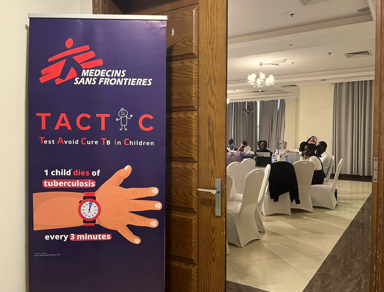
The national health ministry, through the National Tuberculosis Programme, together with Médecins Sans Frontières (MSF) and partners, organized a roundtable in Juba on 27 and 28 April to address the challenges related to childhood tuberculosis (TB) in South Sudan.
A MSF press release extended to Radio Tamazuj said the discussion was focused on the barriers preventing children from accessing appropriate care, as well as on efforts to develop the national strategy to improve early diagnosis and treatment of TB. Health authorities and professionals, clinicians, and technical partners noted that TB remains a major public health challenge in the country, particularly for children.
Since 2023, MSF has been implementing the Test-Avoid-Cure Tuberculosis in Children (TACTiC) initiative across South Sudan. The initiative supports the roll-out of the World Health Organization (WHO) recommended clinical decision algorithms that allow healthcare workers to diagnose and start TB treatment for children, even when laboratory tests are unavailable, inconclusive, or negative.
Dr. Roselyn Morales, MSF Medical Coordinator in South Sudan, said MSF’s TACTiC initiative aims to implement the WHO algorithms and provide assistance for doctors to diagnose and initiate treatment of TB among children as soon as possible.
“Through this, we aim to improve the prognosis for children affected by tuberculosis in South Sudan,” she stated.
According to MSF, while progress has been made in fighting the disease, integrating TB screening into nutrition, HIV, and regular child health services is essential in South Sudan, where child malnutrition is widespread, and medical services are often disrupted.
MSF said findings from a multi-country study, evaluating the accuracy and feasibility of WHO-recommended diagnostic algorithms for childhood TB, conducted in five countries in sub-Saharan Africa – including South Sudan – were shared during the roundtable.
Dr. Lazro Fidelle Nyikayo, a study co-investigator, said results of the study conducted in Malakal, Upper Nile, show that the algorithms are an effective tool in settings like South Sudan.
“By utilizing them, we nearly doubled the number of children who were diagnosed with TB, and who were able to receive treatment,” he said.
During the roundtable, health professionals called for the development of a meaningful and implementable national strategy to improve childhood TB care, focusing on early diagnosis, reduced missed cases, and improved treatment outcomes – particularly for high-risk groups such as malnourished children and household contacts of TB patients.
“Sustained commitment, coordination across child health services, and adequate funding will be essential to turn these plans into action and ensure that no child with TB in South Sudan is left without care,” the statement said.
The World Health Organisation (WHO) estimates that about 38,000 people were affected by the disease in 2024, yet significant gaps in diagnosis and treatment persist. Children are especially vulnerable because TB is often misdiagnosed or diagnosed late, mainly because TB laboratory tests that are used for adults do not work well in children.
MSF TACTiC project is active in 12 countries where MSF provides TB care for children: Afghanistan, Central African Republic, Democratic Republic of Congo, Guinea, Mozambique, Niger, Nigeria, Pakistan, the Philippines, Somalia, South Sudan, and Uganda.
In South Sudan, MSF works with the Ministry of Health to improve access to health care in urban and rural communities, informal settlements, and areas affected by conflict. MSF offers TB treatment services (Bentiu, Leer, Malakal, Yei, Kajo Keji, Renk, Mayen Abun, Abyei, and Aweil). In 2024, MSF treated a total of 2667 TB patients in South Sudan, including adults and children.

 and then