



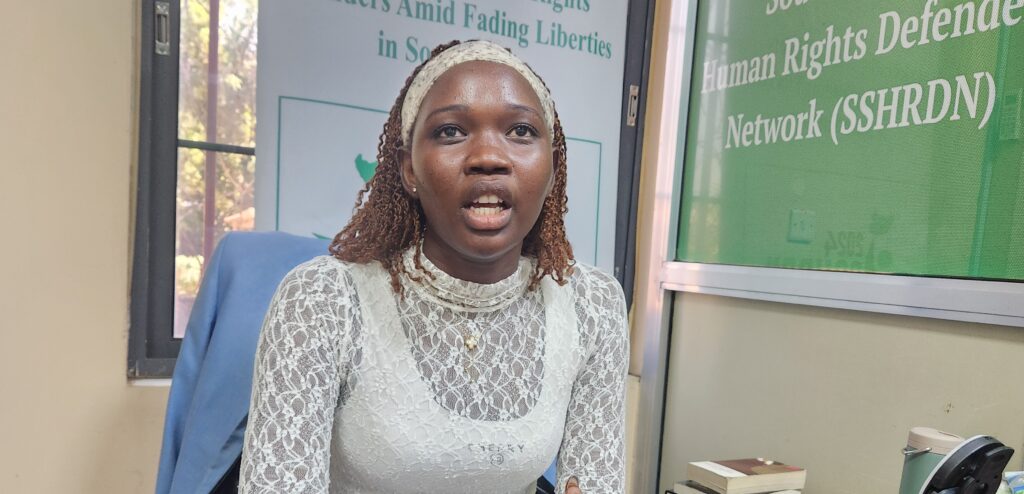
The South Sudan Human Rights Defenders Network (SSHRDN) has raised alarm over increasing online harassment and digital attacks against women and girls, calling for stronger legal protections and greater public awareness as the world marks the 2025 16 Days of Activism Against Gender-Based Violence.
Speaking at a press conference in Juba on Monday, the organisation’s administrative assistant, Adut Andrew, said digital platforms that should empower women are instead becoming spaces of abuse.
“Digital spaces which should serve as platforms for expression, learning and empowerment are increasingly being used to target women and girls through online harassment, cyber-bullying, misinformation, online stalking, hate speech and image-based abuse,” she said.
Adut warned that the impact of online violence is far-reaching in silencing women, limiting their participation in public life, and threatening their safety and dignity. She cited cases of psychological distress, family breakdown, and social stigma.
She said women human rights defenders, journalists, and ordinary internet users remain particularly vulnerable, and many do not report incidents for fear of retaliation or public judgment.
“We have so many women going through these threats, and most of them don’t speak up… Once you speak out, there is fear that someone will come after you or what the public will say,” she said. “We will engage the women human rights defenders (HRDs) in digital safety and protection workshops… We have been having these trainings, and we will continue during the 16 Days of Activism.”
According to Adut, SSHRDN is advocating for the passing of the Anti-GBV Bill and the Cybercrime and Computer Misuse Bill because both laws will help protect women.
“Most of these perpetrators are not brought to law… The Anti-GBV bill is not yet signed,” she said. “Once they sign that bill, there might be higher chances of reducing these violations. We have organisations that deal with direct protection. They can take them to the safe homes… they are the right people to protect such cases.”
For his part, SSHRDN National Coordinator James Bidal said the network is researching to determine the scale of online abuse, although the data is still being verified.
“Daily, one out of three women who experience cyberbullying is the one reporting, yet the rest go silent,” he said. “It is on the increase, and perpetrators can be anybody. The onset is from diaspora because the diaspora community has access to the internet, while people in the country have low penetration.”
Bidal said the organisation is preparing a submission to strengthen the Cybersecurity Bill, arguing that vague definitions in the current draft could be misused.
“We feel we will need to give some submission so that at least it aligns with the international standards,” he said.
Bidal added that their ongoing research also seeks to understand why women are disproportionately targeted.
“From the conversations that we had, it came from the women that they are being looked at as a weaker sex, which I disagree with,” he said, adding that the network is strengthening digital literacy and emotional support due to the trauma caused by online abuse.
Bidal cited recent cases where online users were tracked and arrested, including a female TikToker, stressing that while both genders are affected, women remain more vulnerable.
He urged lawmakers to ensure the cybercrime law does not become a tool to silence civil society and journalists.
“Giving a vague definition to cybercrime will tantamount to a rampant target of civil society, including journalists,” he stated. “We are reinforcing our state-level structure so that they will be able to engage in meaningful conversation and give us data for evidence-based advocacy.”

 and then