



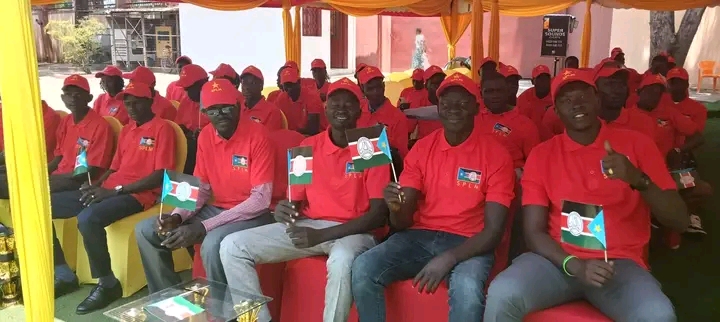
About 123 members of 10 other political parties, including the Lakes State minister of agriculture, environment and forestry, have resigned from their parties and joined the ruling Sudan People’s Liberation Movement (SPLM).
The members, who were part of the Other Political Parties (OPP) umbrella, announced their decision at the SPLM national secretariat in Juba on Friday. The OPP is one of the signatories to South Sudan’s 2018 peace agreement.
The state minister, who was also chairperson of the People’s Liberal Party and a member of the Lakes State Transitional Legislative Assembly, told Radio Tamazuj on Tuesday that the decision followed consultations and a review of their political positions.
“Our experiences, views and aspirations are aligned with the vision, mission, objectives and programmes of the SPLM, and that is why we have collectively decided to return to the SPLM,” he said.
The group included members of parliament, state ministers, members of the Revitalised Transitional National Legislative Assembly and other political party officials, he said.
“We are 123 who have joined the SPLM altogether,” he said.
The state minister said four OPP leaders in Lakes State had left the coalition and returned to the SPLM, adding that members from other political parties and states had also expressed interest in joining the ruling party.
He said his departure from the OPP would not automatically affect the government positions held by members of the group.
“Government positions belong to the government, not political parties,” he said, adding that he had relinquished his position as chairperson of the People’s Liberal Party.
The state minister said he would remain in his government position as long as he was allowed to do so.
“I have just come back to the SPLM regardless of the position I am holding. Anytime I am removed from the position, somebody will take over, whether from the SPLM or other political parties,” he said.
The defectors were received at SPLM House last Friday by senior ruling party officials, including Secretary-General Akol Paul Kordit.
South Sudan’s 2018 peace agreement, which ended a five-year civil war between forces loyal to President Salva Kiir and his then-rival Riek Machar, has faced repeated delays and disputes over its implementation.
Key provisions, including security arrangements and the expansion of political and civic space, remain contentious as the country prepares for elections scheduled for December 2026.

 and then