



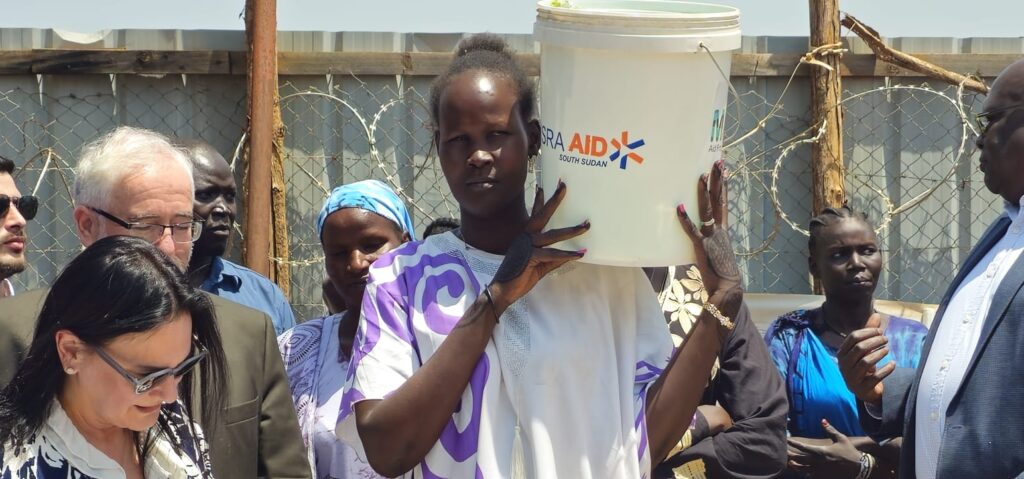
Humanitarian group IsraAID distributed emergency food and household supplies to 2,000 vulnerable families in a displacement camp in South Sudan’s capital, as Israel’s ambassador called for political stability to reduce reliance on aid.
The assistance was delivered to households in Juba’s IDP Camp III on Tuesday and targeted pregnant women, breastfeeding mothers and children under 5 identified as most at risk following recent cholera outbreaks and prolonged food shortages, organizers said.
Each family received maize flour, beans, sugar, salt and cooking oil. Non-food items included jerry cans, buckets, water treatment tablets and soap aimed at improving hygiene and reducing the risk of waterborne diseases.
Nyatiek Chuol, a resident of the camp, said the support was helpful but not enough.
“The non-food items given to me and other members are very helpful,” she said. “But they are not sufficient for everyone. We need more, especially because the rainy season is coming.”
She said IsraAID had previously provided plastic sheets, mats, jerry cans and lanterns to families in the camp.
“Some women here lost their husbands. It is very hard for a mother with children to support herself,” Chuol said.
She warned that food shortages were affecting children’s health.
“When there is no food in the house, children under five and pregnant mothers suffer. Starvation can result in sickness,” she said, urging expanded feeding programs and nutrition support.
Laya Lydia, IsraAID’s South Sudan program manager, described the effort as an integrated emergency response combining food aid with water, sanitation and hygiene support.
“We are reaching 2,000 households with children under five, pregnant and lactating mothers strained with malnutrition,” Lydia said. “Because of the recent cholera response, many communities have not been able to access food or essential non-food items.”
She acknowledged that emergency assistance has limits.
“Emergency programs are short-term. After the food is eaten, the situation may go back,” she said.
Israel’s ambassador to South Sudan, Gerson Kedar, said at the distribution ceremony that while his country was committed to supporting South Sudan, humanitarian aid could not replace political solutions.
“We were with you in your struggle, and since independence we have been with you to help in your development,” Kedar said.
He said that during his four years as ambassador, Israel had focused on capacity building and technical cooperation in sectors including education, agriculture, science and medicine.
Kedar said Israeli experts would conduct a two-day training on innovation and entrepreneurship at the STEM Center of the University of Juba later this week to promote self-reliance among young South Sudanese.
“The idea is to make people here self-reliant, productive and to promote the development of their country,” he said.
While welcoming the support coordinated by Israel’s Foreign Ministry and MASHAV, Israel’s international development agency, Kedar said he had “mixed feelings” about the event.
“Yes, it is our duty to assist people in dire need,” he said. “But continued long-term humanitarian aid anywhere in the world is a stain on humanity.”
He said that although climate shocks and an influx of refugees from neighboring Sudan have worsened displacement, much of the internal crisis is linked to political instability and violence.
“This is something which needs a local solution,” he said. “It is not something Israel can solve.”
Kedar urged South Sudan’s leaders to fully implement their political commitments and expressed hope that displacement camps would eventually close as stability improves.
“At the end of the day, I hope this IDP camp will not have to be here,” he said. “That everybody here will be able to go back to their communities, towns and villages and work together for the economic development of South Sudan.”

 and then