



The International Organization for Migration (IOM) revealed that it is working with the Central Equatoria State Government to launch a durable solutions roadmap to address the long-term needs of internally displaced persons (IDPs), returnees, refugees, and host communities.
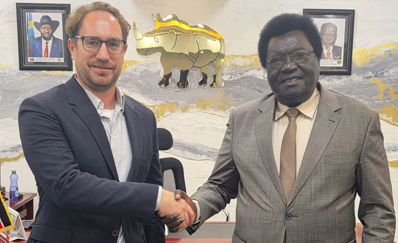
IOM South Sudan Deputy Chief of Mission Newson Michael made the remarks on Monday after meeting with Central Equatoria State Caretaker Governor Augustino Jadalla Kamilo Wani to discuss preparations for the anticipated launch of the roadmap in the coming weeks.
“So it is looking at a process of three to five years as a guiding tool to help develop durable solutions for communities, for Internally Displaced Persons (IDPs), and for returnees,” Michael said.
The IOM Durable Solutions Roadmap also refers to state- and area-based strategic plans developed in coordination with the national and local governments to help IDPs, returnees, refugees, and host communities transition away from crisis aid and toward long-term stability.
In addition, it also focuses on ensuring sustainable Returns & Integration withSupport, safe, voluntary, and dignified returns, local integration, or relocation using a community-driven approach, and basic services and livelihoodsby restoring access to housing, land, and property (HLP) rights, healthcare, education, water, sanitation, and job opportunities.
“So we are very grateful to be able to work so closely with the governor and with the government here to support this initiative and do the launch, which we are hoping will take place in the next few weeks,” Michael said.
The roadmap is intended to guide efforts to address the challenges facing displaced populations and support their transition towards more stable and sustainable living conditions.
Durable solutions generally involve helping displaced people return voluntarily to their places of origin, integrate into their current locations or settle elsewhere, while ensuring their safety, access to basic services and opportunities to rebuild their lives.
The initiative is expected to provide a framework for coordinating efforts by the state government, humanitarian organizations and development partners in responding to displacement-related challenges.
Central Equatoria State, which includes the national capital, Juba, hosts displaced people, returnees and refugees whose needs include shelter, livelihoods, access to essential services and peaceful coexistence with host communities.
The anticipated launch of the roadmap is expected to mark a step towards strengthening the state’s long-term planning and coordination for displacement solutions.
However, details of the roadmap’s specific activities, funding arrangements, and implementation priorities were not provided in Michael’s remarks.
The planned three-to-five-year process is expected to serve as a guiding framework for developing durable solutions tailored to the needs of affected communities across Central Equatoria State.

 and then