



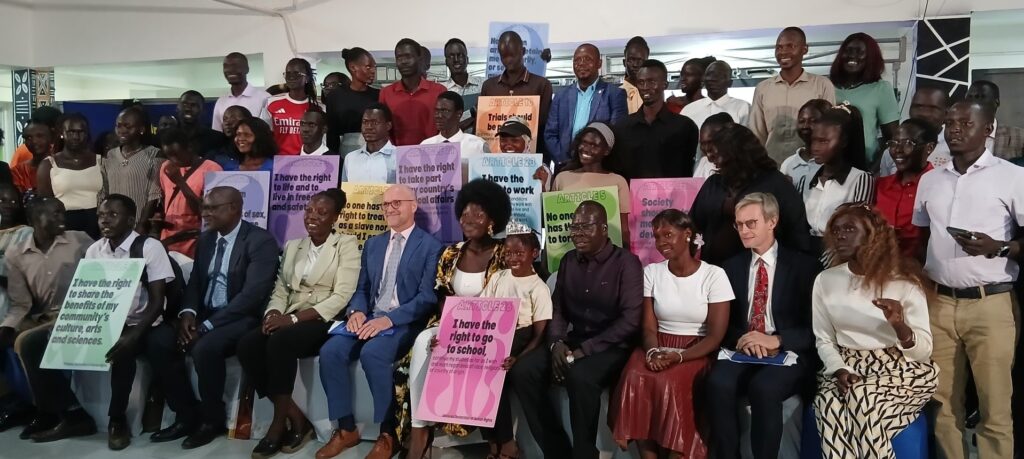
Diplomats, journalists, government officials and civil society leaders gathered at the University of Juba, South Sudan, on Wednesday for a discussion on the state of human rights, marking International Human Rights Day under the theme “The Universality and Indivisibility of Human Rights.”
The event in Juba was organised by the European Union (EU).
A ‘brutal world’ and an ‘urgent compass’
In his address, the EU Ambassador-Designate to South Sudan, Pelle Enarsson, warned of global regression while praising South Sudan’s recent human rights commitments.
“We can never hold enough events to underscore the fundamental message of human rights,” Enarsson said. “It is the promise made to all humanity 77 years ago.”
He quoted Article 1 of the Universal Declaration of Human Rights: “All human beings are born free and equal in dignity and rights.” He described the commitment not as “a relic of the past” but “an urgent compass for our contested and often brutal world — a world where we see alarming backsliding.”
The envoy outlined the core principles of the modern human rights system: indivisibility — meaning political rights cannot be fully realised without economic and social rights — and universality, meaning these rights “apply to everyone, everywhere, at all times.”
He noted that these principles were codified in the legally binding 1966 International Covenants on Civil and Political Rights and on Economic, Social and Cultural Rights.
“I am proud to note that South Sudan joined 173 other nations in ratifying these core covenants last year,” he said.
Enarsson linked the discussion to current global conflicts. “The proliferation of conflict — from Russia’s war of aggression against Ukraine, to the civil war in Sudan, to the conflicts in the Middle East — has appalling consequences for civilians,” he said.
He added: “Let me be clear: conflicts do not waive human rights. Even wars have rules.”
The ambassador also praised South Sudanese environmental activists and human rights award winners, saying “the defence of human dignity takes many forms.” He said the EU remained “steadfast” in its support for human rights defenders, civil society and journalists calling for “peace, truth, justice and accountability.”
Warning on ‘negative criticism’
In a contrasting tone, South Sudan’s Minister of Information, Communication Technology and Postal Services, Ateny Wek Ateny, addressed journalists in the audience, urging them to distinguish between professional criticism and personal attack.
“If you criticise me, criticise me,” he said. “Get the information about what I do… Say the minister is wrong and enumerate it. I will benefit from that. But negative criticism takes you completely out of power. You will be insulted.”
Ateny, who is also the government spokesperson, stressed that journalism and activism were different. “Please differentiate between activism and professional journalism. They are not the same,” he said, emphasising the need for verification and balance.
He added a legal caution: “If you put information in the media that you have not verified from the other stakeholders involved, you break the law.”
While reaffirming his commitment to protect journalists and uphold human rights, the minister said one South Sudanese journalist, Michael Christopher, remains in detention. “I am working to secure his release,” he said.
Commitment to human rights
Minister Ateny said the government remains committed to strengthening human rights and protecting journalists as the country prepares for elections.
Ateny said the government views the promotion of human rights as “an essential pillar of peacebuilding, democratic transformation and state-building.” He said South Sudan is taking steps to advance legal, institutional and political reforms aimed at consolidating peace and safeguarding the rights of citizens.
“Human rights are inseparable from peace and national stability,” he said. “The reforms underway, including legal frameworks and preparations for elections, aim to ensure the rule of law, justice and inclusive governance.”
Ateny acknowledged support from development partners, including the European Union, saying their assistance contributes to institutional strengthening, civic engagement and capacity building.
As minister responsible for information and communication technology, Ateny said access to information, digital inclusion and responsible online communication were central to protecting rights.
“Human rights also include the right to information, freedom of expression and digital participation,” he said.
Laws exist, implementation lags
The President of the Union of Journalists of South Sudan (UJOSS), Oyet Patrick Charles, reminded the gathering that South Sudan’s independence struggle was rooted in the fight for human rights.
He acknowledged legal reforms that established regulatory bodies but said a key challenge remains: “Having good laws that are not implemented does not help us promote human rights.”
Oyet called on the government, as the primary duty-bearer, to ensure detained journalists are promptly taken to court and to improve human rights training for security forces. Referring to the detention of Michael Christopher, he urged resilience.
“Change will not come like switching a light on and off,” he said. “But slowly we will get to a place where our rights are respected.”
During a panel discussion, Oyet emphasized that promoting and protecting human rights is a shared responsibility. He encouraged media stakeholders to keep advocating for journalists’ rights and safety nationwide.
He said the police and other security organs have a duty to ensure due process, including bringing any arrested person before a court as required by law.
South Sudan, which gained independence in 2011 after decades of conflict, continues to face persistent human rights challenges driven by prolonged civil war, governance issues, political instability and severe underdevelopment.

 and then