



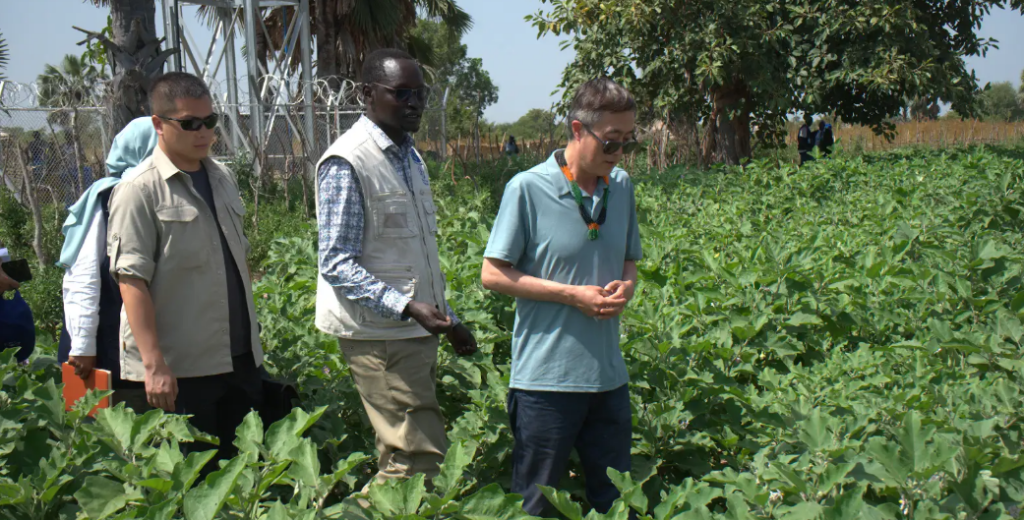
Rice farmers in Northern Bahr el Ghazal state are seeking better equipment and farming technology to increase production, as the World Food Programme (WFP) explores potential cooperation with China to expand cultivation on flood-prone land.
Santino Akech, a 45-year-old farmer in Aweil, said his community had turned to rice after repeated floods damaged sorghum crops grown in low-lying areas.
“When flood came, it affected some farm in the lowland area. It affected sorghum, but the rice succeeded,” Akech said.
Farmers harvested 42 bags of rice, each weighing 90 kilogrammes, from four feddans last year, he said. He still had 13 bags in storage at the time of the interview.
Income from rice had helped farmers pay school fees and medical expenses, while working in groups enabled them to expand cultivation and save through village savings and loan associations, he said.
But farmers need equipment, including ox-ploughs, to prepare land on time and increase production.
“We are not demanding tractor,” Akech said, explaining that government tractors were not always available when needed. Some farmers already owned bulls and could contribute towards the cost of ox-ploughs, he added.
Expanding Cultivation
Haileselassie Berhanu, head of the WFP Aweil Field Office programme, said the agency was working with communities to cultivate flood-prone land with rice rather than lose crops to excess water.
Repeated flooding had damaged sorghum, a major crop in the area, prompting WFP and farmers to begin experimenting with rice before gradually expanding cultivation, he said.
More than 2,100 farmers or households were involved in rice cultivation this year, with about 1,000 hectares planted under the wider initiative, Berhanu said.
The programme needs machinery, improved seeds, training and equipment for harvesting, drying, threshing and polishing rice. Technical expertise on rice varieties is also important, he said, pointing to possible cooperation with China.
Chinese Ambassador to South Sudan Ma Qiang, who visited agricultural activities in Aweil, said the area had favourable conditions for rice production and that the initiative could help improve local food supplies.
China had previously donated agricultural machinery to local communities, and further cooperation on farming technology was possible, he said.
“There are great potentials,” Ma said, adding that cooperation with national and local authorities and international partners could increase food production.
He also warned that natural resources, including water, required proper management, highlighting the need to address flooding.
Food Security
WFP Country Representative Muntina Chimuka said rice cultivation could improve food security by enabling communities to grow their own crops and diversify food sources.
The crop at the site visited appeared promising despite dry conditions affecting other agricultural areas, she said. But expansion would depend on funding and stronger cooperation with the government.
WFP relies on voluntary contributions to finance its operations, Chimuka said, adding that climate change and unpredictable weather were making farming increasingly difficult. She urged state and national authorities to work with communities to identify suitable growing areas and rice varieties.
Deng Deng Bol, caretaker minister of agriculture, environment and forestry in Northern Bahr el Ghazal state, said farmers needed equipment, training and storage facilities to increase production and preserve their harvests.
The state had fertile land suitable for agriculture, but changing weather patterns remained a challenge, he said. Flooding damaged crops last year, while drought had affected rice, sorghum and other crops this year.
For farmers such as Akech, access to equipment is essential to expand cultivation and harvest crops on time. Rice has shown promise in low-lying areas repeatedly affected by floods, but scaling up production will require improved technology, training, funding and better water management.

 and then