



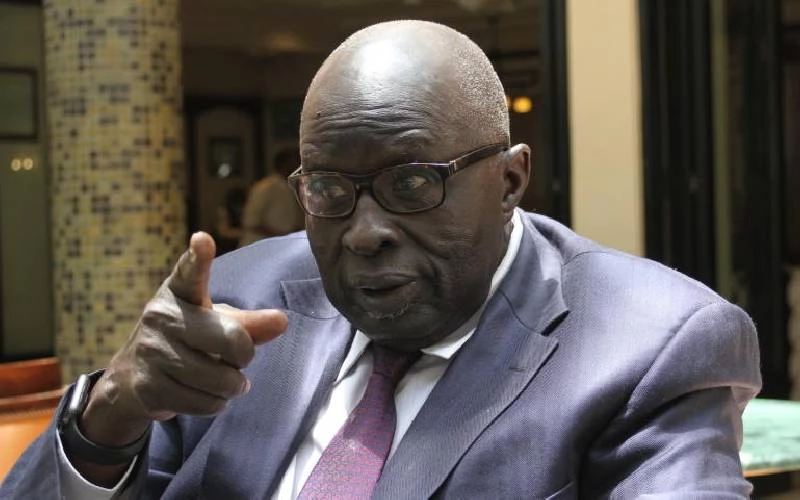
Veteran South Sudanese politician Dr. Aldo Ajou Deng said that President Salva Kiir would win the country’s Dec. 22 election by a landslide, arguing that no political figure had yet emerged as a credible successor to the president.
Riek Machar, Kiir’s longtime political rival and a potential election challenger, is currently detained and on trial in Juba on treason and other charges, which he denies.
Aldo, an influential member of the Jieng Council of Elders and a former lawmaker, said any eventual successor to Kiir would likely come from a younger generation of politicians.
Speaking to Radio Tamazuj in Juba, Aldo said he supports holding elections to end what he described as South Sudan’s prolonged political transition.
“This transitional government has been running from 2005 to the present day,” he said. “For over twenty years, we have lived in a continuous and unstable state of transition.”
South Sudan gained independence from Sudan in 2011 after decades of armed struggle. A civil war that erupted in 2013 ended with a 2018 peace agreement that established a transitional government, whose mandate has since been extended several times.
Kiir dissolved the transitional government on Sept. 22 and appointed a caretaker administration ahead of the election. Under amendments to the electoral law, he will remain president during the electoral period until an elected president is sworn in.
Aldo attributed much of South Sudan’s instability to what he described as poor political leadership and the use of armed conflict to resolve political disputes.
“The root cause of this war lies in a failure of leadership, specifically with the leaders who divided the party and the movement to pursue armed conflict,” he said.
He said years of conflict had damaged the economy and state institutions by diverting public resources towards military spending.
“Nothing can thrive in a wartime environment because public funds are diverted toward military expenditures,” Aldo said. “War is exceptionally costly, yet many fail to grasp just how expensive it is to incite violence.”
He also accused politicians of exploiting ethnic identities to mobilise support during periods of conflict, saying this had deepened tribal divisions.
“This ongoing violence has produced instability and stoked tribalism,” he said. “Politicians who waged war manipulated tribal identities for recruitment, entangling national politics with tribal conflict.”
South Sudan opposition
Aldo rejected the idea that foreign governments could determine who should lead South Sudan, saying political authority should come through elections.
“Some opposition groups believe foreign powers can intervene, save them, and place them in power,” he said. “They fail to understand that leadership is granted by the electorate, not imposed by foreign nations.”
He criticised the country’s opposition parties, saying none of the current political groups had the strength to mount a serious challenge to Kiir.
“Every small faction creates a party simply to gain a foothold in government,” he said. “Although there are now many registered parties, none possesses the capacity to challenge Salva Kiir.”
Aldo said political parties should put national interests ahead of factional considerations.
“In every sovereign nation, nationalism must serve as the overriding ideology,” he said. “Opposition factions should support the nation first, structuring their political platforms to compete fairly for public leadership.”
He defended Kiir against criticism of his record in government, saying the president had shown what he described as restraint in dealing with political opponents.
“President Kiir has shown immense tolerance: accommodating them, bringing them into Parliament, appeasing them, and providing resources for them to build homes,” Aldo said.
Aldo also referred to allegations over the disappearance of billions of dollars in public funds, saying Kiir had demanded accountability.
“He demanded accountability, insisting those funds be returned,” Aldo said.
He said the transitional system had failed because political actors had treated it primarily as a means of securing government positions and parliamentary seats.
“The transitional model has failed because political actors view it merely as a vehicle to secure government appointments and parliamentary seats,” he said. “It has become drawn-out and ineffective.”
December elections
Aldo said elections are necessary to give South Sudanese citizens the opportunity to choose their leaders and establish a more stable government.
“The electorate must be granted the right to choose,” he said. “A stable government can resolve national problems, whereas a government that changes continuously cannot. That is why elections are essential.”
The National Elections Commission has set Dec. 22 as the date for presidential and legislative elections. The vote would be the country’s first national election since independence, although preparations have been accompanied by political and security concerns.
Aldo said he expects Kiir to win by a large margin because, in his view, no current political figure poses a serious challenge to the president.
He said the country’s next generation of politicians would eventually have to take over its leadership.
“The successor will come from the next generation,” Aldo said, without naming a potential successor.
Kiir’s legacy
Aldo rejected accusations that Kiir’s leadership is driven by ethnic loyalty, saying the president had worked to promote inclusivity and peace with his opponents. He said talks with the opposition would resume after the elections.
“President Kiir Mayardit is not a Dinka leader, nor has he ever viewed himself as one,” he said.
He said Kiir had spent much of his life in the liberation struggle and deserved to remain in office to consolidate what he described as his political legacy.
“He joined the fight as a young man, fought in two liberation wars with the SPLA, and has never betrayed his country,” Aldo said.
Aldo credited Kiir with helping steer South Sudan through the 2011 referendum on independence following the death of the country’s founding Sudan People’s Liberation Movement leader, John Garang.
“A leader who has dedicated his life to this fight deserves to be elected to complete and sustain his legacy,” he said.
Aldo also criticised opposition leaders, arguing that some had contributed to renewed conflict rather than using political institutions to resolve disputes.
He cited Oyet Nathaniel Pierino, a senior SPLM-IO figure, as an example, saying political disputes over parliament should not be used to justify armed conflict.
“Citizens are taking up arms over legislative disagreements without the capacity to sustain a conflict,” Aldo said. “While Parliament is accountable to political parties, its ultimate duty is to the people.”
Aldo said South Sudan’s political future should ultimately be determined by its citizens through elections rather than by armed groups or foreign governments.
“The current political chaos is not Salva Kiir’s creation; it is the creation of his opponents,” he said. “That is a primary reason I support him.”
He also questioned what would happen to veterans of the independence struggle if the current leadership is replaced.
“What happens to the veterans who fought for this nation?” Aldo said. “What becomes of the foundation built through decades of struggle to secure independence from northern rule?”

 and then