



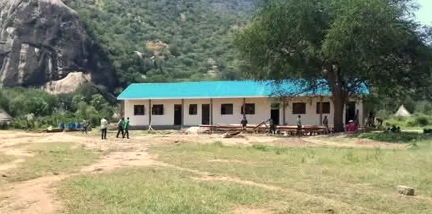
The United Nations Mission in South Sudan (UNMISS) on Tuesday officially handed over a newly constructed three-classroom building and office to the Loming Community of Eastern Equatoria State’s Imehejek Administrative Area.
The structure was constructed under UNMISS’ Quick Impact Projects (QIPs), which focus on implementing rapid, small-scale improvements in communities, such as building schools, clinics, police posts, and women’s centers. Each project in Eastern Equatoria State is designed to cost under USD 50,000 and aims to foster peace, enhance security, and improve living conditions in various counties. The project also aims to empower local authorities and reinforce the rule of law through essential infrastructure and capacity building.
Community members were excited as they welcomed the development, saying it would improve learning because children used to learn under trees.
Okello James, a representative from Child Mentor Africa (CMA), the organization that implemented the project, thanked the local leaders for cooperating and seeing the project through to completion.
He highlighted the key features of the new infrastructure, which include a classroom block and an office for the headmaster and a staff room for teachers, complete with essential furniture such as desks, tables, and chairs, all generously donated by UNMISS.
“The roots of education are very bitter, but the fruits are very sweet. Today, many dignitaries, including doctors and honorable members, are testaments to the power of education,” Okello said. “Let us send our children to school.”
For his part, Ayiru Jildo, the chief of the Loming Boma, expressed gratitude to the community for their contributions in kind, such as stones, sand, and other resources to support the school’s construction.
“This achievement was a community effort, not a government initiative,” he said. “The community should support the school by contributing in any way possible to ensure its sustainability.”
Additionally, he raised concerns regarding the water situation, urging the community to repair the boreholes ahead of the school’s opening in February. He also advocated for the installation of solar-powered water systems to meet the needs of the children and community.
Meanwhile, Ambrose Oyet Albino, a representative from the state ministry of education, celebrated not only the completion of the school but also the collaboration between UNMISS and the Loming Community. He urged the community to safeguard the school and ensure that animals do not intrude and that children actively engage in their studies.
Lino Attari Albano, the chief administrator of the Imehejek Administrative Area, appealed to the community to protect the school from any external disturbances and to commit to cultivating their land to sustain the local populace.
“From today, I officially hand over this school to the community,” he stated.
He also proposed measures for accountability and suggested that parents of pupils who miss school be fined. He also highlighted the necessity for families to contribute towards school fees to ensure the proper functioning and prosperity of the school.

 and then