



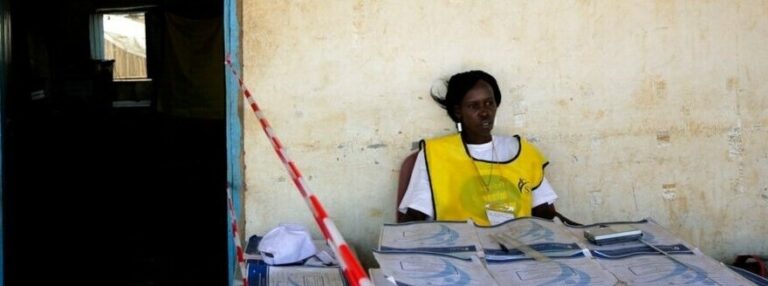
A surge of violence and critical unmet benchmarks from the fragile 2018 peace agreement are threatening plans to hold South Sudan’s first presidential election in December, analysts and civil society leaders warn, raising the prospect of more instability in the world’s youngest nation.
Fighting has intensified in recent weeks between the SSPDF and the SPLA-IO in Jonglei and Unity states.
Ter Manyang, executive director of the Center for Peace and Advocacy, told Radio Tamazuj on Wednesday that the fighting stems from deep public and political frustration over the unimplemented 2018 peace accord that ended a five-year civil war.
“This fighting did not come out of nowhere. It is a result of disappointment,” Manyang said. He cited the lack of progress on key provisions, including unifying security forces and enacting institutional reforms.
The unresolved security situation, he argued, makes a credible electoral process nearly impossible. “You cannot talk about elections when there is fighting across the country and when the main peace agreement itself is not implemented,” Manyang said.
He and other analysts point to a series of major obstacles: a permanent constitution has not been drafted, a nationwide population census has not been conducted, and electoral institutions require reform.
Manyang said the National Elections Commission (NEC) itself is divided over whether conditions are suitable for voting in December this year.
The logistical and financial challenges are equally daunting. Millions of South Sudanese remain displaced internally or as refugees in neighboring countries, some recently uprooted by conflict within South Sudan and the war in Sudan. Voter education is absent in much of the country.
“People in many parts of the country are not even aware of what elections mean, yet leaders keep talking about going to the polls this year,” Manyang said.
He also highlighted a severe economic crisis, with civil servants unpaid and a cash shortage affecting all sectors. “Elections require huge financial and human resources. Right now, there is no money in the country,” he said.
Policy analyst Boboya James Edimond, echoing these concerns, warned that the escalating fighting between the main warring parties to the peace agreement poses a direct threat to any electoral process.
He said insecurity in Jonglei and Unity states has worsened due to weak local authority and the failed security arrangements of the peace deal.
“The violence we are witnessing is not accidental,” James said. “It reflects unfinished peace and fear of losing power within the transitional process.”
He said political competition is turning violent while local grievances fester, fueling displacement that will complicate voter registration. “Insecurity will continue to affect voters, candidates and electoral officials because they cannot operate safely,” James added.
Both analysts stressed that elections this year amid expanding violence are unrealistic. They called for an urgent ceasefire, the protection of civilians, and the accelerated unification of armed forces as immediate priorities.
“Without stopping the fighting first, no political process can work in South Sudan,” James said.
They also urged an inclusive national dialogue involving all political actors, civil society and community leaders.
Manyang warned that without a dramatic shift in political will, general elections planned for December 2026 are unlikely to be held or seen as legitimate.
“If elections are held without all stakeholders on board, they will not be credible, and the outcome will not be accepted,” he said. “I don’t think elections will happen unless a miracle occurs.”
Last month, the presidency and cabinet approved amendments to key provisions of the 2018 peace agreement, delinking the December 2026 general elections from the permanent constitution-making process, a political census and other institutional reforms.
The amendments also included the removal of provisions stating that the 2018 peace agreement takes precedence over the constitution.
The 2018 peace deal, signed by President Kiir, detained First Vice President Riek Machar and other political leaders, has faced repeated delays, including missed election timelines. Elections have been postponed several times and are now scheduled for December 2026, despite objections from Machar loyalists who say the presidency-led consultations excluded them.

 and then