



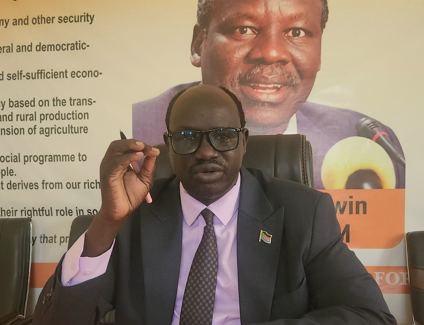
Bol Joseph Agau, Secretary General of the National Democratic Movement (NDM), said the inter-party dialogue has stalled, failed to make its resolutions public, and that any resolutions remain known only to a few people. He contends that an inclusive dialogue should include all political parties in decisions on amendments to the agreement.
Radio Tamazuj caught up with him and sounded him out in an exclusive interview during which he said that South Sudan is not ready for elections under the current circumstances. He added that political leaders should avoid actions that aggravate existing conflicts and instead work together to promote peace, reconciliation and political understanding.
Agau speaks about his party’s absence from the ongoing inter-party dialogue on elections, its concerns about the December 2026 polls, a dispute over its registered leadership, and what is needed to ensure a credible electoral process.
Below are edited excerpts:
Q: Why is NDM not participating in the inter-party dialogue on elections?
A: Thank you for giving me this opportunity to explain NDM’s position so that the public can get the correct information about what the party is doing and why it is not participating in the inter-party dialogue. NDM is a member of the South Sudan Opposition Alliance (SSOA). The alliance issued a press statement rejecting the inter-party dialogue because it was not the inclusive dialogue we had agreed to pursue.
Since the peace agreement was extended for another two years, NDM and SSOA have maintained that there should be an inclusive dialogue in which all political parties participate in decisions regarding amendments to the agreement.
However, the current inter-party dialogue has stalled. Up to now, no resolutions have been made public, and if there are any, they remain known only to a few people.
The dialogue has put the cart before the horse. It should have taken place before the dissolution of the transitional government and the changes to the legal framework. On September 21, 2026, the SPLM used its parliamentary majority to amend laws in a manner that, in our view, was neither procedural nor based on consensus. Other political parties were not given an opportunity to express their views meaningfully.
NDM cannot participate in a dialogue whose resolutions we believe have already been predetermined. Furthermore, those participating appear to be discussing power-sharing rather than how elections will be conducted. If the discussion is based on the peace agreement, that agreement has already been amended in parliament by the SPLM. If it is about a new agreement, we have not seen any negotiations or a mediator.
This is why NDM decided not to participate.
Q: Were you invited?
A: Yes, NDM was invited. However, the letter reached our chairman, Dr. Lam Akol Ajawin, late in the evening on September 23, just hours before the dialogue was scheduled to begin on September 24.
On that same day, we discovered that the Political Parties Council (PPC) had changed NDM’s registered leadership details on its website, replacing our chairman with a person we did not recognize as the party’s leader and replacing me as the second contact person.
This raised questions about the status of our chairman at the dialogue. He had been invited as the leader of a political party, yet the institution responsible for registering political parties had allegedly altered the party’s official records.
We considered this a serious contradiction and one of the reasons we could not participate.
Q: Do you believe the ongoing inter-party dialogue can produce meaningful agreements on elections if some political parties, including NDM, are not participating?
A: No! We do not believe the current inter-party dialogue can produce meaningful resolutions that will lead the country towards peaceful elections.
We believe the SPLM’s enthusiasm for elections is not genuine and that the government is using the electoral process to advance its own political agenda. The constitutional and legal changes made in parliament have raised serious concerns about the legitimacy of the process.
For elections to take place peacefully, political party leaders must work together. They should be able to coordinate campaigns and visit communities together. Leaders from the SPLM, SPLM-IO, SSOA, the Other Political Parties group and the Former Detainees should be able to travel together, engage citizens and seek their votes.
Such joint activities would demonstrate unity and help reassure communities that their leaders can work together despite their political differences.
However, the SPLM appears to be acting unilaterally, without recognizing that South Sudan belongs to all its people and not to one political party. The current dialogue will not produce the desired results unless the SPLM changes its approach and allows other political parties the political space they need to campaign.
We are also concerned about the limited time remaining before the December 22 elections. We have only a short period left, yet the country has unresolved problems that have accumulated over many years.
Peace and reconciliation have not received sufficient attention. Communities continue to experience communal violence, cattle raiding, abductions, and other insecurity.
There are also reports of soldiers selling guns to civilians because they are not being paid and need money to meet their families’ basic needs, including food, medical care, and education.
These realities must be addressed if the country is to hold peaceful and credible elections.
Q: With elections scheduled for December 22, 2026, does NDM believe South Sudan is ready to hold credible, free and fair elections? What are the main obstacles?
A: We do not believe the country is ready for credible elections under the current circumstances. There are immediate steps that need to be taken.
First, political and civic space must be widened. All political parties intending to participate in the elections should be given airtime on the South Sudan Broadcasting Corporation (SSBC), just as political parties were given opportunities to use the media during the 2010 elections in Sudan.
Political parties should be able to present their programmes, hold rallies and conferences, and communicate with citizens through television and other media platforms. The public needs to see that the political space is not reserved for the SPLM alone.
Civic education is also necessary so that citizens understand their rights and know how to participate in elections.
Second, political parties should be allowed to conduct joint campaigns and visit states to engage communities, discuss elections, and promote reconciliation.
Our communities have experienced years of communal fighting, cattle raiding, abductions, and other forms of violence. These problems are not confined to one region. They affect communities across the country.
Political leaders should use electoral campaigns as an opportunity to bring communities together and encourage peaceful coexistence.
Third, there must be an electoral code of conduct. As we speak, we have not seen a clear process for adopting such a document. An electoral code of conduct should be transparent and known to all political parties participating in the elections.
We are also concerned about the removal of the chairperson of the electoral commission when fewer than 100 days remained before the scheduled elections. Such a development raises questions about the preparations and the possibility of holding elections as planned.
Fourth, the institutions responsible for conducting elections must be adequately funded. The electoral commission has repeatedly raised concerns about funding, and we are worried that the country has not made sufficient preparations, including the provision of ballot papers.
Civic education takes time, particularly in helping voters understand how to mark their ballot papers correctly. These preparations cannot be completed properly without adequate resources and time.
Another concern is the National Security Service Bill, particularly Section 57, which we believe poses a threat to politicians because of its provisions concerning arrests without warrants.
Political candidates must be able to campaign without fear of intimidation or arbitrary arrest. We also need an independent and credible judiciary capable of resolving electoral disputes.
These are some of the immediate steps that must be taken if South Sudan is to conduct credible elections.
The main obstacles remain inadequate funding, limited political space, insecurity, insufficient preparations, and the short time available before the scheduled election date.
Q: What specific conditions must the government meet for NDM to participate in the December elections? Would your party take part if these concerns remain unresolved?
A: NDM has consistently called for an inclusive political dialogue. If there is anyone in the government who is genuinely patriotic, the best course of action would be to set aside the current approach and use the available resources to convene an inclusive dialogue.
The African Union’s declaration of September 29, 2026, should be implemented, with support from IGAD, to facilitate an inclusive process.
The dialogue should bring together political parties and groups that are currently outside the process so that they can agree on a new political direction for the country.
We need a political settlement that all parties can support and a renewed commitment to implementing agreements in both letter and spirit. No political party can solve all the country’s problems alone. The SPLM cannot continue making decisions unilaterally while the people of South Sudan face serious challenges in service delivery.
If you visit government health centers in many counties, you will find shortages of basic medicines. Many essential services depend on humanitarian organisations, while the population remains vulnerable.
South Sudan needs a political dispensation that prioritizes the welfare of its people and addresses the country’s challenges through collective leadership.
If these concerns remain unresolved, NDM will not participate in what we consider sham elections. We will not allow our participation to be used to validate or legitimise a process that we believe lacks the necessary political and institutional foundations.
Q: NDM has called for inclusive political dialogue to address outstanding issues in the peace agreement. What alternative does your party propose if the current electoral preparations remain contested?
A: I have already explained that we want an inclusive dialogue to address the outstanding issues in the peace agreement and establish a new political understanding.
If credible elections cannot be conducted by December 22, the country will face a serious political and constitutional challenge as the transitional period approaches its scheduled end.
The peace agreement provides for the transitional period to end on February 22, 2027. If elections are not held and there is no legitimate arrangement to guide the country beyond the scheduled election date, the government will face further questions about its legitimacy.
We want the government to proceed with the electoral preparations it has announced while the public observes whether the necessary conditions are being met.
I have taken it upon myself to update the people of South Sudan through my Facebook page about the number of days remaining before the scheduled elections.
We also want to clarify that the registration of political party members is not the same as official voter registration conducted by the National Elections Commission.
The priority should be to resolve the outstanding political disagreements, establish an inclusive process, and create the conditions necessary for credible elections.
Q: Your party has accused the Political Parties Council of changing its registered leadership details. What exactly happened, and how could this dispute affect NDM’s participation in the elections?
A: NDM was registered on June 29, 2026, and its registration was publicly announced on June 30 by the chairman of the Political Parties Council, Engineer James Akol.
The announcement identified Dr. Lam Akol Ajawin as the party’s chairman and me, Bol Joseph Agau, as the second contact person.
On September 22, 2026, we discovered that changes had been made to the records of registered political parties on the PPC website. According to our information, the changes followed instructions allegedly given to the PPC chairman by Hussein Abdelbagi, who was then serving as vice-president representing SSOA.
The PPC chairman subsequently issued Order No. 5 of September 22, directing the information technology department to change the records on the website.
Three political parties were affected by these changes, according to our account: NDM, the South Sudan National Movement for Change (SSNMC) and the Federal Democratic Party (FDP).
In NDM’s case, Dr Lam Akol Ajawin was removed as chairman and replaced by a person identified as Majook. My name was also removed as secretary general and second contact person and replaced by Peter Lomude.
We believe these changes were made without following the procedures provided for under Section 21 of the Political Parties Council Act of 2012, as amended in 2022.
Our understanding is that changes to a registered party’s leadership should be initiated by the party and processed through the relevant institutional procedures. The council should consider and approve the changes before the information technology department updates the official records.
We maintain that this procedure was not followed.
On September 24, representatives of the three affected parties visited the PPC to raise their concerns. During that meeting, the council’s deputy chairperson, Dr Lona, reportedly told us that the changes had not been sanctioned by the council as an institution because it had not met to approve them.
We consider the matter serious and are pursuing legal avenues to resolve it. We believe public institutions must protect the integrity of their records and ensure that political parties are treated according to the law.
The dispute could directly affect NDM’s participation in the elections because political parties provide the platforms through which candidates contest.
I intend to represent the people of Urol West, but I need the support of my party and its membership. Political support does not come only from an individual’s personality or personal relationships; it also comes from the organisation to which that person belongs.
If the party’s official leadership and status remain disputed, our candidates and members could face difficulties participating in the electoral process.
We believe the matter must be resolved lawfully so that our party can operate and participate in the political process without interference.
Q: How is NDM engaging with other opposition parties on the elections, and could the party’s absence from the current dialogue weaken the opposition’s ability to influence the electoral process?
A: NDM is a member of the South Sudan Opposition Alliance, which has rejected the current inter-party dialogue because we believe it does not meet the requirements of an inclusive process.
We believe the dialogue was introduced in a way that undermines efforts to establish a broader political dialogue. Our concern is that its outcomes could be presented to the international community, the African Union and IGAD as agreements reached by political parties, even though some stakeholders remain outside the process.
We believe the current process has been designed to favour the SPLM rather than to create a genuinely inclusive political settlement.
For this reason, we maintain that all political parties and relevant stakeholders should be involved in discussions on elections and the country’s political future.
Our position is that political disagreements should be addressed through dialogue, and we continue to call on political actors and our supporters to remain peaceful and avoid violence.
Q: What immediate steps should the government, opposition parties and international partners take to resolve the current political disagreements and ensure a peaceful and credible electoral process?
A: The African Union has already issued a declaration containing 15 points that we believe could help South Sudan move towards credible, free and fair elections.
The government should implement the declaration and work with the African Union, IGAD, opposition parties and other relevant stakeholders to establish an inclusive political dialogue.
South Sudan is not ready for elections under the current circumstances. Political leaders should avoid actions that aggravate existing conflicts and instead work together to promote peace, reconciliation and political understanding.
We are concerned that political decisions are sometimes being taken in ways that worsen tensions in communities where conflicts could otherwise be addressed through dialogue.
The government and opposition parties should work together to resolve outstanding issues in the peace agreement and establish the political conditions necessary for credible elections.
My message to the people of South Sudan is to remain hopeful. Whatever difficulties the country is experiencing today will not last forever. Political leaders and governments are temporary, but the country belongs to its people.
I believe that one day South Sudan will have leadership that prioritizes the welfare of its citizens, promotes food production, addresses insecurity, and ensures that people can access basic services.
To NDM members across the ten states and three administrative areas, I urge you not to lose hope because of the dispute over the party’s registration records.
We are pursuing legal avenues to resolve the matter and restore the party’s official status. We believe the work our members have done to establish the party should not be wasted because of changes to its records.
I call on all our supporters to remain peaceful, maintain discipline, and pursue their political objectives through lawful means.
We remain hopeful that the matter will be resolved and that South Sudan will move towards a more inclusive and peaceful political future.
 and then