



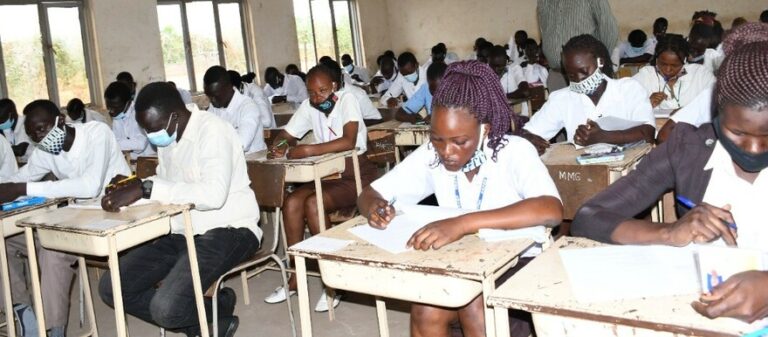
At the end of every year, as final national examinations approach, both at primary and secondary levels, South Sudan enters a predictable and troubling cycle: heightened tension, widespread rumors of leaked papers, public accusations, and confused finger-pointing.
Almost immediately, the blame is thrown at the Ministry of General Education. Government officials are condemned, exam administrators are criticized, and social media erupts with demands for accountability.
But the question that South Sudan rarely confronts is: Is the government truly the architect of this crisis?
A deeper reflection reveals a far more uncomfortable truth: Exam malpractice is not simply a government failure—it is a societal failure. It is a crisis rooted in our homes, fueled in our communities, and quietly encouraged in our schools, long before any government officer enters the picture.
The truth is painful but undeniable. Parents, teachers, school administrators, and community leaders have become active contributors to the erosion of examination integrity. Until South Sudanese society confronts its own moral decay, no reform, law, or policy from Juba will save the future of our children.
Education should be the ladder that lifts children out of poverty and equips them to compete in an increasingly demanding world. It should reward patience, sacrifice, discipline, and genuine effort. Yet today, across South Sudan, this ladder is being dismantled—not by policymakers in Juba, but by the very communities entrusted with safeguarding their children’s future.
Instead of nurturing honesty, academic discipline, and a strong work ethic, many families and schools have embraced a dangerous culture of shortcuts. The values that once shaped education, integrity, merit, and hard work are slowly being replaced by quick fixes and illegal backdoors.
What do we see happening?
- Parents pay for leaked exam papers, believing that buying results is a form of support or a guarantee of success.
- Teachers accepting money to ‘assist’ candidates, even when doing so betrays the profession they vowed to uphold.
- Schools proudly advertise ‘special centers’ that promise excellent grades, not because of improved teaching, but because they operate outside the rules.
- A student growing up believing that cheating is normal, learning early that dishonesty pays more than effort or discipline.
These practices are not isolated; they are becoming ingrained. And with each leak bought, each bribe accepted, and each dishonest grade celebrated, we continue to break the very ladder that should help our children rise.
This behavior has become so normalized that many no longer view it as wrong—just another shortcut in a society that increasingly rewards quick results over genuine effort.
When a student receives excellent grades, few people dare ask the critical question: “Were these grades earned or purchased?”
By normalizing corruption in the classroom, we normalize corruption in every sector of national life. Education is the root of national character—when its foundations are corrupted, the entire society follows the same path.
In many cases, the primary financiers of malpractice are not teachers or government officers—they are parents. Driven by fear of failure, societal pressure, or the desire for status, some parents believe buying results is an ‘investment’ in their child’s future.
But what kind of future is being purchased?
- A future where children cannot compete regionally.
- A future where university students struggle with basic comprehension.
- A future where certificates carry no credibility.
- A future where the nation’s reputation is damaged.
By paying for cheating, parents are not helping their children—they are crippling them. They are teaching dishonesty as a life skill, rewarding laziness, and punishing hard work.
South Sudanese parents must embrace the truth.
We are lowering our educational standards through our own actions. We cannot continue blaming the government for a fire we are helping to keep alive.
Teachers today face enormous pressure. Many are torn between upholding integrity and facing backlash or threats, or giving in to pressure from parents, chiefs, school owners, and local leaders.
Some teachers fear losing their jobs if a school performs poorly. Others are directly threatened by parents who demand that their child be ‘assisted’ during examinations. Even some headteachers feel compelled to inflate results to attract more students and satisfy the school proprietors.
Private schools, in particular, often market themselves based on guaranteed exam success rather than genuine academic performance. This undermines the many hardworking teachers who want to build a culture of excellence but are trapped in a system that rewards shortcuts.
In many communities, local leaders—including chiefs, elders, and influential individuals play a silent but significant role in perpetuating exam malpractice. Instead of promoting accountability, some leaders push schools to deliver good results ‘by any means necessary’.
To them, education is not seen as a long-term investment in children’s future, but as a competition for pride, prestige, and community status.
When communities glorify fake success and ignore honest struggle, they destroy the education system from the ground up.
Certainly, the government is not blameless. Its challenges include weak monitoring and oversight, limited financial resources, inconsistent training of exam officials, poor logistical systems, and inadequate supervision of examination centers.
Nonetheless, even the strongest laws cannot withstand a society that does not value honesty. Governments can design systems, but society shapes culture. And in South Sudan, the culture surrounding examinations has become dangerously corrupted.
Until communities choose truth over shortcuts, no government reform will succeed. Ending exam malpractice is not the responsibility of one institution—it is a national obligation that requires collective action. Every sector of society, from the home to the classroom to the government, has an essential role to play in restoring integrity to our education system.
1. Parents: The first line of defense
Parents must take the lead in shaping a culture of honesty within their families. Their choices directly influence whether children grow with integrity or with shortcuts as a way of life. Parents should:
- Stop financing the leakage of examination papers or encouraging any form of cheating.
- Promote consistent study habits to ensure children prepare throughout the year, rather than relying on last-minute shortcuts.
- Teach and model honesty, accountability, and responsibility in daily life.
- Build relationships with schools, attend meetings, support teachers, and monitor their children’s academic progress.
- Accept failure as a natural part of learning, not a source of shame or a reason to seek illegal alternatives.
True parental support is not found in secret payments or leaked papers—it is found in guidance, encouragement, and presence.
2. Communities: Reject the culture of shortcuts
Communities shape societal norms. When a community normalizes exam fraud, the entire education system collapses. To rebuild a culture of integrity, communities must:
- Stop glorifying students who succeed through corruption; instead, demand transparency and honesty.
- Celebrate genuine performance, recognizing the effort and discipline behind authentic success.
- Invest in community learning spaces, such as neighborhood study groups, reading clubs, and local libraries.
- Speak out and report schools or individuals known to encourage or tolerate cheating. Integrity must not be a rare virtue; it should be a shared community standard.
3. Teachers and schools: Promote professionalism
Teachers and school administrators are guardians of educational integrity. Their policies and actions directly influence how students perceive fairness and honesty. Schools must:
- Implement strict exam regulations with clear consequences for malpractice.
- Provide ethical and administrative training to teachers to strengthen their professionalism.
- Resist parental or community pressure to manipulate results or compromise examination procedures.
- Prioritize teaching and learning, shifting focus from inflated grades to actual competency and skills.
Teachers who uphold integrity must be protected, motivated, and rewarded—not left vulnerable to threats or pressure.
4. Government and education partners: Strengthen oversight
The government plays a pivotal role in ensuring that examination processes are fair, transparent, and well-supervised. Key actions include:
- Strengthening transparency in the printing, storage, and distribution of exam papers.
- Deploying independent, well-trained monitors across all exam centers to ensure fairness.
- Strictly penalizing schools, officials, and individuals involved in malpractice serves as a deterrent.
- Collaborating with NGOs, CSOs, and education partners to promote awareness on exam ethics and community responsibility.
- Revamping teacher training colleges and improving curriculum quality to build long-term academic standards.
Education partners can complement government efforts through training, public awareness campaigns, community engagement, and targeted support to schools.
Exam malpractice is not a minor challenge; it is a national emergency with far-reaching consequences. It damages our workforce, corrodes our institutions, and endangers the very future of South Sudan. Solving this crisis requires more than pointing fingers at the government or venting frustrations on social media.
We must accept a difficult truth: this problem was born within our homes, our communities, our schools, and so the solution must begin there as well.
The future of South Sudan’s education will not be determined by policies written in Juba alone, but by the values we choose to live by as parents, teachers, community leaders, and citizens. Real change will come from a collective decision to reject shortcuts and embrace integrity.
If we truly want a nation built on knowledge rather than corruption, we must act with urgency.
- Integrity must return to our classrooms.
- Honesty must return to our homes.
- Pride must return to our certificates.
Our children deserve an education rooted in truth, fairness, and opportunity, not one shaped by cheating and manipulation. The responsibility to fix this crisis rests with all of us. The time to act is now.
The writer is a media specialist and development practitioner. He can be reached via leek2daniel@gmail.com.
The views expressed in ‘opinion’ articles published by Radio Tamazuj are solely those of the writer. The veracity of any claims made is the responsibility of the author, not Radio Tamazuj.

 and then