



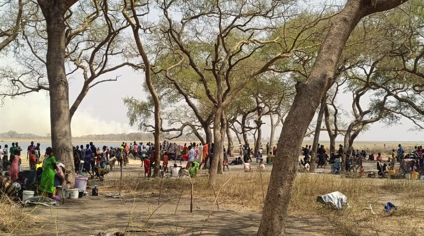
Médecins Sans Frontières (MSF) on Monday said a humanitarian disaster is unfolding in Nyirol County’s Nyatim area in Jonglei State, where an estimated 30,000 people fled in search of safety and are living under trees next to a swamp after recent violence in Lankien and Pieri.
A MSF press release extended to Radio Tamazuj quoted the medical charity’s staff members in the area saying that at least 58 people have died over the past four weeks, where authorities are blocking humanitarian access to aid organisations.
“Most of the people who have been displaced to Nyatim are women, children, elderly people, people who are ill, and others who are unable to endure moving to safer locations,” the statement reads in part.
As well as being subjected to abductions by armed gangs, people are without adequate food and shelter, clean water, medicines, or means to leave the area. Humanitarian access and a scale-up of assistance are urgently needed in Nyatim, MSF stressed.
The information comes from our colleagues who were displaced from Lankien and Pieri and arrived at Nyatim, subsequently describing the situation there.
“One of our colleagues, who is currently in Nyatim, has reported that people are dying of suspected hunger, as their only food is boiled tree leaves,” says Gul Badshah, MSF operations manager. “They also said that around a dozen children died of acute watery diarrhoea and suspected malaria.”
“Based on the ground reports, at least 10 people were abducted by armed gangs in the Nyatim area, including one breastfeeding mother who was shot dead,” he added.
MSF teams also managed to hear from women who were able to leave Nyatim with their children and arrived at Chuil, where we are responding to people who have been displaced there. The distance between the two villages is some 50 kilometres, which means the people have to walk for days while being exposed to potential violence, the statement said.
“We adults try to be strong, but the children die in front of our eyes. Sometimes children watch their mothers or fathers die,” says Nyaluat, who arrived in Chuil. “This was happening every day in Nyatim. If you survive, you survive. If you die, you die. That is how we live now.”
“The truth is that people are dying there,” says Nyapini, who is displaced in Chuil. “Some die from sickness, some from hunger, and some are killed in the bush when they go to collect wild fruits, leaves, or water lilies. If something can be done to help them, it would be very important.”
“When we fled Lankien, the men and women became separated,” says Nyaruop, also displaced. “We ran in different directions, and I went with the children toward Nyatim. We suffered a lot there. We were hungry, we were sick, and there was no help coming from anywhere. Life there was very hard.”
“People in Nyatim are being trapped. Even if they want to leave this area, the vast majority of them do not have the strength or means, including transportation and money, to do so,” says Badshah. “MSF calls upon the relevant authorities to urgently secure humanitarian access to Nyatim and prevent even more deaths and suffering. Our teams have been requesting access to Nyatim for the past month, but without any success so far.”
MSF called upon the international community, United Nations agencies, relevant embassies, and other influential organisations to help urgently secure humanitarian access to Nyatim.
According to MSF, at least 25,000 people who fled the conflict in Jonglei state have sought refuge in Chuil, a small town on the shores of the Sobat River. There, MSF has upgraded the general healthcare centre to provide emergency care, treatment for malnutrition, maternal health services, and stabilisation for trauma cases.
“Our teams also distributed relief items to more than 1,500 families to help them cope with the harsh living conditions. More distributions will follow,” the statement concluded. “To help with water and sanitation services, MSF is building latrines and constructing a water purification plant.”

 and then