



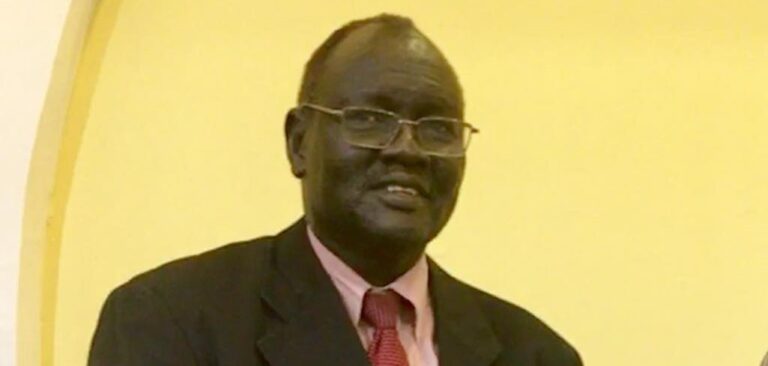
A senior opposition official on Thursday accused South Sudan’s president of planning a “sham election” by rewriting the nation’s 2018 peace agreement, as he dismissed the trial of eight opposition figures — including his party’s leader — as a political “witch hunt.”
Joseph Malwal Dong, a focal point of the Sudan People’s Liberation Movement-in-Opposition (SPLM-IO) Political Bureau in Juba, spoke a day after the country’s presidency approved sweeping amendments to the Revitalized Agreement on the Resolution of the Conflict in South Sudan (R-ARCSS).
The changes remove key pre-election conditions, including the completion of a permanent constitution — a process still unfinished seven years after the deal ended a five-year civil war.
The revised agreement now calls for a national population census to be held after the elections, slated for December 2026, rather than before. Other amendments shorten legal deadlines for election preparations, including reducing the time to publish a final voter register from six months to three months.
“The way they are doing it, they want to amend the constitution, they have deleted so many articles in the agreement, and make them up of their own assumptions,” Malwal told Radio Tamazuj on Thursday. “But I think they are heading for a sham election, which they want to do.”
Malwal’s faction is aligned with suspended First Vice President Riek Machar, a key signatory to the peace deal whose rivalry with President Salva Kiir has long fueled political tension. Malwal insisted credible elections are impossible without honoring the original pact.
“People believe in the agreement, and this agreement has spelled a way out for everybody to follow,” he said. “There cannot be an election in South Sudan once the core of the agreement is out of the way.”
Separately, Malwal criticized the ongoing trial of Machar and seven others, who are accused of involvement in a March 2025 attack on an army base in Nasir County. Proceedings began last September.
“There is nothing in the court, actually,” Malwal said. “The witnesses did not say anything. They did not prove that anybody was involved. It is just a witch hunt.”
He also condemned the international community, which helped broker the 2018 agreement, for what he described as siding with the government “in the name of sovereignty.”
“They think that the government here has the sovereignty when they know that there’s no sovereignty here, no one has the sovereignty,” he said, arguing that legitimacy comes only from an electoral mandate. “There’s nobody that’s a sovereign leader here because they have never run an election, they’ve never been elected.”
Malwal said multiple election prerequisites are being ignored, including internal party conventions to select candidates.
“How can you go for election when you have not even had a convention?” he asked. “All the requirements of the election are not there. The international community knows this and yet they are not being serious about what is going on.”
He rejected the postponement of a permanent constitution and census as illegitimate, saying his group was excluded from the decision.
“There are no parties to the agreement that have agreed,” he said. “They don’t want the permanent constitution. And therefore, how can we agree to the election? We have no constitution to take us to election.”
Asked whether his group was open to dialogue, Malwal pointed back to the unamended peace deal.
“We want the process that has been worked out by the agreement to have a permanent constitution that will lead us to the permanent election of the country,” he said. “But that is not there.”
The government has not immediately responded to Malwal’s allegations. The SPLM-IO and the ruling SPLM have repeatedly accused each other of violating the peace agreement, which established a unity government and charted a path to South Sudan’s first post-independence elections.
The deepening stalemate threatens further instability in a nation that has seen little peace since gaining independence in 2011.

 and then