



South Sudan’s Ministry of Foreign Affairs has defended its request for the US to lift sanctions on a former senior official and to support the prosecution of opposition leader Riek Machar, among others, saying diplomatic negotiations are based on reciprocity and that talks with Washington are ongoing.
The response follows revelations that after agreeing last year to accept deportees from the United States, South Sudan sent Washington a list of requests in May 2025 that included backing for Machar’s prosecution and the lifting of sanctions on former vice president Benjamin Bol Mel, who is accused of diverting more than one billion dollars in public funds.
The requests were contained in two diplomatic communications reviewed by Radio Tamazuj last month, offering a rare glimpse into concessions some governments may seek while negotiating with Washington over deportees.
In the documents, the United States expressed “appreciation” to South Sudan for receiving the deportees and listed their names, nationalities, and the crimes for which each individual had been convicted.
In July, South Sudan became the first African country to accept third-country deportees from the United States. Rwanda, Eswatini, Ghana, and Equatorial Guinea have since also received deportees.
The eight men sent to South Sudan included nationals of Mexico, Cuba, Vietnam, Laos, Myanmar, and South Sudan. They arrived in Juba after spending weeks on a US military base in Djibouti, where a US court temporarily blocked their deportation. Six of the eight remain in Juba.
South Sudanese national Dian Peter Domach was later freed, according to the Ministry of Foreign Affairs, while Mexican national Jesus Munoz-Gutierrez was repatriated in September. Authorities have not publicly outlined any long-term plan for those still in custody. The deportations drew criticism from rights groups, who warned that South Sudan risked becoming a dumping ground.
Among the most controversial requests was a call for the lifting of US sanctions on Bol Mel, as well as support for Machar’s prosecution. Machar, the now-suspended first vice president, faces treason, murder, and other charges in a highly contentious case.
Bol Mel is accused of diverting more than $1 billion earmarked for infrastructure projects into companies he owned or controlled, according to a UN report. He wielded significant influence within the government and was viewed by some as President Salva Kiir’s likely successor until he was dismissed and placed under house arrest in November 2025.
In its communications with Washington, South Sudan also asked for sanctions on South Sudanese oil companies to be lifted “to encourage direct foreign investments,” and urged the United States to consider investing in sectors including fossil fuels, minerals, and agriculture.
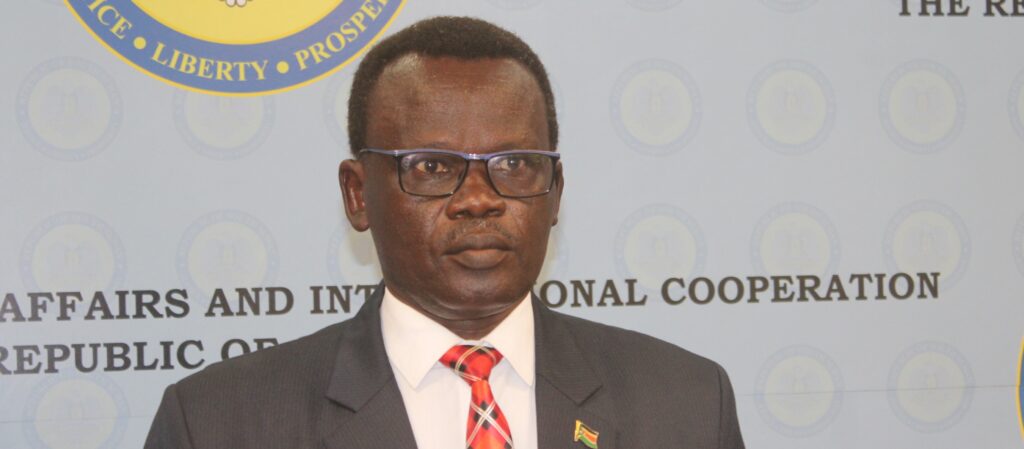
Speaking during a question-and-answer session after the ministry’s monthly media briefing, foreign affairs spokesman Thomas Kenneth said the letter that entered the public domain recently was issued in May 2025 and reflected the government’s strategic interests at the time.
“When you talk of diplomacy you talk of negotiations, and when you talk of negotiations you talk of reciprocity, it is a give and take is isn’t? This is reciprocity. In reciprocity you take and you give. But if I give, and I don’t take that means something is there is isn’t?” he said.
“The document was issued under the leadership of the country. Why this question was not asked all that time? Because the letter was talking about that time. The letter was talking of some leadership of the country,” he added.
Kenneth stressed that foreign policy is guided by national interests and implemented through relations between states.
He later said the letter was issued last year and that any response to it was being handled through diplomatic engagement.
When asked whether there had been progress on the demands made to Washington, he said: “Of course we are a country and we have an embassy in Washington and they have an embassy here and we always channel our negotiations through diplomatic channels.”
He pointed out that discussions between the two countries were ongoing.
Asked about the status of the foreign deportees still in South Sudan, Kenneth said the matter remained classified.
“Deportees? Yes, deportees are there. But it still remains classified information. We will make it available one day. Don’t worry. Since you are aware that they are here,” he said.
On criticism from international NGOs over attacks and bombardments affecting aid operations in conflict-hit areas such as Jonglei, Kenneth said the ministry had not received official communication.
“Is it brought to us officially? I don’t know how you get your information,” he said, adding that the government only responds to concerns raised through formal diplomatic channels.
On the peace process and a Kenyan proposal for peace talks between the government and the opposition, Kenneth said consultations were ongoing within the government and that further steps would be announced after those discussions.
On elections, he said the government remained committed to holding polls in December 2026.
“Almost everyone is talking about elections and I think elections are the only way for us to get out of the situation we are in. I want to assure you that the country is committed and there are countries that are with us in that,” he said.

 and then