



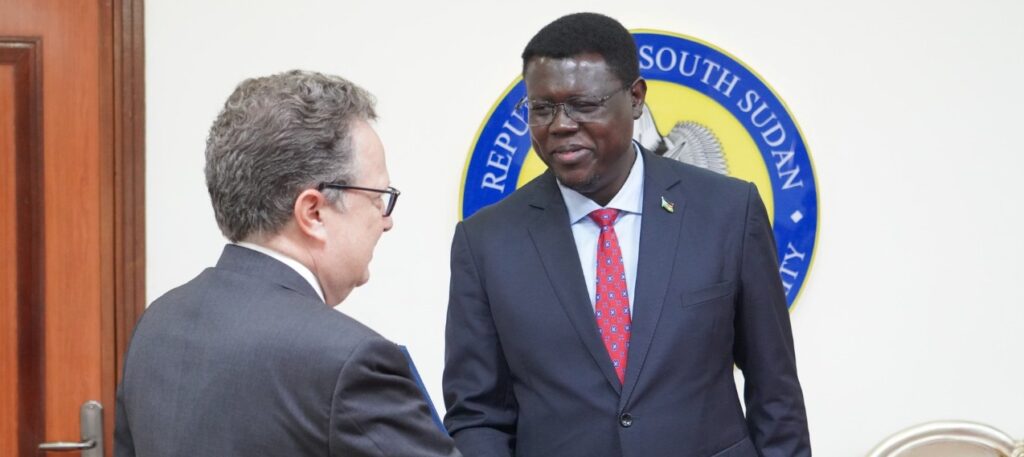
After agreeing last year to accept deportees from the United States, South Sudan’s government sent Washington a list of requests that included US support for the prosecution of an opposition leader and the lifting of sanctions on a senior official accused of diverting more than a billion dollars in public funds, according to documents seen by Radio Tamazuj.
The requests, contained in two diplomatic communications reviewed this week, provide a rare glimpse into the type of benefits some governments may have sought while negotiating with Washington over accepting deportees.
In the documents, the United States expressed “appreciation” to South Sudan for receiving the deportees and listed their names, nationalities and the crimes for which each individual had been convicted.
In July, South Sudan became the first African country to accept third-country deportees from the United States. Rwanda, Eswatini, Ghana and Equatorial Guinea have since also received deportees.
The eight men sent to South Sudan included nationals of Mexico, Cuba, Vietnam, Laos, Myanmar and South Sudan itself.
Contentious deportations
They arrived in the South Sudanese capital, Juba, after spending weeks on a US military base in Djibouti, where they were held after a US court temporarily blocked their deportation. Six of the eight remain in Juba.
South Sudanese national Dian Peter Domach was later freed, according to the Ministry of Foreign Affairs, while Jesus Munoz-Gutierrez, a Mexican national, was repatriated in September.
South Sudanese officials have not publicly outlined any long-term plan for those still in custody. The third-country deportations proved highly contentious, drawing criticism from rights groups and others who warned that South Sudan risked becoming a dumping ground.
Details of the deal between Washington and Juba remain unclear. It is not known what, if anything, South Sudan actually received or was promised in return. The documents offer only a partial picture of what the South Sudanese government hoped to secure.
In other cases, Human Rights Watch said it had seen documents showing the United States agreed to pay Rwanda around $7.5 million to accept up to 250 deportees. Washington will give Eswatini $5.1 million to take up to 160 deportees, according to the group.
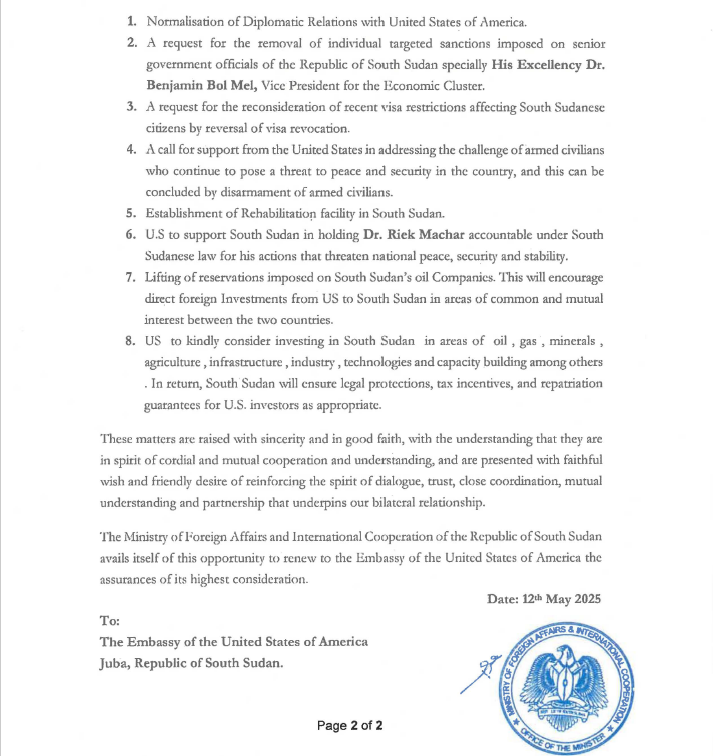
For South Sudan, a communication dated May 12, 2025, and marked confidential, shows the Ministry of Foreign Affairs raised eight “matters of concern which the Government of South Sudan believes merit consideration.” These included easing visa restrictions for South Sudanese nationals, building a rehabilitation centre and “support in addressing the problem of armed civilians”.
Request to lift sanctions
Among the most striking requests was a call for the lifting of US sanctions on former vice president Benjamin Bol Mel, as well as American support for the prosecution of opposition leader Dr. Riek Machar, the now-suspended first vice president, who faces treason, murder and other charges in a controversial case.
The accusations against Machar stem from violence in March, when the White Army militia, which has historical links to him, attacked a government army garrison in Nasir, Upper Nile state. Machar’s supporters and some activists have described the charges as politically motivated.
Bol Mel is accused of diverting more than $1 billion earmarked for infrastructure projects into companies he owned or controlled, according to a UN report. He wielded significant influence within the government and was viewed by some as President Salva Kiir’s likely successor until he was dismissed and placed under house arrest in November.
Bol Mel was also widely seen as a key figure behind the prosecution of Machar.
Machar was Kiir’s deputy when the two fell out in 2013, triggering a civil war as forces loyal to Kiir clashed with those backing Machar.
A 2018 peace deal returned Machar to government as the most senior of five vice presidents. His prosecution has been widely criticised as a violation of that agreement and has coincided with a surge in violence that the United Nations says killed more than 1,800 people between January and September 2025.
The UN has also warned that renewed fighting has pushed the country “back to the edge of a relapse into civil war.” Machar remains under house arrest in Juba as his criminal trial proceeds.
In its communications with Washington, the South Sudanese government also asked for sanctions on South Sudanese oil companies to be lifted “to encourage direct foreign investments,” and urged the United States to consider investing in sectors including fossil fuels, minerals and agriculture.
A spokesman for South Sudan’s Ministry of Foreign Affairs, Thomas Kenneth, declined to comment, saying he could only comment on documents originating from his office.
Notice of Correction: An earlier version of this report included a reference to an attempt to reach the U.S. Embassy in Juba. This has been removed.

 and then