



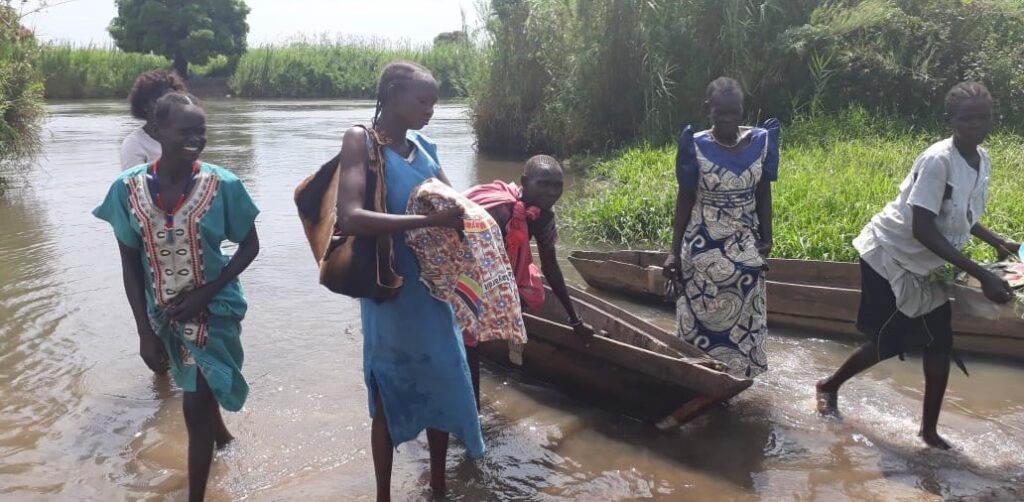
For the sixth straight year, floodwaters have swallowed huge swaths of South Sudan, submerging villages and pastures and forcing tens of thousands of people onto shrinking islands of dry land. Nowhere is the crisis more acute than in oil-rich Unity State, where survival hinges on a fragile network of earthen dikes.
From atop one such barrier, Nyakuka Both Nhial, 42, looks out over a submerged world. Somewhere beneath the gray, horizon-spanning water lies Bar Malual, the village where she was born, married and raised six children. It has been under water for four years.
“The water did not just come once,” she said. “It came and stayed.”
She fled in 2021 as the floods consumed her home, crops and cattle. Now she lives in Bilnyang village, a crowded patch of higher ground protected by a dike — a slender margin between survival and displacement.
“If this dike was not here, you would not find us alive,” Nyakuka told Radio Tamazuj. “This dike is our life.”
The dike is part of a 52-kilometer flood-protection system built around Bentiu and Rubkona by the International Organization for Migration under a World Bank-funded project. It now protects more than 100,000 people, according to the IOM.
“Without these dikes, this entire area would have been submerged,” said Miriam Mutalu, head of the IOM’s sub-office in Unity State.
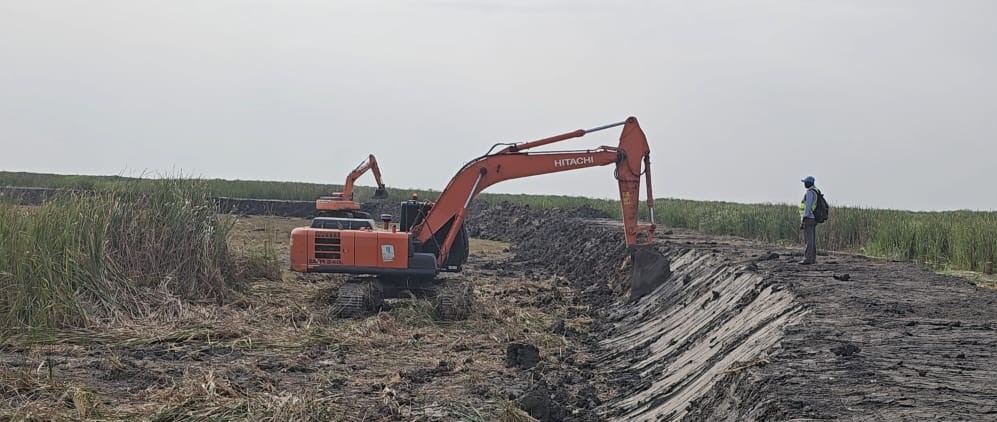
Construction of a section of an earthen dike designed to protect people from chronic flooding
Unity State is South Sudan’s main oil-producing region, yet residents say the wealth extracted from beneath their feet has never reached them.
“We hear about oil, but it does not help us,” Nyakuka said. “I have never seen anything that benefits civilians.”
State officials acknowledge the dikes are a temporary shield, not a permanent fix.
“We are working with partners, but we also need more long-term solutions,” said Sudan Choug, director general at the state’s Ministry of Local Government and Law Enforcement. “The flooding will not stop next year or the year after.”
Maintaining the barriers is a constant struggle. Erosion from wave action eats away at the earth, requiring year-round monitoring and reinforcement by engineers and communities.
“If one section fails, the whole system is at risk,” said Tombe Anthony Jadalla, a senior disaster risk management engineer with the project.
For Nyakuka, the dike offers safety but not stability. The land in Bilnyang is infertile, leaving families dependent on markets where prices are unaffordable. Many survive by fishing and gathering water lilies — grueling, risky work.
“Our bodies are in pain from staying in the water,” she said. “But we have no other option.”
She dreams of returning to Bar Malual if the waters ever recede. “There, we could cultivate and feed our children,” she said. “Here, we are only surviving.”
For now, life in Unity State balances on a narrow ridge of soil. Children run barefoot along the dike crest. Fishermen cast nets into dark pools. Women navigate the blurred line between land and water.
“The floods destroyed my life,” Nyakuka said. “But as long as this dike stands, we are still here.”

 and then