



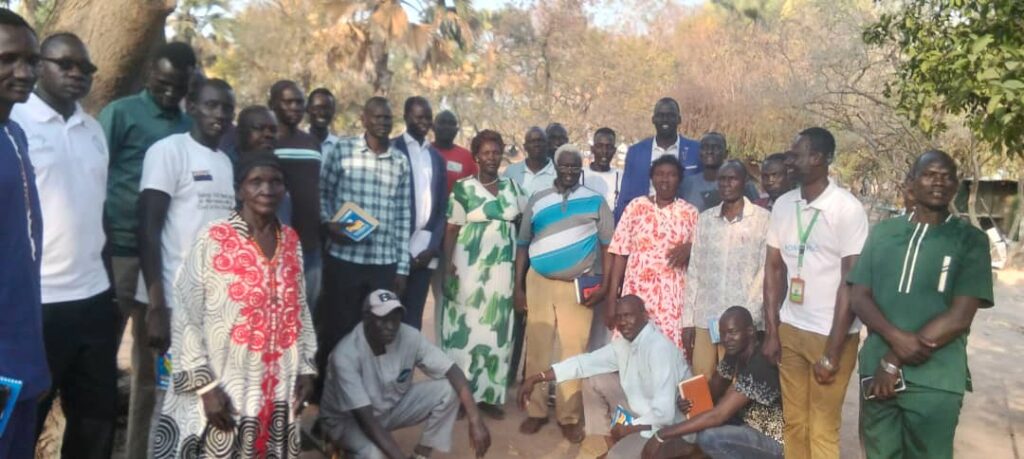
Community leaders, government officials and civil society representatives from two conflict-prone counties in Lakes State have pledged to support peacebuilding efforts after a two-day engagement concluded Thursday in Rumbek.
The meeting brought together about 60 participants from Rumbek North and Cueibet counties, including local officials, intellectuals, youth leaders, women and traditional chiefs. It aimed to secure elite commitment to peacebuilding and socioeconomic development.
The engagement was organized by KONGKOC, a consortium of seven national and international organizations, under the theme “Strengthening the constructive role of elites in community-led peacebuilding.”
Mathiang Mading, acting peace coordinator in Rumbek, said participants signed a communiqué containing 11 resolutions focused on reconciliation and accountability.
“These resolutions are very important, and the participants committed themselves to implementing them in letter and spirit,” Mading said.
Among the key resolutions was an agreement to form a joint peace committee between Rumbek North and Cueibet counties. The 15-member body will be chaired by the state minister of peacebuilding and include representatives from various community groups, he said.
Participants also agreed to include members of the Rup community from Mayom and Malek payams in Rumbek Central County in future peace engagements, despite those areas not formally falling under KONGKOC’s operational mandate.
“It was found necessary because without involving the Rup community, there will be no lasting stability between Rumbek North and Cueibet,” Mading said, noting that the areas share borders.
Another resolution committed elites to withdraw support for communal violence. Mading said participants acknowledged that some intellectuals had previously played a negative role by financing or promoting conflict.
“They have agreed to stop supporting communal conflicts and to refrain from propaganda that fuels violence,” he said.
Lakes State Minister of Local Government and Law Enforcement Mabor Meen Wol said the meeting brought together lawmakers, ministers, youth leaders and women’s groups from both counties.
“The discussions focused on peace and reconciliation because these communities have been fighting,” he said. “Some resolutions will be implemented by the government, others by the communities, intellectuals and members of parliament.”
Wol said the government would strengthen security, enforce the rule of law and pursue suspects accused of killings. He added that authorities and partners would work to improve feeder roads in both counties to enhance security and access.
Deputy Speaker of the Lakes State Transitional Legislative Assembly Ayen Meen Ador said participants agreed to form joint committees to promote peace between the Gok and Pakam communities.
“This workshop was about implementing peace — taking the knowledge and skills back to the counties and working with chiefs, commissioners and security forces,” she said.
She also called for full enforcement of customary laws and public order legislation passed by the state assembly.
Ayieda Makur Mangok, a participant from Tiaptiap Payam in Cueibet County, said intellectuals have a responsibility to remain nonpartisan in communal conflicts.
“Our role is to prevent violence and advocate for peace in the communities,” she said, adding that participants also committed to promoting children’s education.
Sultan Manyiel Lieny, an executive chief in Rumbek North County, urged communities to maintain peace and return raided cattle.
“The return of raided cattle is the true meaning of peace and reconciliation,” he said.
Lakes State has experienced repeated cycles of intercommunal violence driven by cattle raiding, revenge attacks and political tensions, despite ongoing peace initiatives.

 and then