



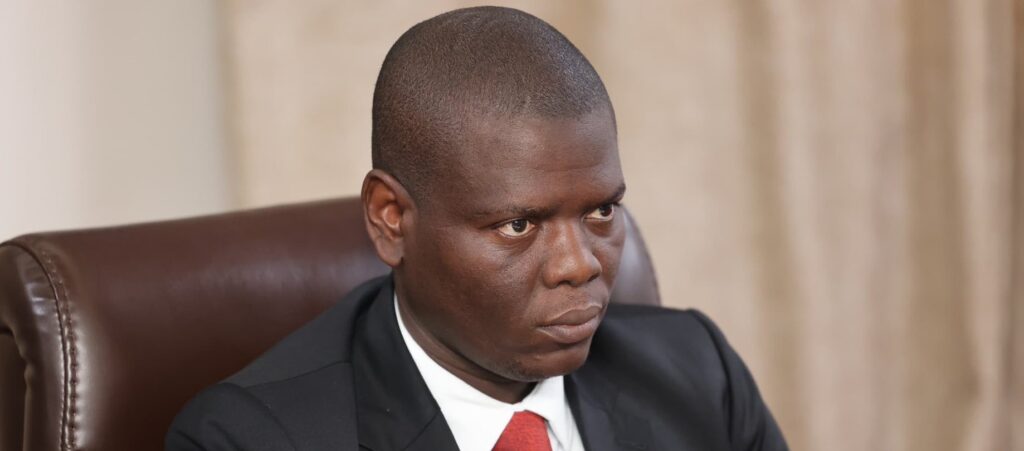
The African Union’s High-Level Ad Hoc Committee on South Sudan, known as the C5, has proposed a retreat for South Sudan’s political leaders in South Africa, aimed at resolving outstanding differences before the end of the country’s transitional period.
The committee, led by South African Minister of International Relations and Cooperation Ronald Lamola, made the proposal during meetings in Juba on Thursday, according to sources who spoke to Radio Tamazuj.
The sources said the proposal was discussed during a meeting between the visiting AU delegation and eight representatives of stakeholders to the 2018 peace agreement. The delegation also briefed the stakeholders on plans for a separate AU summit on South Sudan to be held in Addis Ababa, Ethiopia, in February.
It remains unclear whether the C5 will be able to secure the release of political detainees to participate in the proposed retreat.
The stakeholders included representatives from civil society, faith-based groups, women, youth and academia.
During the meeting, the AU delegation reaffirmed its commitment to supporting a genuine political transition process in South Sudan.
The stakeholders urged the C5 to push for an immediate ceasefire in line with the 2017 Cessation of Hostilities Agreement, the release of political detainees — including detained First Vice President Riek Machar — and the launch of an inclusive national dialogue. They also called for genuine preparations for peaceful and credible elections under a conducive political and security environment.
They further asked the C5 to advocate for the appointment of an AU high-level representative for South Sudan, preferably a former African president, to closely monitor developments and support the country’s transition to democracy.
The stakeholders warned that South Sudan is gradually sliding toward a renewed full-scale conflict, citing ongoing fighting in parts of the country. They said recent military confrontations between government forces, the South Sudan People’s Defence Forces (SSPDF), and the opposition SPLA-IO pose a serious threat to the prospects of holding free and peaceful general elections.
Edmund Yakani, a civil society leader, described the meeting as positive but said stakeholders expected stronger action from the AU.
“We demanded the AU C5 to demonstrate concrete and practical commitment to helping South Sudanese leaders make peace happen,” Yakani told Radio Tamazuj.
“While the primary responsibility for peace lies with our leaders, they are not serious about delivering peace,” he said, adding that the failure to hold spoilers of the peace agreement accountable has undermined stability.
Yakani said stakeholders urged the AU Peace and Security Council meeting scheduled for Jan. 19, 2026, to produce concrete and actionable decisions on the political transition. They also called on the C5 to ensure inclusive engagement with legitimate signatories to the revitalized peace agreement.
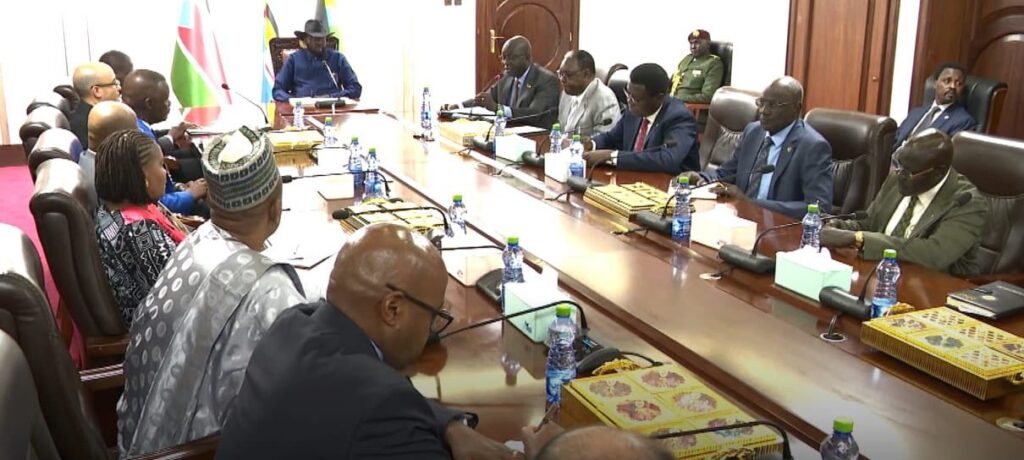
After meeting the stakeholders, the AU delegation held talks with President Salva Kiir and several government ministers.
In a joint statement, Lamola said the delegation was in Juba to assess the status of the Revitalized Peace Agreement and review progress in election preparations. He called for a nationwide ceasefire and inclusive dialogue among the parties to the agreement to pave the way for free, fair and inclusive elections.
Lamola also urged calm and solidarity to allow conditions necessary for elections to be fully realized.
South Sudan’s Foreign Affairs Minister Monday Semaya Kumba reaffirmed the government’s commitment to peace, elections and continued cooperation with regional and international partners.
In a statement issued Thursday after the conclusion of the meetings, the Ministry of Foreign Affairs said the visit marked the C5’s second trip to Juba. The delegation included representatives from South Africa, Algeria, Rwanda and Nigeria. Chad, also a member of the committee, was not represented.
The C5 was established by the African Union to support implementation of the peace agreement in South Sudan, the world’s youngest nation, which has faced persistent instability and repeated delays in its political transition since independence in 2011.

 and then