



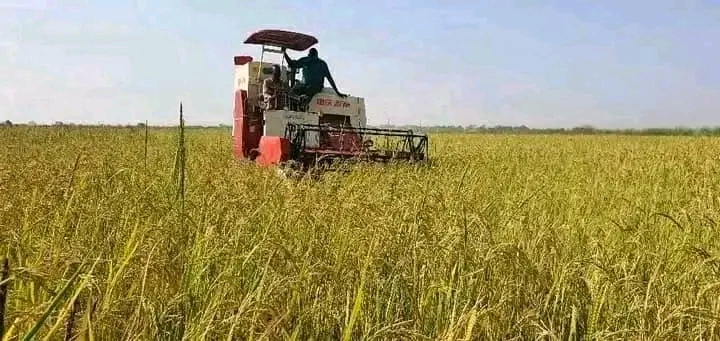
The livelihoods of more than 2,500 people across 500 households in Northern Bahr el Ghazal State have improved after China donated 10 heavy-duty rice combine machines to the Aweil Rice Scheme. The machines are now being used to harvest and thresh rice, increasing production.
The donation, made in 2016 through China Aid, replaced traditional harvesting methods that relied on sickles and sticks, a practice that persisted after the Second Sudanese Civil War (1983-2005).
According to a survey by Radio Tamazuj, the Aweil Rice Scheme previously cultivated around 300 acres, but the introduction of the Chinese machines has expanded production to between 1,200 and 1,800 acres annually. Annual output has tripled from 800 metric tons to 2,400 metric tons.
The number of workers involved in the scheme has also risen sharply, from about 330 people to over 2,500 individuals across more than 500 households. This expansion has included work in Aweil East and Aweil South Counties.
Farmer Santino Deng Ngong described the difference the machines have made. “Before these machines, farmers used sickles and sticks to harvest and thresh rice manually,” he said. “Now the work takes one to three hours instead of a whole day, which motivates farmers to produce more.”
Luka Akol Akol, Secretary-General of the Rice Cooperative Association in Northern Bahr el Ghazal, said he earned over 14 million SSP in the 2024-2025 season, supplementing his family’s consumption and covering expenses such as tuition and medical bills. “I produce rice for my family and sell the surplus to prepare for the next season,” he said.
Local farmers and consumers have welcomed the increased availability of rice, which is sold at lower prices than imported varieties. Farmer Malong Deng Nyuany said, “The combine machines are being used to clear rice from straw, and local rice is now more affordable than Dura.” Female farmer Bakheita Ahok Deng added that her Women Peace Group produced 200 large bags of rice, of which she owns 30.
Consumers confirmed the price difference between local and imported rice. “One kilogram of imported rice costs about 15,000 SSP, while four kilograms of local rice cost around 11,250 SSP,” said Majak Chol. Achol Wol said, “I buy local rice because imported rice is too expensive.”
The Chairperson of the Rice Cooperative Association, Akoon, urged additional support, including tractors, spare parts, and funding, to sustain production. “The Chinese machines have been very helpful, but spare parts are scarce,” he said.
Local activist Achol Yuel said that if grinding mills, packaging processors, and trained technicians are maintained, local rice could dominate markets and reduce reliance on imports.
The Aweil Rice Scheme is a public institution managed by a team including a managing director, deputy director, and heads of administration, finance, and plant protection. Private farmers and investors may also rent land to continue rice production at the scheme.

 and then