



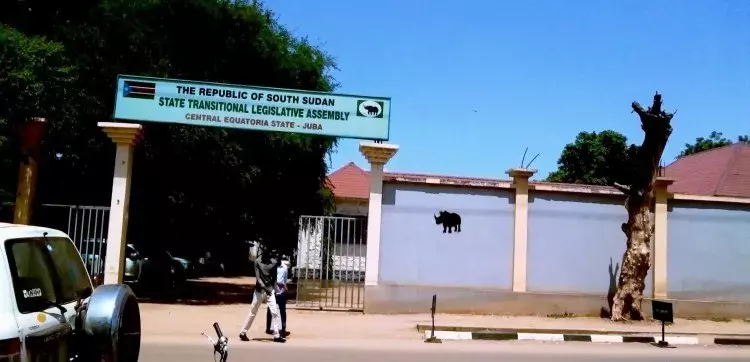
Central Equatoria State’s Transitional Legislative Assembly on Wednesday reopened for its third session after a recess of more than a year, far exceeding the customary three-month break.
Addressing lawmakers in Juba, Governor Emmanuel Adil Anthony described the reopening as a “renewed commitment” to peace, reconciliation and development.
“It is a great honour to address this August House on its re-opening for the Third Session, after a full year surpassing the traditional three-month recess period,” Adil said. “Today’s opening symbolises our renewed commitment to work collaboratively towards peace, reconciliation and development.”
He said the Assembly, as the legislative arm representing the will of the people, plays a critical role in governance and accountability, urging lawmakers to strengthen their oversight function.
“We must build an accountable government grounded on transparency and integrity in managing public affairs,” he added.
Peace conference planned
Adil said insecurity remains the state’s top priority, citing the activities of holdout opposition groups, clashes involving cattle herders, land disputes, child abductions and criminal gangs.
He announced plans to convene a state peace and reconciliation conference bringing together political actors, community leaders and other stakeholders to address what he called the root causes of division.
“My government will collaborate with all stakeholders to promote grassroots reconciliation, dialogue and community healing initiatives, particularly among farmers and pastoralists,” he said.
The governor also raised concerns over alleged cross-border encroachment into Kajo-Keji, Morobo and Yei counties by neighbouring Uganda and the Democratic Republic of Congo, calling for border demarcation efforts to be finalised.
On child abductions, he directed authorities to intensify efforts to recover abducted children and ensure perpetrators are brought to justice.
Economic recovery plans
Turning to the economy, Adil acknowledged the downturn but said agriculture would anchor recovery efforts.
“My government prioritizes economic revitalization with agriculture as the backbone of the state economic recovery policy,” he said.
He pledged increased budget allocations for agriculture, livestock, fisheries and tourism, alongside rehabilitation of key feeder roads, including the partial rehabilitation of the Juba–Yei–Kaya road.
Adil directed the Ministry of Agriculture to trace and recover tractors previously supplied to counties to ensure they are put to use.
He said 204 cooperatives had been registered, two agro-processing plants established and more than 50,000 households supported with seeds and tools.
Domestic revenue increased by 15 percent due to improved tax enforcement, he added, with plans to introduce a digital revenue collection system.
Services and environment
The governor announced measures to improve sanitation and environmental management in Juba and other urban centres.
“I have banned and declared littering a crime in the towns,” he said.
Authorities plan to plant one million trees along streets and in residential areas and to introduce stricter waste management measures, including public waste bins and fines for offenders.
On service delivery, Adil pledged to reopen schools closed due to insecurity, improve teachers’ welfare and revive teacher training institutes.
In the health sector, he said authorities would regulate private health facilities in Juba and strengthen maternal and child healthcare services. The state managed more than 9,000 cholera cases and achieved 85 percent measles and polio vaccination coverage across all counties, he said.
He also pledged to expand access to clean water, including piped systems in urban centres, and to engage national authorities over high water prices in Juba.
Support for elections
In his closing remarks, Adil welcomed the National Elections Commission’s announcement setting Dec. 22, 2026 as the date for South Sudan’s first post-independence general elections.
“Let us support the decision to hold the general elections on the set date,” he urged lawmakers. “I am strongly urging our people not to miss this rare opportunity for democratic transformation of our nation and state.”
He called on legislators to prepare citizens for voter registration and participation and pledged to ensure eligible voters across counties, payams and bomas are able to register and vote.
Call for unity
In remarks delivered on his behalf by Assembly Clerk Simon Peter Johnathan, the Deputy Speaker welcomed lawmakers back after the prolonged recess, describing the reopening as a renewal of hope and commitment to serve with integrity.
He congratulated President Salva Kiir and the signatories to the 2018 Revitalized Peace Agreement for sustaining dialogue during political tensions and urged state leaders to translate national commitments into tangible results.
The Deputy Speaker acknowledged that the extended recess had weakened the Assembly’s ability to perform its constitutional roles of legislation, representation and oversight, and called on lawmakers to recommit to good governance and accountability.
He cited the passage of the 2023–2024 fiscal budget despite limited funding as a key achievement of the previous session and stressed the need for cooperation between the executive and legislature.
The speech also paid tribute to two late lawmakers, Silvano Bata Yokoju and Amos Dawangwodi, and called for the establishment of a medical support system for constitutional office holders.
Highlighting challenges including land grabbing in Juba, insecurity linked to holdout groups, border disputes, child abductions, illegal taxation, inflation, delayed salaries and poor service delivery, he urged unity among political leaders.
“Political differences must never be more important than our duty to serve our people,” he said.

 and then