



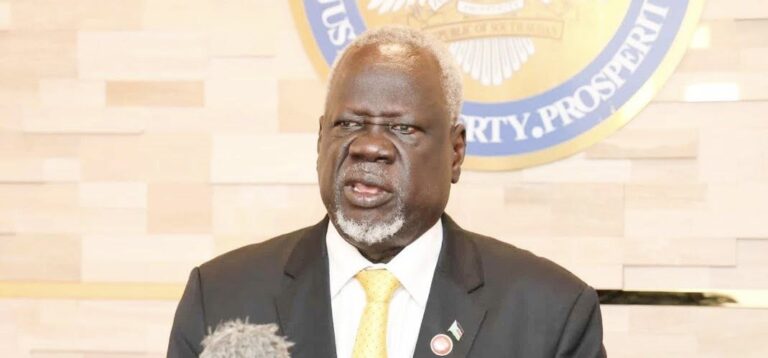
Leaders of the Bor community have condemned remarks by Jonglei State Governor Riek Gai Kok during recent public rallies, saying his comments misrepresented the 1991 Bor massacre and caused distress to survivors and families of victims.
The remarks were made during gatherings in Twic East and Duk counties, where the governor said the 1991 violence mainly affected Duk County and that residents of Bor had fled, suggesting there were no deaths in Bor during the attacks.
In a statement issued Monday, Jan. 19, 2026, the Bor Community described the comments as historically inaccurate and called for a public retraction and apology.
“We express deep concern and disappointment over statements that deny or diminish the suffering of victims of the 1991 Bor massacre,” said Gen. Peter Wal Athiu, acting chairman of the Bor Community. “Thousands of civilians were killed, families displaced and livelihoods destroyed.”
Athiu said denying the massacre disregards documented history and risks reopening wounds among survivors, warning that such statements could undermine reconciliation and peace efforts in Jonglei State.
The statement also criticized what it described as demeaning implications in the governor’s remarks, saying they could fuel division among communities in the Greater Bor area.
“As governor, your words carry weight and should promote unity and healing rather than deepen grievances,” Athiu said.
The Bor Community urged the governor to publicly retract the remarks, formally acknowledge the suffering of victims and commit to truth-telling as part of reconciliation efforts. It also called on the national government to caution state officials against statements that marginalize communities.
Despite the criticism, the community leadership appealed for calm, saying the issue would be addressed through institutional and leadership channels.
Separately, Bor Community Association chairman Dr. Angok Kuol Tiir, speaking in a live Facebook video, urged young people to remain alert and protect their communities while avoiding political violence.
“I am not asking youth to fight for the government,” Angok said. “I am asking them to protect their land and families and to learn from history so that Bor is not destroyed again by political conflicts.”
Manath Gany Lual, press secretary in the governor’s office, confirmed receipt of the statement and said the governor was reviewing it.
“The governor has seen the document and is considering the next steps,” Lual said, adding that no decision had yet been made on whether an apology would be issued.
The Bor massacre refers to large-scale killings of civilians in and around the town of Bor in November 1991 during Sudan’s civil war. The violence followed a split in the Sudan People’s Liberation Army, when forces loyal to Dr. Riek Machar attacked areas perceived to support SPLA leader Dr. John Garang.
Thousands of civilians were killed, though exact figures remain disputed. The violence deepened ethnic divisions and is widely regarded as one of the most traumatic episodes in South Sudan’s history, with lasting effects on intercommunal relations.

 and then