



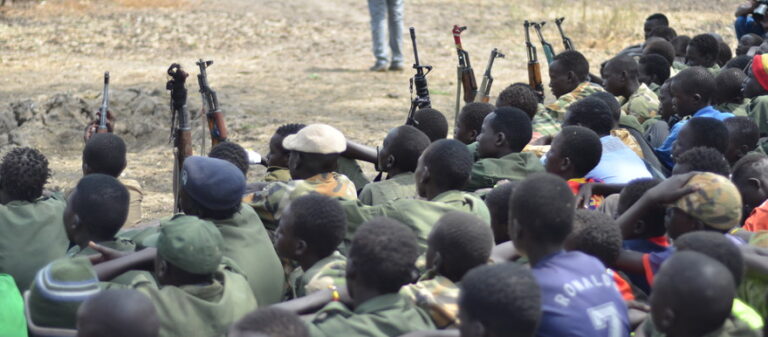
Twenty-two children formerly associated with armed groups in Western Equatoria State have been released and handed over to child protection authorities, marking a significant step in efforts to end the recruitment and use of children in armed conflict.
The handover took place in Rimenze, a village 30 kilometres outside Yambio Town, where community leaders, government officials, UNMISS, and UNICEF gathered to welcome the children—among them two girls aged 14 and 17—into a supervised reintegration programme.
Captain Santo Tameku Peter of the South Sudan People’s Defence Forces (SSPDF), who previously commanded the children in the bush, told Radio Tamazuj that he was relieved to see them freed.
“These children were with me in the bush under my command. Life there was very hard, and they suffered a lot,” he said. “I thank the government and partners for taking them so they can recover and begin a new life.”
A 17-year-old girl, speaking anonymously for her protection, described their release as the beginning of healing.
“I need psychological support and a chance to join a vocational school,” she said. “I want to study driving and simple mechanics so I can support myself and my family.”
For his part, John Zebruna Gasi, Director General in the State Ministry of Gender, Child and Social Welfare, praised community leaders for identifying the children and supporting the release process.
“No child should be in any armed group,” he stated. “We are committed to reintegrating them, and they will be enrolled in vocational training to rebuild their future.”
Meanwhile, Rimenze Chief Ben Paulino also urged continued community support, emphasising that children under 18 have no place in the armed forces.
“These children were taken during conflict, yet they are too young to serve in the military,” he stated. “The government should empower them with skills like mechanics, plumbing, and agriculture so they can support themselves tomorrow.”
UNMISS Child Protection Officer Rita Bampo described the release as a milestone in ending child rights violations in Western Equatoria.
“Our engagement has yielded results. Twenty-two children, including two girls, have been verified, screened, and formally handed over to the state DDR programme,” she said. “UNMISS will continue to support full implementation of the action plan to prevent and end violations against children.”
On her part, UNICEF Child Protection Extender Ginana Wilson confirmed that reintegration support is already in progress.
“The children are now at the Yambio Child Transit Centre for two weeks of psychosocial support,” she disclosed. “They will then be reunited with their parents and enrolled in vocational training next year, along with receiving start-up kits.”
Most of the children come from Rii Rangu, James Diko, Nadiangere, Rimenze, and Sue areas.
The release followed a collaborative effort in which traditional leaders identified the children, while UNMISS, UNICEF, and state authorities conducted verification to ensure their safe transition.
The children are currently housed at the Yambio Child Transit Centre, where the Save Lives Initiative and the State DDR Committee are providing counselling, learning materials, and tailored reintegration support.
Community leaders and families across Western Equatoria welcomed the release, describing the children as the future of the state and the nation.

 and then