



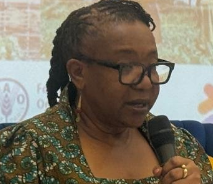
21 women mediators, through collective action, are driving dialogue, strengthening participation, and advancing the Women, Peace, and Security agenda in South Sudan, UN Women said on Thursday.
A press release extended to Radio Tamazuj said that while Human Rights Day is commemorated on 10 December, UN Women put the spotlight on the 21 women mediators as essential participants in the peace process. Their participation in the peacebuilding process is fundamental to building an inclusive and just South Sudan and the realization of human rights of the South Sudanese people.
“The courage and leadership of South Sudanese women mediators show that peace is possible when women are at the table,” said Delphine Serumaga, UN Women Country Representative in South Sudan. “Their efforts are bridging divides and creating pathways for political dialogue.”
With UN Women’s leadership, and in close partnership with Community Empowerment for Progress Organization (CEPO) and women’s civil society organizations, 21 women were trained, mentored, and coached in mediation and negotiation. Their work has strengthened the national Women, Peace and Security (WPS) agenda and empowered women to lead inclusive dialogues at a critical juncture in the country’s peace process.
Lidia Ruben, one of the trained women mediators, said she appreciates that their efforts are yielding concrete results in the peace negotiations.
“With my protection background, I know peace is vital to safeguard rights and improve the lives of the South Sudanese people,” she said.
According to UN Women, their advocacy has already yielded significant results: political parties have begun holding bilateral meetings to seek consensus and engage in consultative dialogue. The women mediators’ facilitation has created space for constructive engagement among stakeholders.
Historically, women’s participation in peacebuilding processes has been shown to contribute to successful transitions to peaceful nations, as seen in post-war Liberia (1999) and Sierra Leone (1995). Women mediators influence the peace process, demonstrating that inclusive dialogue led by women is essential for building trust, bridging divides, and moving the country toward political resolution. In South Sudan, women’s participation in peace dialogues and transitions, particularly as mediators, is not a new phenomenon.
The UN Women statement says that through the actions of the 21 mediators, who managed to hold five (5) inter-party dialogues and facilitated a resolution to the impasse, resulting in a joint political party agreement to pursue a political resolution at the highest levels. From 15 to 19 December 2025, parties to the 2018 Revitalized Agreement on the Resolution of the Conflict in South Sudan (R-ARCSS) will hold a joint high-level political dialogue to advance consensus and overcome the current impasse.
Meanwhile, Edmund Yakani, Executive Director of the Community Empowerment for Progress Organization (CEPO), said the engagement of these women mediators is a powerful demonstration of how inclusive dialogue can move South Sudan forward.
“Their work is helping political actors find common ground and reinforcing the principle that peace must be built collectively,” he said.
The efforts are supported by the donor community, specifically, the Government of Norway for prioritizing women’s participation in the peace and security agenda, the European Union and the United Kingdom as co-chairs of the Women, Peace and Security Working Group, whose secretariat is led by UN Women, and the UN International Elections Assistance Team. These efforts advance peace and embed gender-responsive approaches at the heart of South Sudan’s peacebuilding efforts.

 and then