



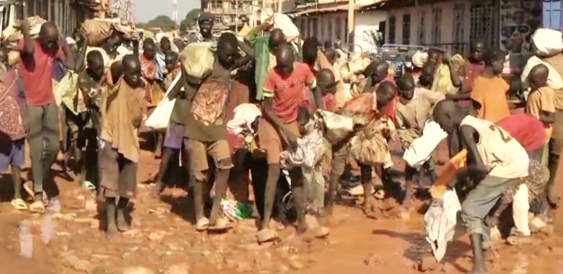
More than 70 street children in the Western Bahr el Ghazal State capital, Wau, are rewriting their stories by exchanging lives of crime and survival for community service, demonstrating that vulnerable children can become valuable contributors to society when given guidance, opportunity, and hope.
The children, who were once widely associated with looting and causing insecurity in Jou Market, are now volunteering to rehabilitate damaged sections of the market’s main roads. Their efforts include filling waterlogged areas with stones, bricks, and leveling uneven surfaces to improve access for traders, customers, and motorists.
Speaking during the road renovation exercise, one of the children, Sudan, said the initiative has given them a sense of purpose and responsibility.
“We are repairing roads by filling flooded areas with stones, bricks, and leveling uneven sections,” he said. “Last week, we worked in front of the Jou Market Police Station, and now we are waiting for Long Body to tell us where we will work next. We appeal to the government and well-wishers to support us in any way they can.”
Another participant, Tong, expressed gratitude to Daniel Makol John, popularly known as Long Body, for believing in them despite their difficult backgrounds.
“Long Body is the only person who has stood with us. He guides us to do what is right and teaches us not to steal from people in the market,” he stated. “He treats us with respect and care, and that is why we respect and obey him as the only father figure many of us have.”
Meanwhile, Daniel Makol John (Long Body) said the initiative was born out of a desire to give the children meaningful activities while helping them rebuild their lives.
“Rather than allowing them to remain idle, I wanted to keep them engaged in productive work that benefits both them and the community. Most of these children are on the streets because of the economic hardships facing their families,” he said. “They are intelligent and capable; they simply lack opportunities. With access to education or vocational training, they can become responsible citizens and future leaders.”
“I have also been mentoring them to stay away from drugs and criminal activities,” he added.
Makol called on the Ministry of Gender, Child and Social Welfare to establish comprehensive programmes aimed at rehabilitating, educating, and reintegrating vulnerable children into their families and communities.
For his part, Justin Joseph Pio, the Director of Block C in Wau Municipal Council, praised the initiative, describing it as a remarkable example of how compassion and mentorship can transform lives.
“I sincerely appreciate Long Body for taking the initiative to mentor these young people. These children are no longer seen as a problem; they are becoming valuable members of our community,” he said. “They now help safeguard the market and even assist in identifying thieves when traders lose their property. We encourage the community to support initiatives like this so that these children can grow into responsible citizens.”
Both Makol and Pio renewed their appeal to the Ministry of Gender, Child and Social Welfare and humanitarian organizations to invest in sustainable programmes that address the root causes of street life and provide children with access to education, vocational skills, psychosocial support, and family reunification.
Last week, the group launched a market-wide cleaning and road rehabilitation campaign aimed at improving sanitation and preventing stagnant rainwater from accumulating within Jou Market.
The transformation follows a declaration made by many of the children last month expressing their willingness to leave street life, reunite with their families, and return to school if supported by the government, humanitarian agencies, and members of the community.
Their journey from surviving on the streets to serving their community is a powerful reminder that, with guidance, compassion, and opportunity, vulnerable children can become an asset rather than a burden. Their story is not only one of rehabilitation but also a call for collective action to ensure that no child is left behind.

 and then