



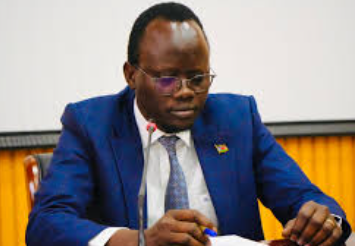
South Sudan’s Minister of Finance and Planning, Bak Barnaba Chol, on Monday presented the long-awaited SSP 7.00 trillion Draft National Budget for the Financial Year 2025/2026 to the Transitional National Legislative Assembly (TNLA), outlining a stabilization-focused spending plan that prioritizes wages, debt servicing, and infrastructure development.
The minister told lawmakers that the government projects total revenue of SSP 7.00 trillion against total expenditure of SSP 8.58 trillion, resulting in a fiscal deficit of SSP 1.58 trillion.
“For FY 2025/26, the fiscal aggregates are as follows: total revenue of SSP 7.00 trillion, total expenditure of SSP 8.58 trillion, and a fiscal deficit of SSP 1.58 trillion,” the minister said.
Chol told parliamentarians that the budget is fully domestically financed, with SSP 5.22 trillion expected from oil revenues and SSP 1.78 trillion from non-oil sources, reflecting the government’s effort to reduce reliance on external borrowing amid continued fiscal stress.
Expenditure priorities
According to the minister, the largest share of spending in the new fiscal year will go to wages and salaries, which have been allocated SSP 1.90 trillion, as the government seeks to meet its obligations to public servants.
Debt servicing has been allocated SSP 842 billion, while infrastructure development will receive SSP 1.17 trillion and capital projects SSP 1.29 trillion.
“Sectoral allocations prioritize infrastructure, security, rule of law, and economic functions,” Chol told the Assembly, adding that humanitarian and health sectors will continue to benefit significantly from off-budget support provided by development partners.
Deficit financing and debt management
On financing the fiscal deficit, the finance minister said the gap will be covered through grants and concessional financing in line with public financial management reforms, as well as exchange-rate reunification measures coordinated with the Bank of South Sudan.
To restore sovereign credibility and reduce exposure to litigation, the government has earmarked USD 187 million for debt servicing in FY 2025/26, covering both principal and interest payments.
Chol described the FY 2025/26 budget as a disciplined response to the country’s economic challenges rather than an expansionary plan.
“The FY 2025/26 Budget is a discipline-driven stabilization budget, focused on restoring macroeconomic balance, honoring public obligations, strengthening institutions, and laying the foundation for sustainable growth,” he said.
He formally submitted the Draft National Budget, the Appropriation Bill, and the Finance Bill to the TNLA for consideration and approval, in line with the country’s constitutional and legal requirements.
MPs reactions on the budget
While some MPs have welcomed the presentation of the outdated budget, Samuel Buhari Loti, who represents Torit County, described the presentation of the budget as a violation of the constitution because it is overdue.
“Right Honorable Speaker, the Constitution’s Article 88, Sub Article 1, clearly stipulates the time for presentation of the budget, so is the Conduct of Business for the National Legislature, regulation 130, sub regulation,” Loti said. “Right Honorable Speaker, the presentation of this budget was due more than seven months ago. We are supposed to be preparing for next year’s budget. As it is being presented today, it’s a budget that is already spent.”
He further stressed the fact that no expenditure report has been presented to the lawmakers, making the budget meaningless.
“This house has not been presented with expenditure reports by this minister. And this is already a violation of appropriation act,” he charged. “This minister, by not presenting expenditure reports, has violated the Appropriation Act section 12C.”
For her part, Speaker Jemma Nunu Kumba appealed to the lawmakers to allow the presentation of the budget to give the Minister of Finance time to prepare for the 2026/27 budget.
Kumba noted that this presentation is just to formalize the budget, citing a lot of challenges that have affected the Country.

 and then