



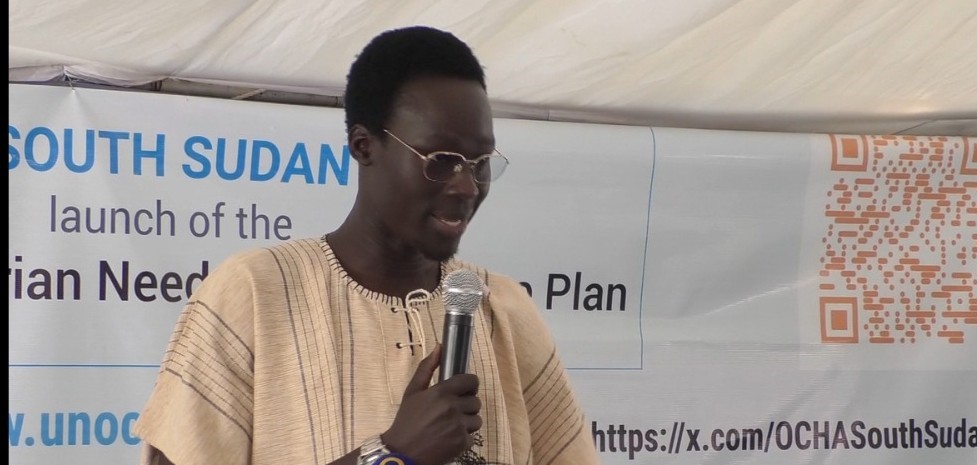
A South Sudanese lawyer on Tuesday publicly challenged the government over corruption, illegal barriers to aid delivery and reliance on foreign assistance, delivering a rare and pointed critique during the launch of the country’s 2026 Humanitarian Needs and Response Plan in Juba.
Speaking before senior government officials, including Vice President Rebecca Nyandeng de Mabior, lawyer Mabile M. Jöthdít questioned whether South Sudan could claim true sovereignty while millions of its citizens depend on humanitarian aid to survive.
“Is a nation truly sovereign if it cannot feed its own children?” Jöthdít asked. “Is a country truly independent if its survival is tied to the generosity of taxpayers in the U.K. and the U.S.?”
South Sudan, which gained independence in 2011, is facing one of the world’s worst humanitarian crises, driven by conflict, flooding, disease outbreaks and economic collapse. Aid agencies say more than two-thirds of the population will require assistance in 2026, even as donor funding continues to decline.
Jöthdít said the crisis could not be blamed solely on climate shocks or donor fatigue, arguing that governance failures and corruption were central drivers of suffering.
“We talk of a humanitarian reset because donor fatigue is real,” he said. “But we must also talk of a governance reset.”
He accused officials and security forces of obstructing humanitarian aid through illegal checkpoints and administrative fees, saying such practices had turned life-saving assistance into a source of profit.
“Aid workers are risking their lives to reach our brothers and sisters, only to be met by man-made barriers, illegal checkpoints and fees that turn life-saving grain into a commodity for the corrupt,” Jöthdít said.
“Why does it cost more to move a bag of sorghum from Juba to Pibor than it does to ship it across the ocean?” he added.
Humanitarian groups have repeatedly warned that access constraints, including extortion and movement restrictions, delay aid deliveries and increase costs in a country with limited infrastructure and persistent insecurity.
“Access is not a negotiation,” Jöthdít said. “Every road, every river, every airstrip must be a corridor of life, not a theater for extortion.”
He also questioned the government’s claims of limited resources, pointing to South Sudan’s oil revenues and domestic taxes.
“If the oil under our feet and the taxes collected from markets cannot fund a single hospital, where is that wealth going?” he asked. “Can we keep asking for millions from humanitarian actors and call that sustainable?”
Jöthdít cited international reports linking corruption to preventable deaths, saying the consequences extended far beyond financial loss.
“Corruption in South Sudan is not just a financial crime; it is a death sentence for the vulnerable,” he said.
Turning to the country’s youth, Jöthdít rejected what he described as a growing narrative that celebrates survival over opportunity.
“We are constantly told we are the leaders of tomorrow, but we are the sufferers of today,” he said. “We do not want to be resilient. We want to be productive.”
He called for the humanitarian response to prioritize local solutions, including investment in youth-led agriculture, training for health workers and payment of living wages through national systems.
“Do not just give us food. Invest in youth-led farms,” Jöthdít said. “Do not just build temporary clinics. Train our medics and pay them from the National Treasury.”
Addressing the vice president directly, Jöthdít urged leaders to treat the humanitarian crisis as a moral and political test.
“A mother does not watch her children beg for bread while the granary is locked by those she trusts,” he said.
He ended his remarks with a challenge to both the government and international partners.
“Let this be the last time we meet to discuss how to manage our misery,” Jöthdít said. “Will 2026 be the year we finally turn the page?”
Speaking on behalf of national and international nongovernmental organizations, Rose Abuk, executive director of the Women Agency for Resilience Transformation, said the humanitarian situation continues to deteriorate, with women and children bearing the brunt of conflict, displacement and climate shocks.
“This is not merely a planning document; it is a reflection of realities and a test of whether the government, with the support of the international community, can rise to meet escalating needs under increasingly constrained conditions,” Abuk said.
She warned that widening funding gaps were undermining life-saving programs and urged donors to increase not only the amount but also the quality of funding through flexible, predictable and multi-year financing.
Abuk also called on the government to uphold its responsibility to protect civilians, facilitate humanitarian access and ensure the safety of aid workers, saying effective humanitarian action depends on strong leadership, accountability and partnership.

 and then