



Must I remind the esteemed scholar that the R-ARCSS itself exists because the original ARCSS collapsed a year after its signing—its ink hardly dried in 2016 before rupture overtook it? The communiqué issued in Ethiopia on 12 June 2017, after the 31st Extraordinary Summit of IGAD Heads of State and Government, clearly articulated the objectives behind the call for revitalization. I quote:
“…urgently convene a High-Level Revitalization Forum of the parties to the ARCSS, including estranged groups, to discuss concrete measures, to restore a permanent ceasefire, to full implementation of the Peace Agreement, and to develop a revised and realistic timeline and implementation schedule towards a democratic election at the end of the transition period.”
With these objectives in mind—objectives explicitly referenced in the R-ARCSS—the situation today remains stagnant. The agreement has been extended multiple times, each extension a reminder of its fragility. Where, then, lies its binding force? It resembles chewing gum: stretchable, mutable, endlessly prolonged but never transformed. The many concerns weighing on the minds of South Sudanese remain unanswered. Has the R-ARCSS achieved the “permanent ceasefire” envisioned? Has it been implemented “fully,” as promised? Most importantly, has it created a conducive environment for democratic elections at the end of the Transition period?
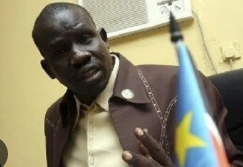
The answers, regrettably, present themselves. Roadmaps—numerous, revised, recycled, and ceremoniously signed—have emerged only to be dishonored with equal enthusiasm. Yet Professor Luka Biong Deng calls unapologetically for further dialogue among the signatories, urging the continued revitalization of a pact that seems to die and resurrect in cyclical rhythm. Have the people of South Sudan run out of ideas to the extent that we now surrender ourselves to elite stereotypes, intellectual mimicry, and constant imitation of borrowed models? If so, I would welcome illumination from the well-read Professor. Why must we cling with such tenacity to an agreement so demonstrably botched?
While urging renewed dialogue under the R-ARCSS framework, Professor Luka Biong Deng simultaneously acknowledges—almost in the same breath—the deep divisions among stakeholders, the absence of political will, and the mutual mistrust that has birthed the very impasse he seeks to remedy. In the sixth paragraph of his article, he states: “All the parties to the R-ARCSS concur that trust deficit and lack of political will are the key factors obstructing the implementation of the R-ARCSS.”
If Dr. Biong concedes primarily that the paralysis stems from deliberate delays and willful violations on the part of the parties, why then does he advocate for the revitalization of such an agreement? Stranger still, he proceeds to characterize the R-ARCSS as either in the morgue or in the Intensive Care Unit—yet insists it remains the only viable mechanism for engaging the signatories.
This is a living-dead agreement, an oxymoron of the highest order. One only wishes he had provided the readership with coherent reasons to reconcile this paradox. In truth, an agreement becomes legally binding only when certain foundational elements exist: offer and acceptance, mutual assent, exchange of value, capacity and legality of purpose, clarity of terms, formalities, and—critically—equal bargaining power. Unfortunately, the R-ARCSS meets none of these essential criteria.
As the Latins assert: “Ex nudo pacto non oritur actio.” No action arises from a naked agreement—that is, a promise lacking consideration is unenforceable. Yet the Republic of South Sudan is expected to anchor its future upon such a fragile and naked pact.
The writer, Yien Mathew Chol Joack, holds a A.A. in Psychology; B.A. Education—English Language & Literature; M.A. Curriculum & Instruction; and is a PhD Candidate, Curriculum & Instruction. He can be reached via yienchol472@gmail.com.
The views expressed in ‘opinion’ articles published by Radio Tamazuj are solely those of the writer. The veracity of any claims made is the responsibility of the author, not Radio Tamazuj.

 and then