



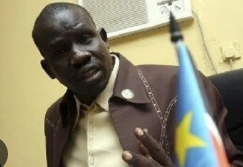
It is now 1:00 a.m., Friday, December 12, 2025, on my side of planet Earth. Eleven hours ago, I encountered a striking piece of literary craft penned by Harvard scholar Dr. Luka Biong Deng, titled “Will elections be held in December 2026 in South Sudan?” As the title suggests, the author seeks to illuminate the possible scenarios awaiting the Republic of South Sudan, whether or not elections ultimately occur in December 2026.
At the onset of his 22-paragraph article, however, Dr. Biong frames the entire conversation around the Nasir incident of March 2025. He states, and I quote: “In March this year, conflict erupted in Nasir, Upper Nile State, bringing the 2018 Revitalized Agreement on the Resolution of the Conflict in South Sudan (R-ARCSS) to a standstill when the South Sudan People’s Defense Forces (SSPDF) and the Sudan People’s Liberation Army-in-Opposition (SPLA-IO)’s allied White Army engaged in direct military confrontation.” (End quote.)
This assertion is not only misrepresentative; it is exasperating. It is difficult to comprehend how a scholar of Dr. Biong’s intellectual standing could so casually claim that the White Army is an “ally” of the IO. If this is indeed his conviction, then I would gladly summon him to serve as a witness in court regarding the Nasir incident. Allow me to pose a simple question to the esteemed Harvard scholar: On what basis did he conclude that the White Army is allied to the IO? Does he fully grasp the implications, legal, diplomatic, political, or otherwise, of such a declaration?
Military literature is clear. A military alliance denotes a formally binding pact—an understanding involving mutual defense, shared intelligence, pooled resources, and coordinated operations. So, I ask: what substance exists to justify calling the White Army an
IO ally? I register my strong dissatisfaction with such an opinion. Disagreement, after all, is neither sin nor treason in the Republic of South Sudan.
Furthermore, Dr. Biong’s framing suggests that the R-ARCSS has stalled solely due to the Nasir incident. He avoids calling it a halt, opting instead for the gentler term “standstill”—a linguistic choice that is, perhaps, characteristic of his style. But whether we call it a halt, paralysis, or a standstill, the essence is unchanged. Let us be frank: even if fully implemented “in letter and spirit,” this agreement will not yield meaningful fruit. The Hold-Out Groups (H.G.s) refused to sign for a reason—it is flawed at its core. It concentrates power within SPLM factions and evades the fundamental political, socio-cultural, and economic questions underpinning South Sudan’s crises.
How, then, can a scholar envision an agreement that centralizes authority in the hands of political elites as a mechanism for national transformation? Does the agreement address the primary question of governance systems? It does not.
The agreement elevates the gun-class, incentivizes perpetrators, and rewards human-rights violators. At the regional level, it appeases interested actors with stakes rooted in oil and the familiar “pay-back-time” mentality. Why, therefore, must a scholar succumb to an agreement that dispenses wealth and power to elites based on pseudo-assumptions of military legitimacy?
I remain convinced that the agreement merely legitimizes the regime and preserves the status quo. It places the entire constitutional-making process in the hands of political elites without providing any clear mechanisms for genuine reform. The R-ARCSS functions, in effect, as an anesthetic—numbing the conscience of the innocent and making unresolved problems appear superficially addressed.
Tragically, our contemporary politics—dominated by inconsequential cliques and vested interests—fails to appreciate the magnitude of the danger. While 80% of our people exist under dire economic conditions created in part by the bloated R-ARCSS-designed government, a small elite accumulates wealth daily. How has it become so difficult to live a dignified economic life in the Republic of South Sudan? Why must we be divided into the desperately poor and the extravagantly wealthy? If scholars cannot help guide us out of this quagmire, then who will?
Returning to Dr. Biong’s article, his second paragraph calls for dialogue between warring parties as the prudent path to avoid confrontation following any court verdict, whether conviction or acquittal. But this is the very same formula embedded in the R-ARCSS: revitalization, regeneration, and endless recycling. Irony served in broad daylight. I must ask: Does Dr. Biong truly believe the agreement is still alive?
Later, he introduces a vaguely defined group of “observers” who, he claims, believe that recent government reshuffles—within the IG and the SPLM ruling party—have brought “relative stability” to the country and even to the national army.
We are asked to imagine that the mere appointments of Adut Salva, Pieng Deng Majok, Africano Mande, and Mabior Garang have ushered in national stability. Who are these observers exactly? Is Dr. Biong one of them? And most importantly: Has this stability actually materialized?
The writer, Yien Mathew Chol Joack, holds a A.A. in Psychology; B.A. Education—English Language & Literature; M.A. Curriculum & Instruction; and is a PhD Candidate, Curriculum & Instruction. He can be reached via yienchol472@gmail.com.
The views expressed in ‘opinion’ articles published by Radio Tamazuj are solely those of the writer. The veracity of any claims made is the responsibility of the author, not Radio Tamazuj.

 and then