



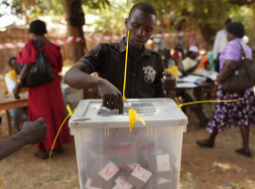
Dr. Luka Biong’s article, “Will elections be held in December 2026 in South Sudan?”, published by Radio Tamazuj on 12 December 2025, is a serious and timely contribution to the national debate on South Sudan’s stalled democratic transition. It carefully outlines the legal, political, and institutional obstacles facing the country’s electoral roadmap. However, while the article is analytically rich, it ultimately suffers from three major weaknesses: an over-legalization of what is fundamentally a political crisis, an implicit normalization of elite-driven postponement politics, and a troubling readiness to legitimize extra-constitutional governance arrangements under the guise of pragmatism.
Dr. Luka frames the likelihood of elections almost entirely through technical and legal constraints—constitutional gaps, timelines under the National Elections Act (NEA), constituency delineation, census requirements, and procedural deadlines. While these are real challenges, the analysis risks mistaking symptoms for causes.
South Sudan’s electoral paralysis is not primarily legal; it is political by design. Laws can be amended within weeks if there is political will—as has repeatedly been demonstrated when elite interests are threatened. The same political class that Dr. Luka describes as incapable of meeting election deadlines has, paradoxically, shown remarkable efficiency in extending transitional periods, reshuffling ministers and generals, weakening independent institutions, and neutralizing political rivals through security and judicial means.
The failure to hold elections is therefore not a consequence of missing laws, but a strategy of power preservation. By foregrounding legal technicalities, the article unintentionally shields political actors from accountability and diffuses responsibility into abstract institutional incapacity. Dr. Luka acknowledges the house arrest and prosecution of Dr. Riek Machar and senior SPLM-IO figures, but treats these developments primarily as contextual instability, rather than as a decisive rupture of the R-ARCSS.
This is a critical omission. You cannot meaningfully discuss elections while the principal opposition leader is detained, his party is forcibly fragmented, senior opposition figures are exiled or imprisoned, and the judiciary is widely perceived as politicized. Elections are not merely an administrative exercise; they are a contest of political freedoms. Without explicitly confronting the collapse of political space, the article risks presenting elections as a technocratic event rather than a democratic process rooted in liberty, pluralism, and consent.
Perhaps the most troubling aspect of the article lies in its policy options, particularly the proposal for a “hybrid technocratic government” to replace elected or power-sharing institutions. While presented as pragmatic, this proposal raises serious concerns: it has no constitutional basis, it sidelines citizens entirely from decision-making, and it entrenches the logic that South Sudan’s elites may indefinitely redesign governance structures whenever elections become inconvenient.
This approach risks turning South Sudan into a permanent transitional state, governed by declarations rather than constitutions, consensus among elites rather than consent of the governed. History shows that technocratic caretaker governments imposed from above rarely deliver democracy; instead, they often extend authoritarian rule with a softer vocabulary. Dr. Luka is correct that another election postponement will anger citizens and frustrate international partners. Yet the article still devotes significant intellectual energy to constructing respectable justifications for delay, particularly through the Tumaini Initiative.
Peace processes are vital, but they must not become perpetual excuses. South Sudan’s political class has mastered the art of sequencing: first peace, then constitution; first constitution, then census; first census, then elections—each step endlessly deferred. At some point, delay itself becomes a form of violence against citizens’ political rights.
One area where the article underestimates reality is public sentiment. While Dr. Luka notes waning enthusiasm due to repeated postponements, he stops short of recognizing a deeper shift: citizens are no longer confused; they are disillusioned. South Sudanese citizens increasingly understand that elections are delayed not because they are impossible, but because they are dangerous to entrenched power. Ignoring this political consciousness risks widening the already dangerous gap between state and society. In conclusion, the question is no longer whether elections can be held, but who fears them. Dr. Luka asks whether elections will be held in December 2026. A more honest question might be, who benefits from elections not being held?
South Sudan’s crisis is not one of insufficient frameworks, commissions, or amendments. It is a crisis of political courage, accountability, and respect for the people’s sovereignty. Without confronting this reality directly, even the most well-crafted legal analysis risks becoming part of the problem it seeks to diagnose. Elections may indeed not be held in 2026—but not because the law forbids them. They may not be held because too many powerful actors fear the verdict of the ballot box more than they fear the consequences of postponement.
The writer, John Bith Aliap, is a South Sudanese political analyst and commentator on governance, leadership, and state-building in post-conflict societies. He can be reached via johnaliap2021@hotmail.com.
The views expressed in ‘opinion’ articles published by Radio Tamazuj are solely those of the writer. The veracity of any claims made is the responsibility of the author, not Radio Tamazuj.

 and then