



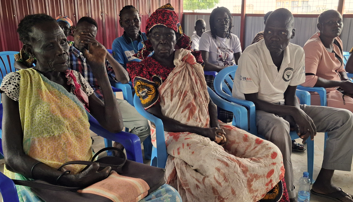
Persons affected by leprosy at the Luri-Rokwe in Juba County on Thursday raised concerns over continued intimidation by armed land grabbers who have repeatedly threatened civilians with guns while forcibly taking over land in the area.
They urged the government to take serious and decisive measures to address the escalating vice and restore security in the area. The appeal followed a visit on Thursday by Sunday Mogga, the Executive Director of Grassroots Women Network (GWN), who went to assess the challenges faced by people affected by leprosy.
Mogga said her visit was to evaluate the living conditions of the people at the center and to sensitize them about their rights to own land. She said that with support from the Norwegian People’s Aid (NPA), GWN remains committed to supporting local communities in their rights.
“Our visit here today (Thursday) is about the issue of land, which is our biggest problem in South Sudan,” she said. “Our work is to sensitize the local people on their rights to own land so that the citizens can follow the right way of reclaiming their land.”
Meanwhile, Joseph Wani Cirilo, the chairperson of the Association for People Affected by Leprosy (APAL), said they were excluded during the land allotment process and not given plots despite being the first settlers in the area. He further stated that land originally reserved for a school and hospital was seized at gunpoint by powerful military personnel.
Wani accused some individuals within the state government of being behind the land grabbing, claiming that heavy security deployment accompanied most of the land seizures from the school and hospital, saying it is an indication of government involvement.
“What pains me is that the government is the main cause because the school land was taken by the government,” he charged. “What was said earlier is true. The school and hospital land were all taken. This hospital was given a very big piece of land, but the government took eight plots out of it.”
Wani added that they had repeatedly followed up on the matter with Luri Payam authorities to no avail.
People affected by leprosy were first settled in the area, commonly known as Jongoli, before South Sudan’s independence in July 2011. Later, the Northern Bari Leprosy Center was established in 2012.
The APAL chairperson claimed the land allotment process was poorly handled, with some families of up to ten members being allocated only one plot, while additional plots were given to individuals who were not original residents of the area.
“The issue of land is a painful story, and as said by most people, we were indeed deprived right from the beginning, because during the allotment, only one token was given to one home,” he said.
For his part, Ebelina Poni Laku, a female resident who has lived in the area for nearly fifty years and is among those affected by leprosy, said that despite spending most of her life in the area, she was never allocated a piece of land and currently resides within the Leprosy Center.
“I buried my husband and all my children here, but still I could not get a piece of land,” she lamented. We are the owners of “Jongoli”, a name referring to leprosy.”
Poni urged the government to find a lasting solution to the issue of land grabbing.
Elia Yugu, the area’s sub-chief, said numerous attempts were made to resolve the matter, but all failed.
“I am the sub-chief in this area, and this is a challenge to me, and what is being said here is true,” he stated. “This is a community piece of land; we gave it to the community school, but it is being grabbed now. We tried all we could, but all in vain.”

 and then