



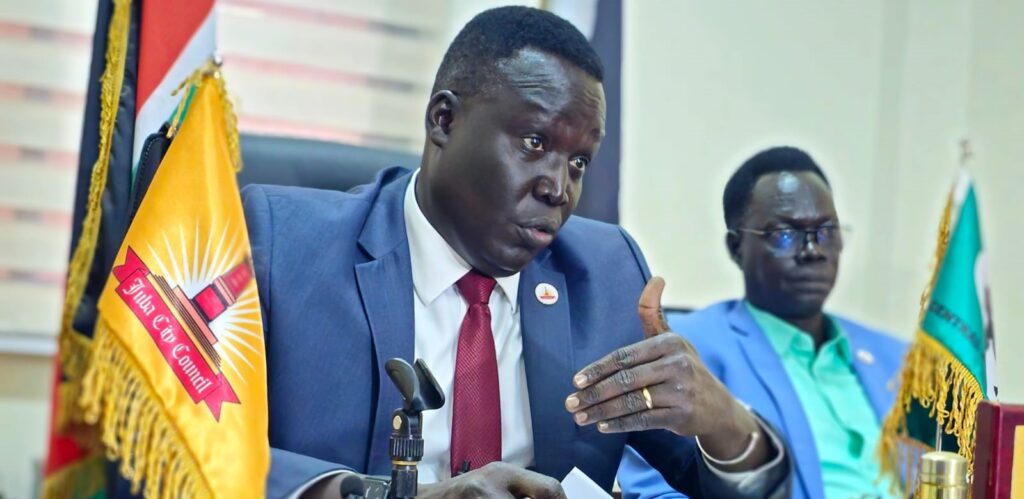
The Mayor of Juba City Council (JCC) on Friday announced a crackdown on roadside garages, illegal billboards, and poor waste disposal, giving offenders seven days to comply and warning that violators will be taken to court as part of what he described as a decisive push to restore order in the capital.
Christopher Serafino Wani, marking 120 days in office, said the new measures signal a break from what many residents have long criticized as weak enforcement of city bylaws.
“This time will be different, and our laws and ordinances will be implemented,” he told reporters.
Seven-day deadline for abandoned vehicles
Under a local order issued on 30 January, mechanics are barred from repairing vehicles along public roads, and owners of abandoned cars have seven days to remove them or face towing and storage fees.
City authorities say roadside garages have obstructed traffic, complicated road construction, and contributed to environmental pollution through oil spills that wash into streams and eventually into the Nile during heavy rains. Vehicles left unclaimed after the deadline will be impounded at a designated city compound, with owners required to cover removal and storage costs before release.
He also announced a temporary suspension of new outdoor advertising installations pending a citywide review. Companies operating billboards have been ordered to re-register and present valid licenses to the council. Authorities say the review will address safety concerns, including structural integrity, obstruction of traffic visibility, and interference with power lines and water infrastructure.
Officials cited previous incidents of collapsing billboards and warned that non-compliance would attract penalties under municipal law.
Waste management enforcement intensified
Waste management remains the city’s top priority, the mayor said, describing it as a chronic issue tied to public health risks during the rainy season.
In December 2025, the council passed a new solid waste management ordinance strengthening enforcement powers. Since then, the city says it has increased garbage collection to between 60 and 65 truck trips per day, the highest level in its history, and introduced night shifts. JCC estimates visible waste has been reduced by up to 60 percent.
A separate order issued on 6 January mandates that all businesses, restaurants, and public establishments install waste bins, particularly to curb plastic bottle litter. Enforcement is expected to follow against non-compliant businesses.
Mayor Wani defended the recent removal of roadside vendors and makeshift tea stalls from major roads, citing security, hygiene, and fire risks. He said markets such as Konyokonyo, Gudele Central, Jebel, and Rujal -Mafi still have vacant spaces and urged traders to relocate there.
“Markets do not follow people, people follow markets,” he stressed.
Beyond enforcement, the mayor outlined administrative reforms within Juba City Council, which marks its 15th year since its establishment. The measures include the deployment of an electronic revenue collection system, the introduction of public complaint hotlines, uniforms and identification badges for city officers, and human resource restructuring and capacity assessments
The mayor acknowledged public frustration with the council’s image and pledged greater accountability.
Violations of new local orders will be handled through the city’s magistrate court, he said, signalling a move toward formal legal enforcement rather than ad hoc penalties.
The enforcement drive comes as Juba authorities race to improve sanitation, road access, and urban order ahead of the rainy season in the capital of the world’s youngest nation.
The mayor pledged “full transparency, full reform and full accountability” as the city widens an enforcement campaign targeting roadside mechanics, informal vendors, illegal car washes and pollution along the Nile.
“I am not here to defend the institution,” the mayor told reporters at the close of a press briefing marking 120 days in office. “This is a very big institution with almost 4,000 employees. But as the current leader, I am committed to reform and accountability.”
His remarks come amid an aggressive municipal push to reorganize trading spaces, enforce sanitation laws, and restore what he described as dignity and order to the capital.
Defending the relocation of roadside tea stalls and informal businesses, the mayor said authorities have deliberately avoided targeting neighbourhood operations but will not tolerate activity along major streets.
“We know people are struggling,” he said. “But the question is always: is it livelihood, or is it life itself? Life comes first.”
City officials argue that informal gatherings along main roads create security vulnerabilities, public health risks, and traffic hazards. Vendors have been urged to relocate to designated markets where vacant stalls remain available.
Crackdown on illegal car washing
The enforcement drive now also targets roadside car washing, which the mayor said is damaging roads and drainage systems.
According to city authorities, wastewater mixed with oil and dirt collects in potholes, accelerates road deterioration, and blocks drainage channels. During rains, runoff flows into streams and ultimately into the Nile, the city’s primary water source.
“These roads cost millions of dollars,” the mayor said. “We cannot allow them to be destroyed by private business.”
He said car washing is a legitimate enterprise, but must operate in designated and properly equipped locations.
Anti-tax evasion measures
The mayor acknowledged persistent tax evasion among roadside operators, describing it as “completely unacceptable.”
He said enforcement under newly issued local orders will ensure compliance with municipal rate schedules, warning that evasion undermines the city’s ability to deliver services.
Electronic revenue collection systems are expected to be rolled out to reduce malpractice and improve transparency.
Nile Day and river protection
Mayor Wani also announced that Juba will mark Nile Day with a marathon and public celebrations, highlighting the economic, cultural, and environmental importance of the river. Referring to the White Nile, which flows through Juba and underpins much of the city’s economy, he said pollution remains a concern.
“The Nile is our identity,” he said, urging residents to prevent plastic dumping and waste disposal into the river.
Authorities have stepped up inspections along the riverbanks to address pollution and protect fisheries and public health. The mayor acknowledged historical land ownership sensitivities along the river and said any long-term development plans, including a proposed Nile Street corridor, would require careful handling and compensation processes.
Open spaces under pressure
The mayor also raised concerns about the disappearance of public squares and open spaces in Juba over the years due to land pressure and allocation decisions made at higher levels of government.
He said preserving open land requires coordination between municipal, state, and national authorities, noting that the city government controls territory management but not all land allocations.
“This time we will enforce”
The enforcement campaign includes seven-day notices for abandoned vehicles, a ban on roadside mechanical repairs, mandatory waste bins for businesses, temporary suspension of unregulated billboards, and Formal court prosecution of ordinance violators.
The mayor emphasized that violations will now be processed through the city’s magistrate court rather than handled informally.
The reform drive marks one of the most assertive governance efforts in recent years by the Juba City Council, as authorities seek to restore order ahead of the rainy season and rebuild public trust in municipal administration.
“We are here to serve the people,” the mayor said. “And we will be accountable to them.”

 and then